Note: Most Thursdays, I take readers on a deep dive into a topic I hope you'll find interesting, important, or at least amusing. These essays are made possible by — and are exclusive to — our VIP supporters. If you'd like to join us, take advantage of our 60% off promotion.
Instead of stretching out the mystery, here's the one weird trick that can turn $750,000 into $400 million, almost overnight. Write a solid script, hire a few young, likable unknown actors, and shoot on the cheap.
Yes, I'm talking about Obsession, the low-budget horror flick that gushing critics point out isn't based on an established intellectual property, has no superheroes, no CGI, hardly any marketing worth mentioning, and a budget that likely wouldn't cover the catering for Avengers: Doomsday due out later this year.
Obsession has some wondering if Hollywood needs to rethink how to produce a blockbuster hit. Or maybe Obsession just remembers something about movies that Hollywood forgot, or got too lazy to bother with.
This isn't a movie review, but I can't talk about the success of Obsession without talking about the film at least a little — and I'll stay away from major spoilers.
The movie centers on four 20something friends — Bear, Nikki, Ian, and Sarah — who hang out after work pretty much every night. Bear (Michael Johnston) has a huge crush on Nikki, to the point where he pretty much idealizes her in every way.
Nikki isn't just the kind of quietly hot cool chick any guy would consider himself lucky to date. She's also the kind of laid-back gal that a guy could say anything to, provided he wasn't a total d*** about it.
And yet even when she practically begs him to tell her if he likes her, he chickens out repeatedly. That's all during a conversation so squirm-inducing awkward that it rates up there with Jon Favreau in Swingers, leaving one increasingly desperate answering machine message after another to a girl he'd just met.
The girl in Swingers was also named Nikki. Coincidence? Only writer/director Curry Barker knows for sure.
It's at Bear's lowest point of self-imposed desperation that he makes a wish on a cheesy wish-granting souvenir he'd just bought at one of those crystal-infused New Age stores: "I wish Nikki Freeman loved me more than anyone in the f****** world."
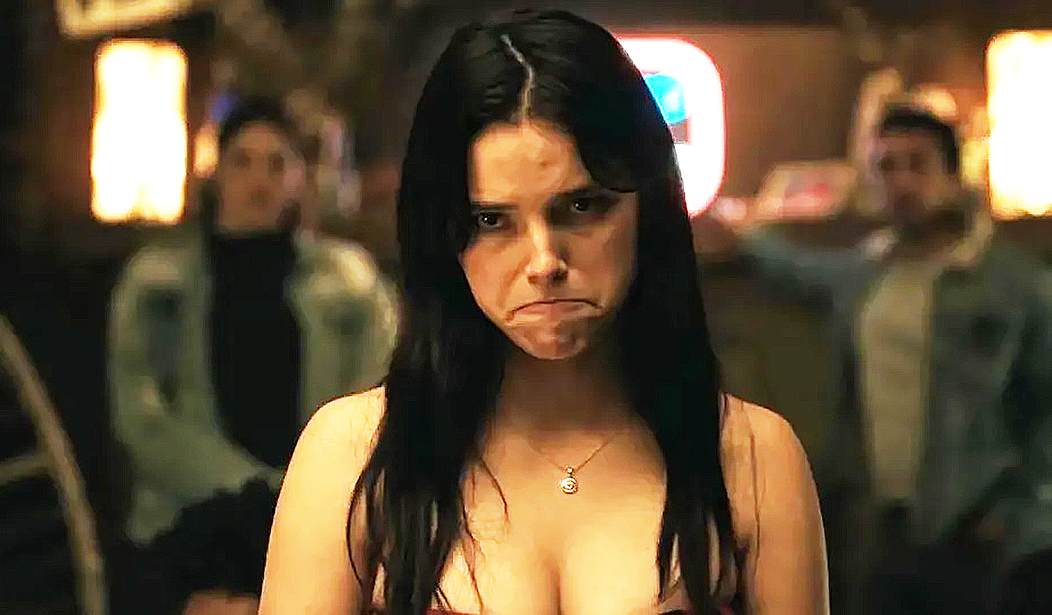
Bear's wish turns Nikki into an increasingly erratic and dangerous monster. You can't just graft true love onto someone's personality. We see that not just in her growing psychosis through most of the film's runtime, but during a brief scene that's as horrifying as it is low-key as it is heartbreaking. That isn't an easy trifecta to pull off.
And Another Thing: The movie's ability to suspend your disbelief hinges on Inde Navarrette's whiplash-inducing ability to flip the psycho switch on and off, and make you buy it. And does she ever.
So basically what we have here is The Monkey's Paw meets Fatal Attraction with a nod at the climax to Romeo and Juliet.
And — this is the shocker — Obsession's word-of-mouth was so good that it broke out from the comparatively narrow confines of horror to find a $400 million global audience.
Christian Toto's review kicked off with the film's unlikely success, noting that "It originally hit theaters on May 15, earning an impressive $17 million in its opening frame." But in its second week, "it earned more than that amount. The same held true for its third weekend."
"That. Doesn’t. Happen. But it did," Christian wrote. “Obsession just kept growing, using word of mouth to fuel its impossible run."
What's the marketing budget? I couldn't begin to guess, because I haven't seen a single bit of marketing material. Nada. I went to see it because my sons, aged 16 and 20, pestered me for weeks. And the older one doesn't even usually like horror movies.
So that's how you go from a $750,000 budget to $400 million in ticket sales to maybe [dr_evil_voice] HALF A BILLION DOLLARS [/dr_evil_voice] by the time video-on-demand (available now) and DVDs are totaled.
Now compare that with Supergirl. Shot for somewhere between $170–186 million, and with a marketing budget probably half that again or more, it earned a dismal $37.1 million domestically in its opening weekend. That put it behind post-COVID big-budget stinkers like The Flash, The Not-So Marvels, and Indiana Jones and the Insufferable Girl-Boss.
Supergirl's word of mouth was even worse, with ticket sales dropping a staggering 75% or more in its second week. As one guest noted on The Critical Drinker's After Hours show, dropping that much from a big opening weekend is bad enough, but Supergirl dropped bigly from a shockingly low baseline. The movie is estimated to lose anywhere from $85 million to $125 million, and no, that isn't because "Christian dads" refused to see it. In fact, 59% of opening weekend viewers were men.
How's this for a wild stat? Supergirl might lose 167 times more money than Obsession cost to make.
It turns out, when people tell other people there's a good movie out, they go and see it. Hollywood keeps chasing the next billion-dollar franchise built on familiar intellectual property. Obsession shows audiences don't need something expensive and familiar. We just want something good.
I know Christian Toto. I like Christian Toto. Christian has been a guest at my wife's and my notoriously fun New Year's Eve parties. And while I always enjoy his sharp takes, I think he missed the boat when he complained that "The film isn’t revolutionary, nor does it reinvent the genre," adding that "for some unspoken reason, Obsession’s impact on Gen Z proved relentless."
Hey, don't leave GenX out, buddy — I thought it was solid entertainment.
So let me show you what Christian might have missed.
A lesser movie would have trod more familiar ground. After turning Nikki into a monster, Bear and the others would have died gruesome deaths before Sarah (Megan Lawless) somehow killed Nikki to become the sole surviving “Final Girl.” This hypothetical — but all too familiar — version still might have opened to $17 million, but it would have left theaters and hit streaming in nothing flat.
What put Obsession head and shoulders above typical horror fare — and most big-budget flicks from recent years — is that Barker (and Johnston) understood that the villain of the piece isn't the murderous psycho.
The villain is the weak-willed, lily-livered coward who turned Nikki into one. I won't detail the horrors Nikki subjects Bear to — and they are horrific — but like Victor Frankenstein, I felt no pity for the man who unleashed a Creature on the world.
Bear is a boy-man, so afraid of his own desires that he ends up destroying everyone around him, starting with the woman he supposedly loves.
A week after our Saturday matinee, my 20-year-old wanted to talk with me (again!) about what a loathsome weakling Bear was, which led me to giving what I hope was some solid advice.
"Son," I said, "when you find yourself in a situation with no good choices, the easiest choice is almost certainly the worst choice."
Christian is a sharp guy, and I don't think he missed any of those things. The difference is that he went to see Obsession as a movie critic, and I went to see it the same way millions of other people did: as a movie-lover increasingly ignored by the Hollywood bigs.
I used to go to the movies every week or three, and my personal Plex library is a testament to the very best and worst of them. Obsession gave me something Hollywood doesn't do nearly so often anymore — a reason to turn off Netflix and buy a couple of movie tix.
Pseudonymous Hollywood screenwriter George MF Washington in February reminded readers that movie magic happens "most reliably when filmmakers do not have unlimited resources from which to draw, and must find creative ways to 'make do' instead."
"What if bigger isn’t better?" he asked in an essay praising the practical stunt-work of 1981's For Your Eyes Only. George called it "the beginning of a decade full of movies that shot real action with real actors on, in and around real physical locations. Commando, Beverly Hills Cop, Cobra, Tango and Cash, 48 Hours, Top Gun, Predator, Rambo, Bloodsport, Terminator, Aliens, Above the Law, Lethal Weapon... we could name them by the dozens."
Six of those movies had budgets in what I call the "sweet spot" of around $40-$60 million in today's dollars, and were arguably the best in George's list: Aliens, Top Gun, Predator, Lethal Weapon, Beverly Hills Cop, and 48 Hours.
I call it the sweet spot because you can do a lot with $50 million, but you can't do everything. So you've got to start with a good script, a director with a firm hand, and a cast and crew made up of real pros.
Warner Bros. probably spent more trying to salvage Supergirl with reshoots and test screenings and recuts than the $20 million (in today's money!) that James Cameron spent making The Terminator from start to finish.
Not only that, but Hollywood could have made three Top Guns for the price of one Supergirl, and if only one or two of them struck gold, so what? The studio would still be swimming in money like Scrooge McDuck.
This used to be something Hollywood understood in its bones.
B movies are my jam, and before people had televisions to sit in front of, Hollywood used to make 450 or more of them every year, if you include the super-low-budget "Poverty Row" studios. Shot quickly and cheaply as the second-billed flick on an A-B double feature (hence the nickname), these were genre pictures with usually nothing more lofty in mind than keeping butts in seats long enough to sell another round of popcorn and Coke.
Only very rarely would an old-school B movie turn into a genuine blockbuster or a critical darling — like the original 1942 Cat People, which returned $4 million in ticket sales to RKO on a $140,000 budget. (That's a $2.8-$3 million budget in today's dollars, and an $80-$100 million gross.)
It's no surprise that studios quit making B flicks when people started spending less money on movies and more time in front of the tube. Hollywood responded to the rise of the small screen by making movies even bigger. In the 1950s, the studios gave audiences Technicolor, CinemaScope, 3-D gimmickry, and wide-screen blazing-color epics like Ben-Hur and The Ten Commandments that TV just couldn't match. In the '70s, Hollywood lured audiences with audio delights like Dolby Stereo and Sensurround.
Today, a middle-class income will put a gorgeous screen and blazing 5.1 audio system in almost any living room.
The "bigger is better" game ran its course years ago, but Hollywood still wants to play.
It's silly to expect Hollywood, or even the independent studios, to make nothing but $750,000 pictures.
But let's look quickly at 1993, which was a great year for big-budget pictures because, well, that's the year Jurassic Park trampled everything in its path with (in today's money) a $145 million budget and an almost billion-dollar gross. It was an even better year for movies that didn't cost very much, but had audiences coming back weekend after weekend.
The Fugitive was number two to JP that year, followed by The Firm, Sleepless in Seattle, and Mrs. Doubtfire rounding out the top five. We didn't know how good we had it, in a year when A Few Good Men could barely crack the top ten, and Groundhog Day couldn't.
At an estimated $400 million, Avengers: Doomsday cost more than double what Jurassic Park cost to produce. And I will bet you my favorite bottle of Bowmore 15 single malt scotch that Doomsday won't contain a single dazzling moment of wonder and awe comparable to Grant and Ellie seeing their first live brachiosaurus.
It isn't so much that Obsession is a great film, because it isn't. It's nothing more than a solid piece of filmmaking. But Barker put enough thought and care into his low-budget production that it does something that yet another lazily scripted Spandex & CGI-Fest can't do: It delivered moments of terror absolutely comparable to Spielberg's velociraptors figuring out the latch to the kitchen door.
That's why Obsession got us buying tickets, more and more of them, every week for a month — that thing that just doesn't happen.
To be fair, Hollywood might not have any good choices right now. 4K streaming and giant TVs bring the theater experience home like never before, COVID lockdowns accelerated the change in viewing habits, and younger viewers who used to fill theaters every weekend now get most of their video entertainment from tiny vertical screens.
Throwing more money, more special effects, and more tired scripts at the problem might be the easy choice.
But as the success of Obsession shows, it's also the worst choice.
Last Thursday: So Who's Winning the Air War?