


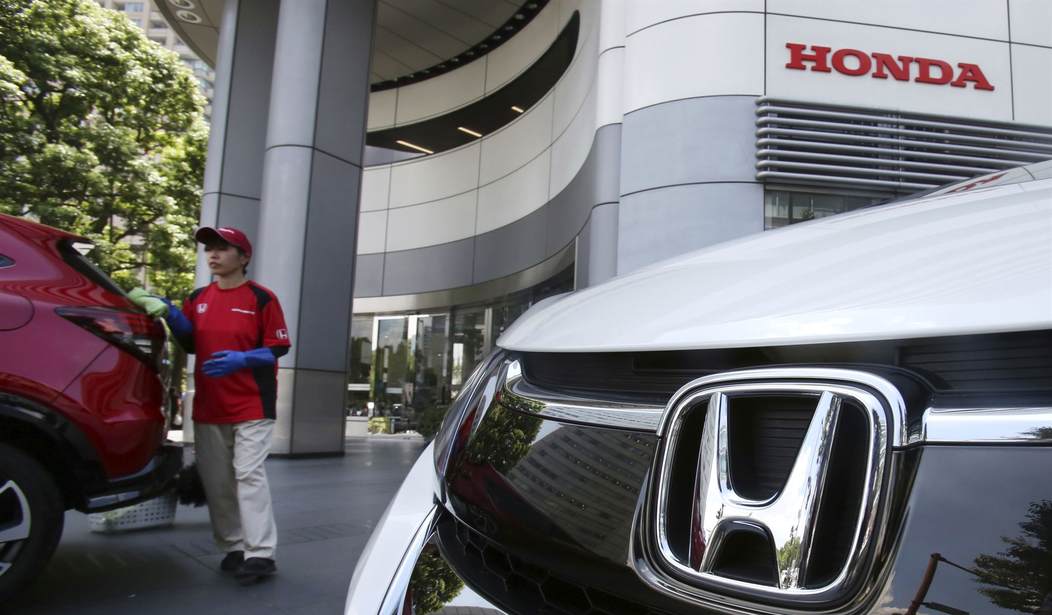
Honda's failed bet on electric vehicles means the Japanese auto giant will have to stretch the lifecycles of five top-selling vehicles "in some cases to more than a decade," according to a supplier memo seen by Automotive News.
The company will continue selling existing versions of the Odyssey, Accord, and HR-V, as well as the Acura MDX and Integra, after writing down up to $15.8 billion worth of investments in EVs, including eliminating three new EV models for the U.S. market.
Car and Driver said the 2023-issue Accord "won't be redesigned until at least early 2030," while "the Odyssey minivan isn't set to be replaced until 2030, while the current HR-V SUV will see its production extended until early 2032." The two Acura models will suffer similar delays.
It seems like just earlier this spring [It was just earlier this spring, Steve —Editor] I reported on Honda's massive losses from betting big on EVs — with a big nudge from Big Stupid Government — but the company's losses show up on more than just the balance sheet. That's why models that the company actually sells and makes money on — like the aforementioned Accord — won't see expected refreshes anytime soon.
There's this little thing called opportunity cost, which is the value of the best alternative you give up when you choose one option over another. Honda bet big on EVs, but then changing market conditions forced the company to scale back those plans to the tune of billions of dollars worth of write-downs.
Worse, however, are the updated models that would have sold in volume that the company chose not to invest in.
Losing a bet this big hurts in the auto industry more than almost anywhere else, due to development times measured in years — yet vehicles are still subject to the whims of fashion. Consumers expect regular model refreshes, particularly loyal customers hoping to trade in their older car for the latest version of the same model. A two- or three-year delay means customers holding onto their current car for that much longer. Or maybe even shopping the competition.
The current version of the Odyssey minivan debuted in 2018 and hasn't gotten anything more than a facelift in 2025. Buyers hoping to trade in for the latest and greatest have to wait another four years.
Honda's loss could prove to be Toyota's gain.
Honda said in a statement, "We are not going to comment on future product plans. We are very confident and excited in our future product strategy including our previously announced plans to advance our award-winning hybrid technology to more models."
The company needed 36 words to say nothing at all.
According to Electrek, Honda's strategy "now centers on hybrids for the near term, with affordable EVs priced under $30,000 pushed to the end of the decade. The only EV still standing in its US lineup is the Prologue, which recently saw a $7,500 price cut — a GM Ultium-based vehicle that Honda didn’t even engineer itself."
Electrek also noted that Honda completely scrapped plans for a multibillion-dollar EV plant in Canada.
Don't get me wrong, Honda makes great hybrids, and for most people looking to save money on gas, they make so much more sense than going fully electric.
But hybrid versions of the company's most-loved models that could have hit showrooms this year or next, now won't be seen until the next decade.
Recommended: It's Official: The Climate Scam Was a Scam All Along
You want more?
PJ Media VIP members get so much more, including exclusive podcasts and video live chats with your favorite writers. You can support alternative conservative news and save 60% with promo code FIGHT.


Join the conversation as a VIP Member