


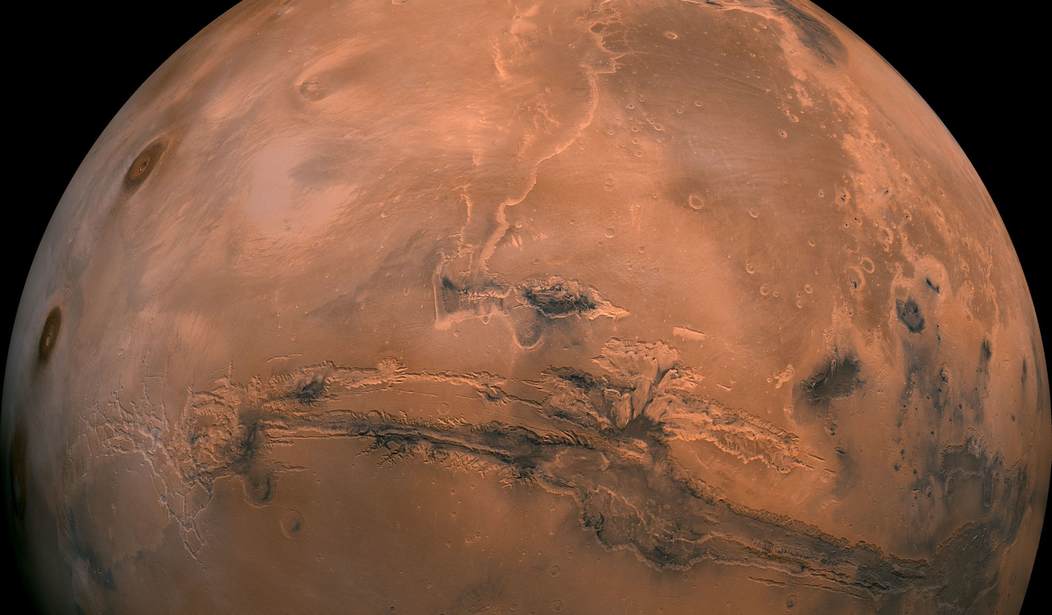
It isn't quick or easy getting to Mars, but what if it were easier and faster to wait a while?
First, there's the waiting. The Hohmann transfer window for "short" flights between This Green Earth and the Red Planet opens only every 26 months, give or take. Even then, the best spaceship we almost have for the trip — SpaceX's Starship, still under development — needs six to nine months to make the journey. That's pushing the limits of human exposure to microgravity and radiation, and once they arrive, it isn't like the Martian environment is a whole lot friendlier.
If getting to Mars is hard, staying there — and astronauts will need to stay until the next transfer window is available — is filled with similar perils. I'd like us to get there someday, but Luna first, plus an O'Neill cylinder-style space habitat (the Jeff Bezos dream), always made more sense to me than Mars (Elon Musk's).
But as I've half-joked on more than one occasion, I'm not the guy with the world's most successful and innovative rocket company, so I don't get to choose.
That's why I was pleased last week when Musk announced that SpaceX has "already shifted focus to building a self-growing city on the Moon, as we can potentially achieve that in less than 10 years, whereas Mars would take 20+ years."
The next day, however, my longtime Right Angle friend/colleague/boss Bill Whittle was absolutely ecstatic when we discussed it during his segment.
What if, Bill wondered, the fastest way to Mars is by way of Luna?
Partly, switching gears to Luna allows for much faster iteration — SpaceX's core strength — than trips to Mars do. You can practically see the light switch on above Bill's head when I mention iteration at the 5:38 mark. Mars trips happen only every 26 months, and then you have to wait months more to find out what worked, what didn't, and what can be improved or made more efficient.
Launch windows to Luna come twice a month, and the voyage takes less than a week, even on the scenic route.
Once fully developed, SpaceX expects Starship to land up to 100 metric tons of mass on Luna or Mars — perhaps as much as 150 tons in improved models. By comparison, Apollo's Saturn V rocket could deposit just 15 metric tons onto Luna's surface. Starship's airlock has more habitable space than the entire Apollo Lunar Lander.
The secret sauce is orbital refueling, a technical hurdle SpaceX has yet to overcome. 2025 was supposed to be the big year for that, but now we'll have to wait until the second half of 2026 at the earliest.
I once wrote a column examining the logistics involved in sending one hundred Starships to Mars during the 60-day launch window, each requiring up to a dozen support launches... and while I can't find the link, let's just summarize the challenge as "daunting in the extreme" and leave it at that.
All of this becomes much easier — or at least much less breakneck — by aiming for Luna. It also buys time for a little project NASA put on the front burner a while back: Nuclear propulsion, which could cut the flight time to Mars in half.
SpaceNews reported Monday that "Federal leadership [they can't bring themselves to say 'Trump administration?'] recognizes the strategic importance of nuclear space power and has already increased funding while easing certain regulatory constraints." However, there's no money in NASA's 2026 budget for nuclear propulsion research or testing, despite successful tests in 2025 on a flight reactor engineering development unit at the agency's Huntsville, Ala., facility.
Canceling the SLS boondoggle — something Trump wants to do — would free up billions (per launch!) for something more in line with NASA's founding mission of supporting basic aerospace research that has future, practical applications.
But I suspect that if Musk revives his Mars dream — and I suspect he hasn't actually given up on it — that Trump's looser regulatory environment and Musk's unprecedented wealth might allow SpaceX to pioneer the nuclear propulsion programs that NASA currently has on ice.
"At SpaceX," Musk said in 2022, "we specialize at converting the impossible to late."
Maybe waiting longer to get there in half the time is his final trick for getting to Mars.
Recommended: Welp, Here Comes the 'Death Spiral'
Like what you’re reading? There’s a lot more where that came from.
PJ Media VIP members get deeper dives, exclusive columns, and commentary you won’t see on the public side. Best of all, you can get 60% off right now with the promo code FIGHT.
Sign up for PJ Media VIP and help us keep telling the stories that matter.








Join the conversation as a VIP Member