I've kind of always joked that I didn't realize the American Dream was alive and well until I began traveling outside of the country. Despite what the mainstream media likes to portray, I've found that many foreigners don't actually hate the United States — we've seen evidence of that since the World Cup began — and, in fact, a lot of them see us as the shining city on the hill, the place where your dreams can come true no matter who you are.
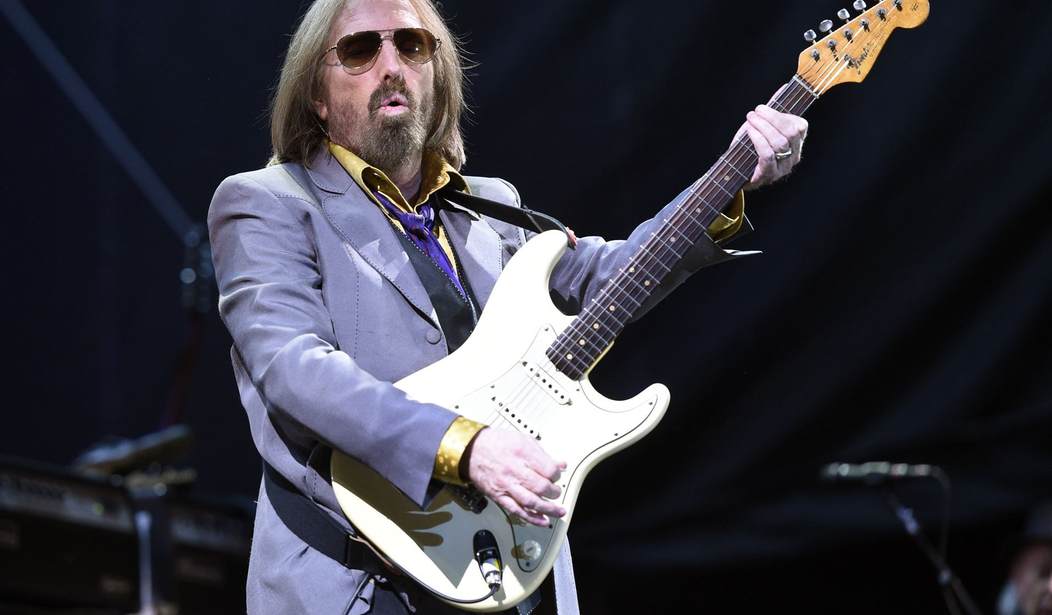
But there's another place where I've experienced that reminder: Tom Petty's house.
I've told this story before, but when I was younger, my grandfather would rent this big house in Florida for my family for a week or two at the beach. It was a unique place with lots of photographs of celebrities, ranging from Lucille Ball to the Beatles, and decor like the big disco ball that hung in the oversized living room or the vibrant blue carpet that lined the steps and boardwalks in the backyard.
Eventually, we found out that it had been Tom Petty's house, and then his ex-wife Jane's after their divorce, and all of that made sense. But one thing that always stood out to me was the big "Made in the USA" sign that hung above the front door.
When I learned of who'd lived there, the sign suddenly made sense, too. Few people embodied the American Dream like Petty. And few musicians wrote lyrics about Americana as he did, which I think is one reason I've always loved his music. No matter how wealthy or how big of a star he became or how much time he spent in Hollywood, he still wrote about the America that many of us can relate to — especially those of us here in the South.
The Gainesville, Fla. native never forgot his roots, revisiting them often in his music, and perhaps that's most evident in his Southern Accents album. Petty set out to write a concept album about the South, and while he ended up collaborating with Dave Stewart of the Eurythmics, which kind of turned the album into something else, there are still a few songs on there that describe what life was like for Petty growing up in the South.
One of those is "Rebels," which is a beautiful tune that references the Civil War in a way some don't like. Petty has described it as being about character who sort of embodies the lives of people who he grew up with in Florida. Some of the lyrics are:
I was born a rebel
Down in Dixie on a Sunday morning
Yeah with one foot in the grave
And one foot on the pedal
I was born a rebel
Even before my father's fathers
They called us all rebels
Burned our cornfields
And left our cities leveled
I can still see the eyes
Of those blue bellied devils
When I'm walking round tonight
Through the concrete and metal
The song is about a guy "who talks about the traditions that have been handed down from family to family for so long that he almost feels guilty about the war. He still blames the North for the discomfort of his life, so my thought was the best way to illustrate this character was to use the Confederate flag," Petty said in a 2015 interview with Rolling Stone.
I think anyone who listens with half a brain understands that (and many of us have even known people like this), but, of course, some found it offensive because that's happens when we acknowledge history in this country at times (I liken it to people tearing down statues). They hated it even more so when Petty toured on this album and used Confederate flag imagery as part of the background for it. While Petty meant it purely as a nod to history and not some sort of political or social statement, there was some backlash. On the other hand, some people grabbed onto it and began bringing the flags to his concert.
"The Confederate flag was the wallpaper of the South when I was a kid growing up in Gainesville, Florida," he told Rolling Stone. "I always knew it had to do with the Civil War. But the South had adopted it as its logo. I was pretty ignorant of what it actually meant. I just honestly didn’t give it much thought, though I should have. It was a downright stupid thing to do."
He eventually told fans to stop bringing the flags to his concert.
Regardless of all that, I love the song for what he meant it to be. Petty is, in my opinion the second-best storyteller in music (after his buddy, Bob Dylan, of course).
There's also the title track from the same album, Southern Accents, which Petty said he wrote in the middle of the night at his home in an almost dream-like state. He's called it one of his favorite things he's ever written.
There's a southern accent, where I come from
The young'uns call it country
The Yankees call it dumb
I got my own way of talkin'
But everything is done, with a southern accent
Where I come from
Both Dolly Parton and Johnny Cash have covered it, and I actually love the Cash version, so I'm going to share that one with you.
While I love both of those songs, my absolute favorite southern-themed Petty song is "Down South," which is from his third solo album, Highway Companion. Every time I hear these Southern Gothic lyrics, they inspire me to write a million stories:
Headed back down South
Gonna see my daddy's mistress
Gonna buy back her forgiveness
Pay off every witness
One more time down South
Sell the family headstones
Drag a bag of dry bones
Make good on my back loans
[Chorus]
So if I come to your door
Let me sleep on your floor
I'll give you all I have and a little more
[Verse 2]
Sleep late down South
Look up my former mentors
Live off Yankee winters
Be a landlord and a renter
Create myself down South
Impress all the women
Pretend I'm Samuel Clemens
Wear seersucker and white linens
The third verse is my favorite:
Spanish moss down South
Find the heroes of my childhood
Who now can do me no good
Carve their names in dogwood
Chasin' ghosts down South
Spirits cross the dead fields
Mosquitoes hit the windshield
All document remain sealed
Like "Southern Accents," Petty has said that this is one of his favorite songs he's ever written. Here's more on what inspired him to write this "wordy" tune, as he called it:
[The South], it’s a very romantic place, but it’s also a spooky place. You’d think a lot of ghosts still linger down there. I’d written about the South years ago. And I wondered, ‘What would I write now? Now that I’ve been gone so long?’
Then I got my head into thinking about what if I went back? What would be my impressions? And then it came pretty easily. I wrote all the lyrics before I wrote the music. It’s the only one on this album that I did that way. I wrote all the lyrics. And I think as I was writing them, I heard the tune in my head.
But when I say Petty's music is filled with Americana, I don't just mean geographically. So many of his songs touch on — no, sink their teeth into — broader American themes.
From politicians to sports teams, "I Won't Back Down" has become the country's soundtrack for situations that require tenacity and toughness and standing your ground — something the American people became pretty good at doing 250 years ago.
On the surface, "Runnin' Down a Dream" sounds like the ultimate road trip song — it doesn't get much American than that — but the lyrics are actually a metaphor for a small fish chasing a big dream through hard work and determination. It symbolizes the freedom to be anything you want in this country, the endless possibilities, and even the hardships you'll typically have to overcome to get there.
I could go on and get into some really deep tracks here, but my editors might kill me, so I'll wrap it up.
What actually inspired me to write this, beyond that fact that I adore all things Tom Petty, is that CBS chose the song "American Girl" as part of its "Sunday Morning Essential American Songbook," celebrating America’s 250th birthday.
Petty wrote what is arguably one his signature songs back in the 1970s, shortly after arriving in California from Florida, hoping to get a record deal. His apartment overlooked a freeway, and he said the sound of the cars made him think of the ocean, which inspired a lyric that led to a song. The band recorded that song exactly 50 years ago on July 4, 1976.
There have many urban legends about the lyrics, that they were about death or specifically about a University of Florida student who jumped to her death from a dorm window, but Petty says it's just the opposite — it's about living. As American Song writer puts it, it's "about longing, desperation, optimism, and wanderlust, with lyrics that focus on a young woman’s attempt to summon the strength needed to chase down a better future. It’s a uniquely American narrative."
I actually think there's a touch of American narratives in every one of Petty's songs. No matter what the actual subject matter is, it's set against a backdrop of some small town in the United States, a road trip, a geographic region, a city, a state, or some place we can all somehow pull up from our memories, even if we haven't actually been there.
Petty, who was the prime example of the American Dream, loved this country, observed it, appreciated what it gave him, and essentially captured so many American ideals, moments, and landscapes in his writing. And as we celebrate America's 250th birthday, we're all better off for having access to that music.