


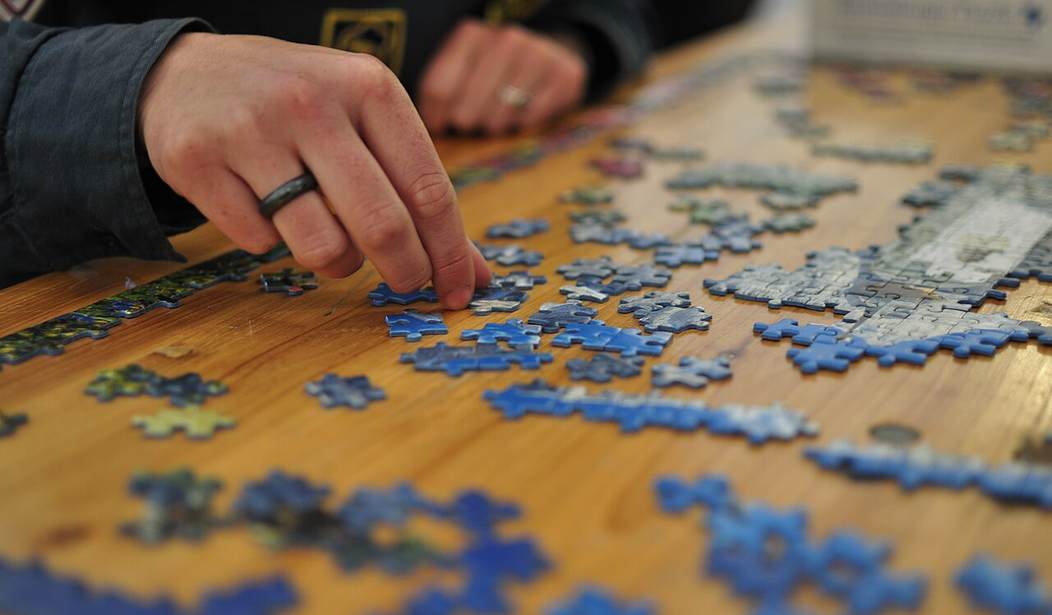
There's a new competitive sport sweeping the nation. To win requires speed, intelligence, moxy, and the eye of the tiger.
Welcome to the world of competitive speed jigsaw puzzles.
As a result of the government-mandated lockdowns during the pandemic, indoor pursuits long set aside by modern people came back into vogue. Arts and crafts stores report huge numbers of people learning how to knit, embroider, and crochet. Coloring books for adults became popular, as did bread making, advanced cooking, and mixology.
Jigsaw puzzles had always been a popular pastime in America, but the pandemic led to a massive increase in the number of people trying to put them together. Naturally, this led to competitions between individuals and teams.
The world of competitive speed jigsaw puzzles is not new, but the pandemic created an entirely new vibe around the sport. In 2022, the volunteer-run USA Jigsaw Puzzle Association (USAJPA) joined with Ravensburger, a leading manufacturer of jigsaw puzzles, to hold a national championship.
USAJPA is a member of the World Jigsaw Puzzle Federation (WJPF). Founded in 2019, this organization brings together competitors from across the globe, with the world championships held in Valladolid, Spain, attracting hundreds of participants.
The American championship attracted 300 participants that first year. The most recent championship, held in Atlanta in March, attracted more than 1,000 competitors and almost as many spectators, and volunteers cheering on their favorites.
“Suddenly, this audience that had no idea that speed puzzling was a thing sees that it’s a thing, and they tag all their friends and they’re like, ‘Oh my gosh, you would be so good at this,’” says Karen Kavett, a movie and TV camera person who won the inaugural American championship in 2022.
Ancillary activities are available during and in between rounds. Casual competitions for puzzle chess are under way: puzzlers use chess clocks, placing one piece at a time with the goal of completing faster than their opponent. Another area is dedicated to panels on topics such as Decoding Data: Speed Stats 101. Vendors sell puzzle accessories and merchandise. A line for autographs from popular image artists stretches out the door.
But the competition is the main event. The first day comprises four preliminary individual rounds of 200 puzzlers each. The top 50 from each session advance to the finals, one fourth of the original pool.
Mari Black and her partner Jim Eakins, both puzzle coaches, have traveled from Boston. Black is here to compete; Eakins is part of several panels and will commentate for the event’s live stream. When I tell Black I’m working on an article about the puzzle community, she jokes: “Do you normally do stories about cults?”
The obsessiveness over jigsaw puzzles among participants and fans makes the "cult" comparison seem apt. But unlike cultists, the puzzle aficionados are overly friendly and welcoming.
"About 80%-90% of the community are women, aged anywhere from their 20s to 60s, estimates Rob Shields, a podcaster with two decades of experience from Portland, Oregon, who hosts a puzzling podcast called Piece Talks," notes The Guardian.
In speed puzzling, participants can compete as individuals, in pairs, or in groups of four. Competitors receive the same puzzle – or two, if they’re competing as a group. Individuals and pairs complete 500-piece puzzles; teams do either a 500-piece puzzle and a 1,000 piece, or two 1,000-pieces.
The event is livestreamed and several contestants havea mounted overhead cameras to record their play in order to create content later.
Kibbutzing from the peanut gallery is unique to speed jigsaw puzzle competitions.
“She’s not doing the border, huh?” remarks one woman.
“Put it in the puzzle jail for a while,” says another spectator. Putting a piece "in jail" is the phrase for isolating a piece after repeatedly failing to find its place.
There is certainly no lack of ambition among players, who have set their sights on building the sport as high as it will go.
“If we could make [speed puzzling] an Olympic sport, that would be awesome,” says Thomas Kaeppler, the Ravensburger North America president.
Yeah, well, don't hold your breath. Watching bread rise might be just as exciting.