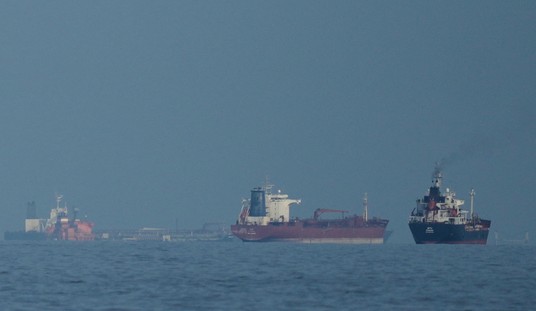



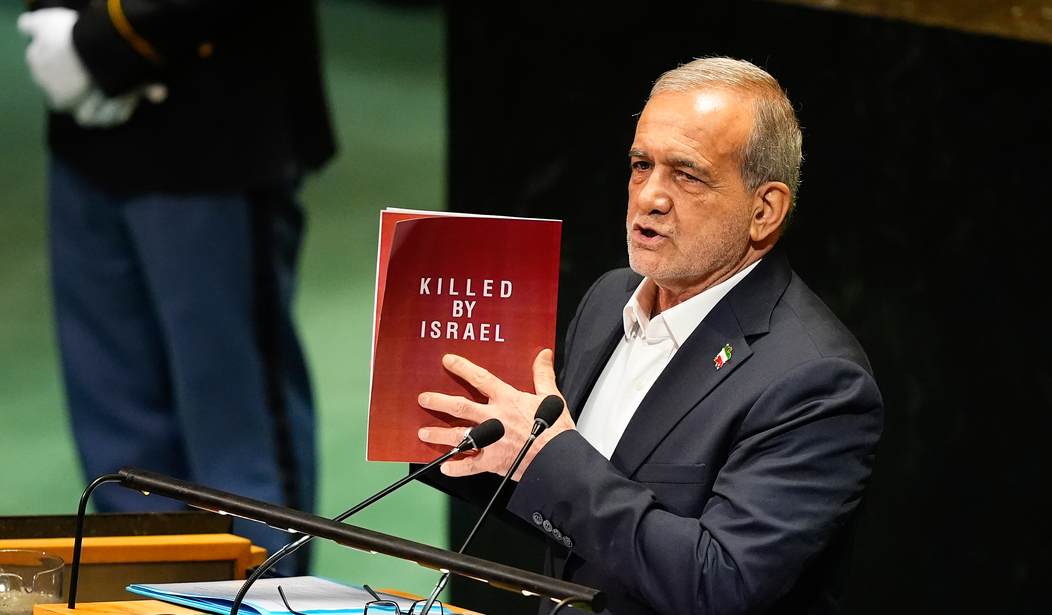
Iranian Foreign Affairs Minister Abbas Araghchi’s announcement on April 17 that the Strait of Hormuz was "completely open" proved to be premature. Within hours, the Iranian navy attacked several vessels looking to traverse the Strait.
The confusion wasn't due to any sort of Iranian "bait and switch" game to lure vessels into a kill box. The foreign affairs minister was taking orders from people who weren't in a position to give them and had no means of enforcing them.
As I have pointed out several times, the Islamic Revolutionary Guard Corps (IRGC) has taken advantage of the leadership vacuum following the death of Supreme Leader Ayatollah Ali Khamenei, the critical injury of his son and successor, Mojtaba Khamenei, and the assassination of several other key members of the inner circle to seize power and operate in the shadows.
That process of what amounts to a military coup was probably brutal and perhaps bloody. With many hands reaching for the brass ring, some are going to be chopped off.
The shakeout took several weeks, and it now appears that IRGC Commander Major General Ahmad Vahidi and members of his inner circle have come out on top, at least for the moment, and are now not only directing military responses in the war but also dictating Iran's negotiating position.
IRGC-affiliated media also announced on April 18 "that Iran has not agreed to participate in another round of negotiations with the United States due to 'excessive' US demands," according to the Institute for the Study of War (ISW).
It's almost unheard of for the Revolutionary Guards to interfere in diplomatic maneuvering. That's a major "tell" that the IRGC is calling most of the shots.
Elements of the regime that have aligned with Vahidi and against Araghchi are coalescing behind the IRGC officer and are presenting a united front in closing the Strait again.
"Vahidi and Khatam ol Anbia Central Headquarters Commander Ali Abdollahi Aliabadi are reportedly driving the regime’s military decision-making, according to anti-regime media on April 7," according to ISW. The Supreme National Security Council (SNSC) of Iran released a statement on April 18 that Iran will “exercise supervision and control” over traffic in the Strait until the war ends. That statement came from SNSC Secretary Mohammad Bagher Zolghadr, a hardliner closely associated with Vahidi.
Vahidi and individuals close to him may have effectively controlled the negotiations process throughout the war, which is traditionally a role reserved for political leaders. Vahidi likely intended to impose IRGC oversight over the recent US-Iran talks in Islamabad. Vahidi attempted to insert Zolghadr into the Iranian negotiating team in Islamabad despite protests from delegation leaders Parliament Speaker Mohammad Bagher Ghalibaf and Araghchi over Zolghadr’s lack of experience with diplomatic negotiations. Vahidi presumably wanted to send Zolghadr to keep an eye on the negotiations and to inform leaders in Tehran if the negotiating delegation strayed from his or Supreme Leader Mojtaba Khamenei’s directives.
Zolghadr sent a complaint to senior IRGC leaders, almost certainly including Vahidi, that Araghchi had surpassed his mandate during the negotiations by expressing flexibility regarding Iran’s support for the Axis of Resistance. Zolghadr’s anger caused senior leaders in Tehran, including former IRGC Intelligence Organization Chief and long-time member of Mojtaba’s inner circle, Hossein Taeb, to call the negotiating delegation back to Tehran.
"The IRGC’s consolidation of control over Iranian decision-making indicates that the Iranian political officials currently negotiating with the United States do not have the authority to independently determine Iran’s negotiating positions," reports ISW. This is the major reason Iran will fight on, even if intense hostilities resume and much of Iranian infrastructure is flattened.
It's the same problem we ran into during the 1979-81 hostage crisis. Our negotiators were constantly on the cusp of reaching a deal, only to have the rug pulled out from underneath them by a faction that had gained some influence in recent weeks.
ISW recently assessed that the United States is negotiating with a divided committee of hardliners and pragmatists that lacks a cohesive, unified position. The IRGC appears to have sidelined more pragmatic figures with whom the United States has negotiated. Araghchi and Ghalibaf’s negotiating team reportedly did not have full authority to finalize a deal with the United States in Islamabad, for example.
This current dynamic likely reflects Vahidi’s position, relationships, and control over IRGC military elements, which has enabled him to wield significant authority over decision-making compared to other senior regime leaders such as Ghalibaf.
Vahidi is not going to keep power if he's seen as weakening in any way in negotiations with the U.S. If Trump wasn't told this before the Islamabad meeting, he almost certainly knows it now. The U.S. is not going to bomb Iran into submission as long as Vahidi is at the controls.
Vahidi is a long-time and experienced IRGC commander, having served as Iran’s first IRGC Quds Force commander between 1988 and 1997 and currently serving as the senior-most IRGC commander. Vahidi was one of the senior IRGC commanders who pushed the Assembly of Experts to select Mojtaba as Supreme Leader in March. Vahidi and his affiliates have reportedly fought with more pragmatic regime officials such as Ghalibaf over Iran’s national security and foreign policy decisions throughout the conflict. Ghalibaf, in contrast, is a former IRGC commander who transitioned into politics in the early 2000s and lacks the influence and control over military elements that Vahidi has. Vahidi and his inner circle appear to have marginalized Ghalibaf, although he is publicly reiterating IRGC rhetoric Ghalibaf likely lacks the leverage or formal executive authority to shape decision-making.
In the cutthroat world of Iranian politics, Vahidi is currently king of the hill. How long that lasts will depend on how he is perceived by the rest of the regime in his ability to stand up to the U.S. and advance the survival of the Iranian state.