


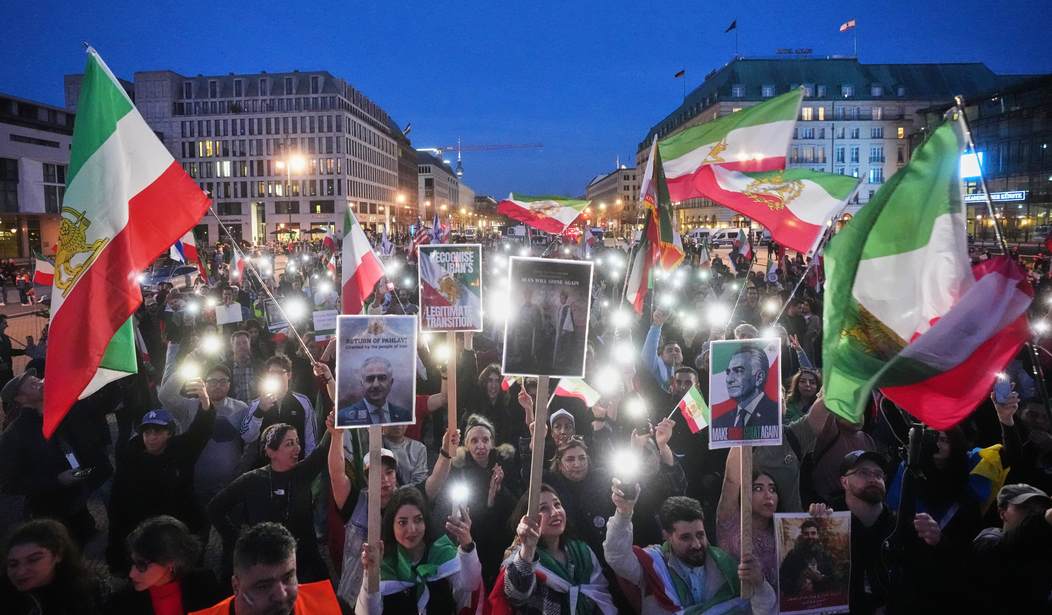
What do the Iranian people think of the war? “If this war were to end now, we would be in an even worse place than we were before,” said Pivi, 36, an architect living in the United Arab Emirates. She thinks that people will eventually return to the streets to demand democracy, but not now.
She said: “But right now, most people are too scared to move.”
"That fear, as missiles and bombs fired by two of the world’s most powerful militaries rain down, as well as the absence of an organized opposition, helps explain why Iranians who participated in the protests against their government just a few weeks ago have not taken to the streets," reports the Washington Post.
The Islamic Revolutionary Guard Corps (IRGC) has given the job of internal security to paramilitary militias made up of young fanatics and true believers, while the adults go off to war. The kids are reportedly eager to enforce the ban on demonstrations, and have terrified neighborhoods.
Meanwhile, the U.S.-Israeli effort to crush the internal security apparatus of the Iranian state continues.
Israel is “creating the optimal conditions for toppling the regime," said Israeli Prime Minister Benjamin Netanyahu at his first press conference of the war.
"I will not detail the actions we are taking. We are creating the optimal conditions for toppling the regime but I won't deny that I can't tell you with all certainty that the people of Iran will topple the regime - a regime is toppled from the inside," Netanyahu said.
"But we can definitely help and we are helping."
The combined strikes targeted Law Enforcement Command (LEC) sites, specifically connected to the traffic and economic security police units, in Gharchak, Tehran Province. The Israel Defense Forces (IDF) separately struck Basij checkpoints in Tehran Province on March 12 and 13, including two in northeastern and southeastern Tehran Province.Basij and other Iranian security personnel have dispersed from fixed checkpoints and taken cover in locations, such as highway underpasses and bridges in cities, including Rasht, Gilan Province, and parts of Tehran Province, likely to reduce exposure to drone surveillance and follow-on strikes.
The combined force has repeatedly targeted elements of Iran’s internal security apparatus, including the LEC, Basij, and IRGC units, that are responsible for suppressing protests and maintaining domestic control. Israeli Prime Minister Benjamin Netanyahu stated on March 12 during his first press conference since the war started that Israel is “creating the optimal conditions for toppling the regime.” Netanyahu noted that a regime needs to be “topped from the inside” but added that “[Israel] can definitely help” and is helping. The IDF also reported that it targeted IRGC, LEC, and Basij command elements in Tehran during a new wave of strikes on March 13.
Many Iranians openly celebrated the death of Ayatollah Ali Khamenei. But there have been no large protests since the war began. The slaughter of more than 30,000 protesters in January is still too fresh in people's minds.
“We are delivering crushing blows to the Revolutionary Guards and the Basij, their street forces, their checkpoints – and more is yet to come,” Netanyahu said in his press conference.
“I say to the Iranian people: The moment when you will be able to embark on a new path of freedom is approaching. That moment is drawing closer. We stand with you. We are helping you. But in the end — it depends on you. It is in your hands,” said Netanyahu.
An unarmed, disorganized populace can do little to help itself. It's not just a question of air dropping weapons and ammunition to Iranian citizens. There is no recognized, organized opposition inside Iran.
Giving people weapons will only result in a larger body count.