


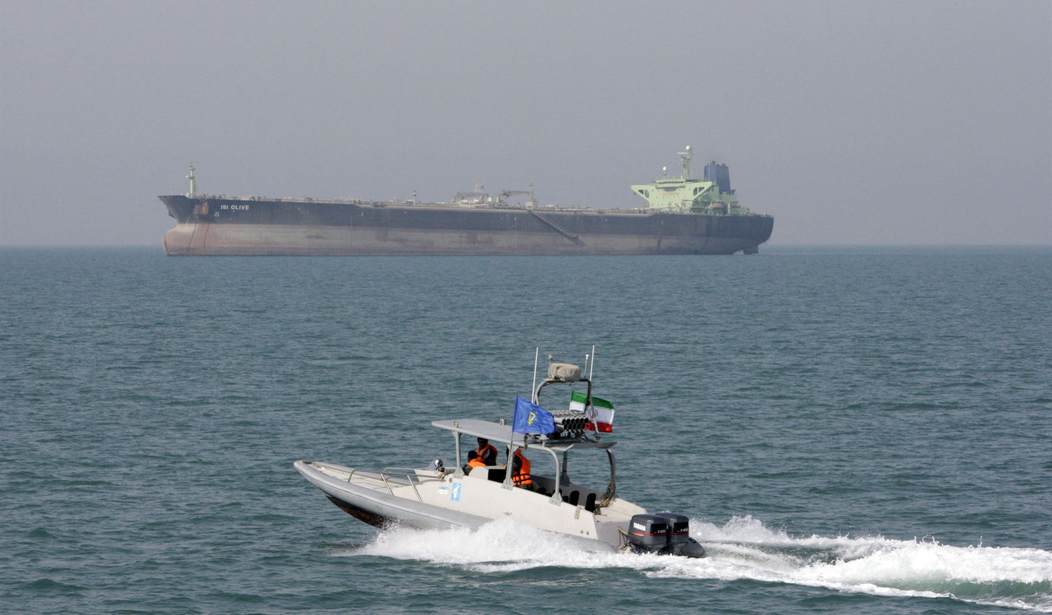
In the last 48 hours, the war has changed. Iran may not be able to inflict the kind of damage that the U.S. and Israel are delivering on an hourly basis, but the board has been flipped as the Western world panics over attacks by the regime on ships in the Strait of Hormuz.
Make no mistake: The regime has been emboldened. Israel and the U.S. have delivered haymaker after haymaker and, perhaps to their own surprise, the Iranian regime is still standing.
Part II of the war has commenced as the U.S. Navy scrambles to organize escorts for tankers.
“Starting a war is easy, but ending it won’t happen with a few tweets,” Iran's top national security official Ali Larijani said on social media Thursday. “We will not let you off until you accept your mistake and pay the price for it.”
“The only way to end this war,” Iranian President Masoud Pezeshkian said late Wednesday on social media, “is recognizing Iran’s legitimate rights, payment of reparations, and firm int’l guarantees against future aggression.”
None of that is going to happen, but it points to Iran's determination to keep fighting. They can still launch drones at ships. They can still fire ballistic missiles at American bases. They are not dead in the water. While the damage they can inflict is minimal, they can count on the Western media to trumpet any successful strikes as "proof" that the war is a failure.
“They are playing for time,” he said.
Indeed, their ace in the hole is soaring oil prices, and Iran plans to turn the screws on the oil markets until the U.S. and Western Europe howl.
Fox Business:
Iran warned the United States Wednesday that oil prices could soar to $200 a barrel as escalating U.S. and Israeli strikes against the country continue to rattle global energy markets.
To prevent what could be one of the worst oil shocks since the 1970s, the U.S. announced that Washington, along with the International Energy Agency (IEA), will soon release a historic volume of oil from its emergency reserves.
If oil prices reach such levels, average gas prices in the United States could surpass $5 a gallon, analysts predict. As of Wednesday, the national average price for regular gasoline stood at $3.57 per gallon, according to the American Automobile Association.
A spokesperson for Iran’s primary military command issued the warning in comments addressed to Washington, Reuters reported. Tehran reportedly emphasized that the instability in global oil markets was the result of what Tehran describes as conditions imposed by the United States and Israel.
"Get ready for oil to be $200 a barrel, because the oil price depends on regional security, which you have destabilized," Ebrahim Zolfaqari, spokesperson for Khatam al-Anbiya Central Headquarters, taunted.
The U.S. still has its own cards to play. We could destroy Iran's oil facilities on Kharg Island, bankrupting the nation by choking off 90% of Iran's oil exports. But such a move carries massive risks. Oil, now at $100 a barrel, could rise to $150-$200 barrel as Iran's 1.5 million barrels a day is yanked from the market. This would lead to $5-a-gallon gas and an inflationary ripple that Donald Trump and the Republicans can't afford with midterm elections coming up in November.
There would also be the risk that, with Kharg Island destroyed, Iran would feel it has nothing left to lose and attack Saudi Arabia's oil infrastructure and other Gulf states. Their thinking would be that if we can't sell oil, no one will.
Also, demolishing 30 million barrels of oil stored in tanks would create an environmental catastrophe in the Persian Gulf, destroying ecosystems as well as desalination plants upon which millions of people depend for fresh water.
The 32-member International Energy Agency (IEA) will release 400 million barrels of oil from national reserves, including 172 million barrels from our own Strategic Petroleum Reserve (SPR).
U.S. Secretary of Energy Chris Wright said at a news conference that the Trump administration had already arranged to replenish the U.S. Strategic Petroleum Reserves with about 200 million barrels over the next year, at no cost to taxpayers. This is after Joe Biden released 180 million barrels from the SPR in 2022 for the blatantly political reason that Democrats were going to get buried in the midterm elections because inflation, driven by high energy prices, was peaking at 10%.
"For 47 years, Iran and its terrorist proxies have been intent on killing Americans," Secretary Wright said. "They have manipulated and threatened the energy security of America and its allies. Under President Trump, those days are coming to an end. Rest assured, America’s energy security is as strong as ever."
That statement will be put to the test over the next few months.
Related: Iran's Attacks on Gulf Shipping a 'Hail Mary' to Bring US to the Table
PJ Media will give you all the information you need to understand the decisions that will be made this year. Insightful commentary and straight-on, no-BS news reporting have been our hallmarks since 2005.
Get 60% off your new VIP membership by using the code FIGHT. You won't regret it.



Join the conversation as a VIP Member