


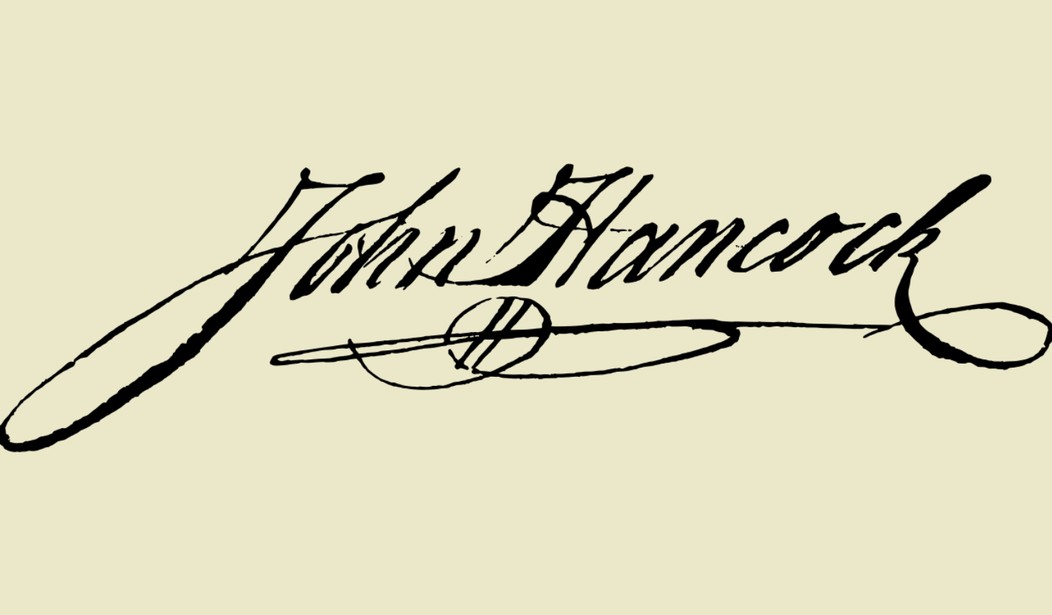
When I look at the penmanship of signatory John Hancock on the Declaration of Independence, I sometimes can’t help but do my own handwriting analysis, amateurish as it may be. I imagine that nuns taught him in a Catholic school, populated mostly by Irish kids, and if his penmanship didn’t meet expectations, the nuns would let him know in their own disciplinarian ways. So he rebelled by doing what they wanted, while always making sure to “color outside the lines.”
I’m not projecting. I’m not projecting. At. All.
On July 4, 1776, when he signed the Declaration of Independence, Hancock was president of the Continental Congress, which was our focus in the most recent installment in this series. When you look at the document today, his is the most prominent signature on the page, clearly, defiantly, proudly proclaiming where he stood on the movement to break free from the British crown.
Pennsylvania delegate Benjamin Franklin was famous for saying that when they signed the Declaration, “We must all hang together, or assuredly we shall all hang separately.” That’s what they call in the news business, “good copy.” For that reason, Hancock’s rejoinder gets much less press on the part of historians, but he replied to Franklin, saying, “We must be unanimous.”
That’s actually a great illustration of the difference between Franklin the orator and Hancock, the more pragmatic manager. Hancock's comment was clearer, more concise, and more accurate for the people in the room, but far less memorable. So, he made up for this through that famous signature of his.
Hancock was born in 1737 in Massachusetts. His father, who was in the clergy, died when Hancock was a child. His uncle, Thomas Hancock, who was a rich merchant in Boston, raised him. John graduated from Harvard College in 1754 and then joined his uncle’s shipping firm.
Related: ‘America 250’ Tuesday: What Was the Continental Congress?
Thomas, who had no children of his own, died in 1764. John then inherited the firm and immediately became one of the richest men in New England. And so, when the crown started to literally put its thumb on the scales of commerce in the 1760s, increasing regulation and taxation on the American colonies, shippers were on the front lines. They felt the impact most immediately, and oftentimes, most severely. A big part of the anti-British movement originated within the shipping world for these reasons.
A lot of the money and leadership of the first rumblings of revolution came from those shippers. Hancock was one who funded and led the way for the growingly frustrated colonists. As he got more and more involved with the movement, he rose in prominence and was elected to serve as president of the Second Continental Congress, which served as the new country’s government throughout the Revolutionary War.
With the nation on the cusp of full-blown revolution, he married Dorothy Quincy in 1775. She was the daughter of another New England merchant. They had two children together, but neither lived to become an adult.
The road to political prominence for Hancock started in 1765 when Bostonians elected him to serve as a selectman. In 1766, he was elected to the Massachusetts colonial legislature.
This is when it gets interesting. The British Parliament had started to impose those famous tax laws that hit the colonists in the wallet and on the table, making life a lot less affordable in the colonies, while the fruits of their labor were shipped across the Atlantic for the British citizenry to enjoy.
As is the case in every story about the revolution, the Americans wanted out from under oppressive British taxes and other restrictions.
In 1768, British customs authorities seized one of Hancock’s merchant ships in Boston Harbor. They accused Hancock of illegally unloading cargo without paying the taxes on it. The ship, not coincidentally, was called the Liberty. The event would then become known as The Liberty Affair.
This caused an uproar among other merchants and the locals. The experience only fueled Hancock’s unrest, along with so many others in Boston. As a result, Hancock became even more generous with his financial and leadership support to the movement for independence, culminating in his roles as a Massachusetts delegate to and president of the Continental Congress.
After signing the Declaration, Hancock continued to lead the Congress until 1777. He oversaw the formation of the Continental Army, which was under the command of Gen. George Washington. He oversaw the war, the administration of this new placeholder government, international diplomacy, and the very beginnings of the process to create a more permanent government for the United States of America.
In 1780, Hancock became the first governor of the Commonwealth of Massachusetts, where he served until he died in 1793.
There is a story behind every signature on the Declaration, and it’s usually one of courage, selflessness, and bravery. Hancock’s story is just that and then some. The more you learn about each of these leaders, the more you can appreciate just what they accomplished and this free nation that is their legacy.