


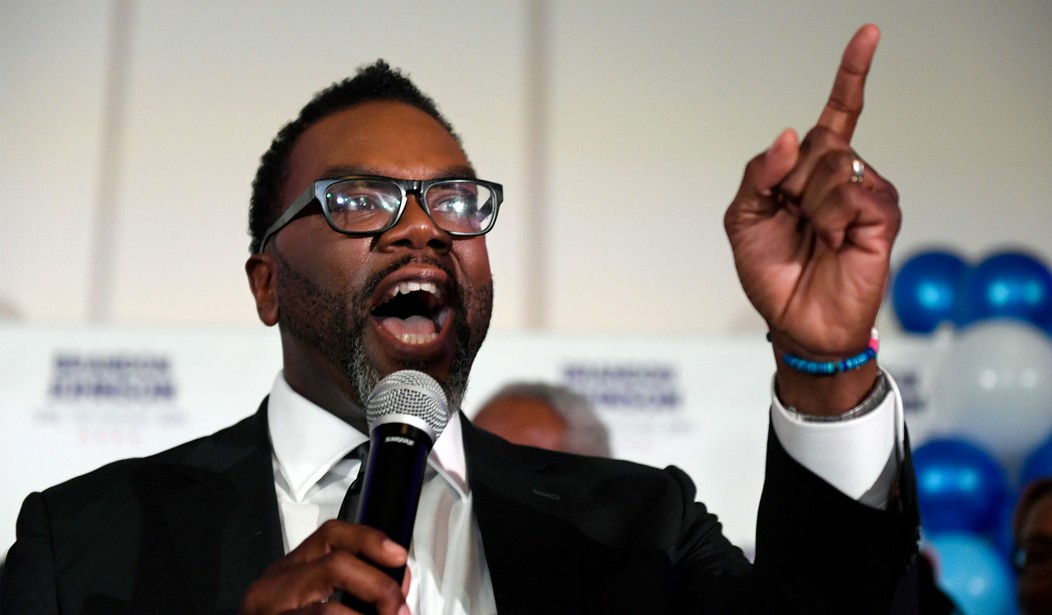
The city of Chicago exists on another plane of the universe than the rest of us. It's a place where up is down, black is white, and the basic laws of physics are held in abeyance so that when adding one plus one, any number that's convenient (and politically viable) can be the answer.
In Chicago's budget, the "new physics" includes the caveat that nothing is real unless we (the aldermen and the city's hapless Mayor Brandon Johnson) say it is. And even then, nothing is permanent in this alternate plane of the universe. An equation that's "true" today may not be so "true" tomorrow.
Do you think I'm being facetious?
"Chicago finished fiscal year 2024 with a $41.1 billion gap between the money it has available to pay bills and the obligations it owes, according to a new report from Truth in Accounting, placing the city among the worst financially managed major cities in the nation," according to The Center Square.
That's only half the story. The city denies there's a deficit at all. City officials say (how can they not giggle when saying this) the budget is balanced.
Truth in Accounting CEO Sheila Weinberg clears up any ambiguity.
“They only include the expenses they’ve paid, not all the expenses they’ve incurred,” Weinberg said. “They also include loan proceeds as revenue and still claim the budget is balanced. In the real world, borrowing money to balance your budget would be insane. But in government budgeting, that’s how they do it.”
One person's "insanity" is another's denial of reality.
Chicago’s four major pension funds are among the most underfunded in the nation, with only about 25 cents set aside for every dollar promised in benefits, according to Weinberg. The city’s unfunded pension liability exceeds total employee payroll by more than eight times.
Weinberg said Illinois leaders expanded police and firefighter pension benefits to gain political favor despite severe underfunding, reducing funding levels to about 17 cents for every dollar promised and increasing the risk of a future federal bailout.
While pension funding has increased in recent years, Weinberg said the city still contributes less than what actuaries say is required.
“They fully fund the statutory requirement, not the actuarially determined contribution,” she said. “That statutory requirement is far less than what the actuaries say they should be paying.”
Playing games with pension funds is not unusual among Democratic-run cities and states. Robbing Peter to pay Paul and then paying Paul a pittance of what is owed is standard operating procedure in blue cities and states.
They're not worried. They're "too big to fail," and a bailout will be in the offing before too long. Even if Congress were to consider refusing a bailout, millions of state and city workers depend on those pensions to live. Refusing to assume those obligations would be a political death sentence.
A day of reckoning may be coming. The federal government may soon mandate that cities and states fully fund their employee pension plans.
Truth in Accounting is now working with members of the U.S. Senate to pursue federal legislation that would require state and local governments to fully fund pension and retiree health care promises.
Weinberg said the effort mirrors the Employee Retirement Income Security Act, which Congress passed in the 1970s after private companies went bankrupt and left workers without promised pensions.
“State and local governments were left out, and that’s how we ended up here,” said Weinberg.
Weinberg said Truth in Accounting is currently working with U.S. Sen. Jim Banks of Indiana, arguing that without reform, taxpayers nationwide could eventually be asked to bail out deeply underfunded governments.
“We’re trying to stop that before it happens,” she said.
Most recent reports from early 2026 and late 2025 estimate the national shortfall for state and local pension plans at roughly $1.27 trillion to $1.48 trillion.
Some economists argue that reported numbers are too low because they use optimistic return assumptions. Market-based valuations, which use "risk-free" discount rates, have estimated the true gap as high as $4.6 trillion to $5 trillion.
The national average funded ratio has improved to approximately 82.5%, up from 78% in 2024, largely due to strong stock market performance in fiscal year 2024-2025.
Taking money earmarked for municipal and state pension funds to spend on goodies for favored constituencies is a time-honored practice of Democratic politicians. They don't care. After all, if they get in trouble, there's always Washington there to bail them out.
The new year promises to be one of the most pivotal in recent history. Midterm elections will determine if we continue to move forward or slide back into lawfare, impeachments, and the toleration of fraud.
PJ Media will give you all the information you need to understand the decisions that will be made this year. Insightful commentary and straight-on, no-BS news reporting have been our hallmarks since 2005.
Get 60% off your new VIP membership by using the code FIGHT. You won't regret it.







Join the conversation as a VIP Member