





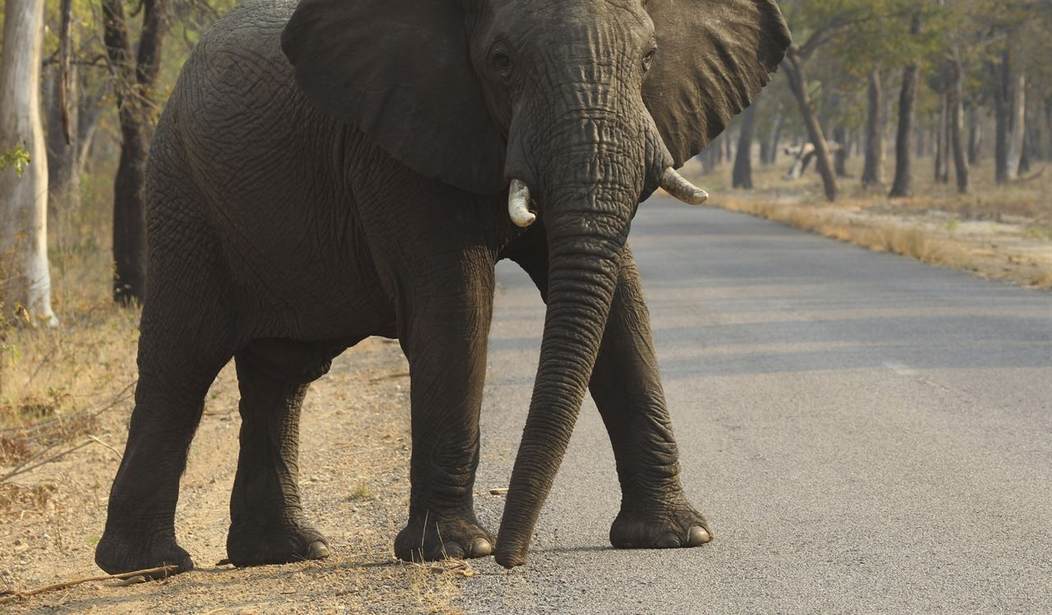
An apocryphal quote attributed to Napoleon Bonaparte says, “God is on the side of the best artillery." A principle Winfield Scott applied to good effect in the Mexican-American War with his longer-range guns. In like manner, the advent of the tank proved of great importance in World War II, along with air power and the aircraft carrier.
In the Second Punic War in 218 BC, the Carthaginian General Hannibal decided that war elephants in Europe could turn the tide of battle. In your school days, you may even have seen a picture in your textbook of elephants making their way through the Alps as snow and wind impeded their trudge to Rome.
To this day, the quest for archeological evidence for those elephants continues. Enter Fernando Quesada Sanz, an archaeologist at the Autonomous University of Madrid. Under a collapsed adobe wall in Cordoba, Spain, a 2,200-year-old elephant ankle bone was discovered along with 12 large stone catapult projectiles.
“It is quite possible that the bone uncovered around Cordoba belonged to one of the elephants that Hannibal used to crush the Carpetani tribe in central Spain,” Dr. Quesada said. Carthage marched into Spain in 228 BC and had great success with the animals. But when Hannibal attacked an ally of Rome, a small conflict ended up in a big war.
The decision was made to cross the Pyrenees, France, and the Alps to Italy. It was a debilitating trek for the animals, and the cold continued into Italy. All empires come to an end, but alas, this time it was Hannibal and his pachyderms who packed it in. Of the 37 elephants he crossed the Alps with in 217 BC, exhaustion, battle, and freezing cold left only one survivor: the tuskless wonder, Surus, or Syrian. It is said Hannibal, who by then had lost one eye, rode it across the Arno swamps, prompting Roman playwright Plautus to say the sight “set my heart a-freezing.”
Rome wasn't built in a day, nor would its empire be destroyed in a day. Its demise, and that of its successor, the Holy Roman Empire, didn't officially come until Emperor Francis II abdicated in 1806, courtesy of Napoleon's famous artillery.
Hannibal's failure to capitalize on his initial triumphs in a timely manner has been credited by some with causing the stalemate that happened after crossing into the Po Valley and moving on to Rome.
RELATED: War Department Hits 1,000 Grads of Defense Manufacturing Program
In his attempt to pacify Spain, Hannibal left 21 war elephants on the Iberian Peninsula under the authority of his brothers Hasdrubal and Mago, and other generals. They had a long stay. In the ancient world's version of a forever war, the Second Punic War lasted another 16 years until 202 BC. The beaten soldiers and surviving elephants then left Spain and returned to Africa, ending an unusual era in European warfare.
War elephants were certainly creatures designed to instill shock and awe. They starred in a few battles, but they were costly, hard to sustain, and did not change the outcome. Like many military innovations, their time quickly passed. How many kingdoms and empires have similarly ended up in the elephant burial ground by sallying forth on a fool's errand with outdated and obsolete ways of war?
Join PJ Media VIP today and get 60% off with promo code FIGHT. Join now to support this news site, go ad-free, and comment as you see fit.



Join the Conversation
VIP members get the ability to comment on articles.