


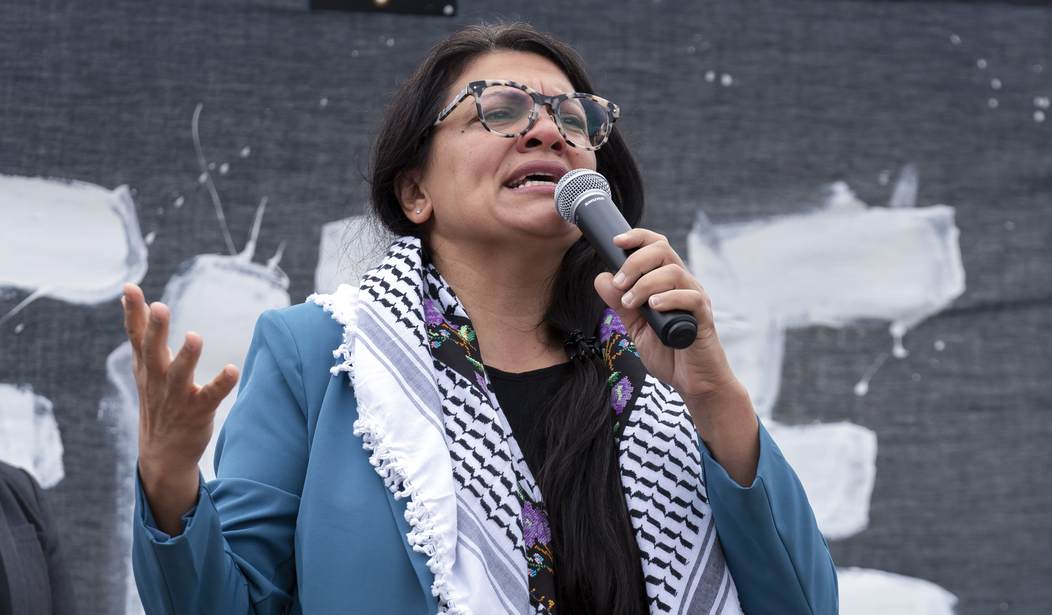
Democratic Rep. Rashida Tlaib of Michigan marked the 12th anniversary of Michael Brown's death by declaring that he "was murdered by a police officer in Ferguson."
Mike Brown should still be with us today.
— Congresswoman Rashida Tlaib (@RepRashida) August 15, 2026
But 12 years ago this week, he was murdered by a police officer in Ferguson. Our fight for justice and an end to white supremacy, police violence, and mass incarceration continues.
Black lives matter. pic.twitter.com/mxkyIjegR2
She didn't call his death tragic or controversial, but she accused former Ferguson police officer Darren Wilson of murder as if the case had never been investigated.
It was exhaustively investigated. The Obama Justice Department reviewed physical, ballistic, forensic, medical, and autopsy evidence. Investigators interviewed more than 100 purported eyewitnesses and canvassed more than 300 homes.
They concluded the evidence didn't support federal civil rights charges against Wilson and didn't establish that his use of deadly force was objectively unreasonable.
As discussed above, Darren Wilson has stated his intent in shooting Michael Brown was in response to a perceived deadly threat. The only possible basis for prosecuting Wilson under section 242 would therefore be if the government could prove that his account is not true – i.e., that Brown never assaulted Wilson at the SUV, never attempted to gain control of Wilson’s gun, and thereafter clearly surrendered in a way that no reasonable officer could have failed to perceive.
Given that Wilson’s account is corroborated by physical evidence and that his perception of a threat posed by Brown is corroborated by other eyewitnesses, to include aspects of the testimony of Witness 101, there is no credible evidence that Wilson willfully shot Brown as he was attempting to surrender or was otherwise not posing a threat. Even if Wilson was mistaken in his interpretation of Brown’s conduct, the fact that others interpreted that conduct the same way as Wilson precludes a determination that he acted with a bad purpose to disobey the law.
The same is true even if Wilson could be said to have acted with poor judgment in the manner in which he first interacted with Brown, or in pursuing Brown after the incident at the SUV. These are matters of policy and procedure that do not rise to the level of a Constitutional violation and thus cannot support a criminal prosecution. Cf. Gardner v. Howard, 109 F.3d 427, 430–31 (8th Cir. 1997) (violation of internal policies and procedures does not in and of itself rise to violation of Constitution).
Because Wilson did not act with the requisite criminal intent, it cannot be proven beyond reasonable doubt to a jury that he violated 18 U.S.C.§ 242 when he fired his weapon at Brown.
VI. Conclusion
For the reasons set forth above, this matter lacks prosecutive merit and should be closed.
The famous "hands up, don't shoot" narrative fared even worse. Investigators found no credible witness who could establish that Wilson shot Brown while Brown was clearly surrendering.
Some witnesses recanted, while others contradicted themselves or the physical evidence. The investigation found no eyewitness who said Brown uttered the words "don't shoot."
Ferguson had real problems. A separate federal investigation found unconstitutional police practices and racial discrimination inside the department. Those findings were exposed by the greatest disinfectant: sunshine; they deserved exposure and reform. They didn't transform unsupported claims about Wilson and Brown into facts.
"Hands up, don't shoot" nevertheless became one of the great political falsehoods of our time. Once a narrative becomes emotionally useful to the loons on the left, correcting it becomes remarkably difficult.
We've observed that truth play out several times, infamously with President Donald Trump's Charlottesville remarks. His "very fine people" comment is still routinely presented as praise for neo-Nazis and white nationalists.
Q Mr. President, are you putting what you’re calling the alt-left and white supremacists on the same moral plane?
THE PRESIDENT: I’m not putting anybody on a moral plane. What I’m saying is this: You had a group on one side and you had a group on the other, and they came at each other with clubs — and it was vicious and it was horrible. And it was a horrible thing to watch.
But there is another side. There was a group on this side. You can call them the left — you just called them the left — that came violently attacking the other group. So you can say what you want, but that’s the way it is.
Q (Inaudible) both sides, sir. You said there was hatred, there was violence on both sides. Are the —
THE PRESIDENT: Yes, I think there’s blame on both sides. If you look at both sides — I think there’s blame on both sides. And I have no doubt about it, and you don’t have any doubt about it either.
And if you reported it accurately, you would say.
Q The neo-Nazis started this. They showed up in Charlottesville to protest —
THE PRESIDENT: Excuse me, excuse me. They didn’t put themselves — and you had some very bad people in that group, but you also had people that were very fine people, on both sides. You had people in that group.
Q (Inaudible.)
THE PRESIDENT: Excuse me, excuse me. I saw the same pictures as you did.
You had people in that group that were there to protest the taking down of, to them, a very, very important statue and the renaming of a park from Robert E. Lee to another name.
Q George Washington and Robert E. Lee are not the same.
THE PRESIDENT: George Washington was a slave owner. Was George Washington a slave owner? So will George Washington now lose his status? Are we going to take down —
The transcript clearly contains Trump's explicit statement that he wasn't talking about those groups and that they should be "condemned totally."
I don't hide my opinion of Tlaib, who ranks near the bottom of my list of favorite public figures. Her politics are bad enough; the arrogance needed to announce a wrong version of history as settled fact bothers me even more.
Tlaib has had 12 years to read the record: ignorance would be a lousy defense now, so the motive is much more.
The political value of her post isn't found among people willing to read an 86-page Justice Department report. It works among low-information voters who remember the slogan, the protests, and the emotional story while forgetting what investigators eventually found.
Facts have a harder job; they arrive later, require reading, and rarely fit neatly on a protest sign.
Tlaib can condemn Ferguson's failures. She can argue for police reform. She can mourn Michael Brown. She can even argue that Wilson exercised terrible judgment — despite Brown's offensive actions against him — reaching into the squad car and trying to grab Wilson's handgun.
"Murdered by a police officer" is a factual accusation.
Unfortunately for Tlaib, 12 years of evidence and all the wishes, candy canes, and rainbows haven't made it true.
Bless her heart, if she has one.
Political narratives survive because too few people bother digging past the slogan. PJ Media does. Join PJ Media VIP today and save 60% with promo code FIGHT.





Join the conversation as a VIP Member