





Near the end of The Blues Brothers, Carrie Fisher corners John Belushi's Jake Blues at gunpoint and demands an explanation for abandoning her at the altar.
Jake unloads everything he has: no gas, a flat tire, no cab fare, a missing tuxedo, a stolen car, an earthquake, a flood, and locusts. He blames everything but Puff the Magic Dragon.
Canadian Prime Minister Mark Carney gave the political version Thursday when asked about wildfire smoke pouring into the United States. He talked about American restrictions on clean energy, Canada's global climate efforts, and Washington pulling back.
From Breitbart:
Canada’s extensive forests have traditionally experienced regular summer fire seasons, controlled through indigenous methods such as controlled burns and the removal of dry, dead tree branches and other material that serves as kindling for large fires. In the past decade, as the Canadian government has largely abandoned forest management as a national policy, these fires have grown larger, more dangerous, and more polluting. The Canadian government has no federal emergency response agency and no national fire authority, leaving the country’s provinces on their own to respond to the fires.
The Canadian government under the far-left Liberal Party has repeatedly responded to demands to proactively manage its forests and aid both indigenous communities and provincial governments by blaming the fires on “climate change” and rejecting claims that it could be doing more. Carney continued the trend in his response to questions about the fires on Thursday, specifically addressing outrage in the United States about the smoke pollution.
“Now we’re focusing on investing in clean energy,” Carney said in French, “in the United States there’s prohibitions now against clean energy — for example, wind energy is one example.”
“Secondly, Canada is maintaining our efforts on the world’s scale and the U.S. is reducing their efforts globally [on climate change], so, yes, climate change is the responsibility of everyone… including the United States.”
Carney’s comments did not elaborate on how the use of wind energy — requiring massive turbines that pose their own maritime environmental threat — would address the Canadian wildfire situation. He also did not specify exactly what he would want the American government to do to address the “responsibility” of alleged “climate change.”
Then came the escape line that puts a chill up the left of any climate greenie: “Climate change is the responsibility of everyone, including the United States.”
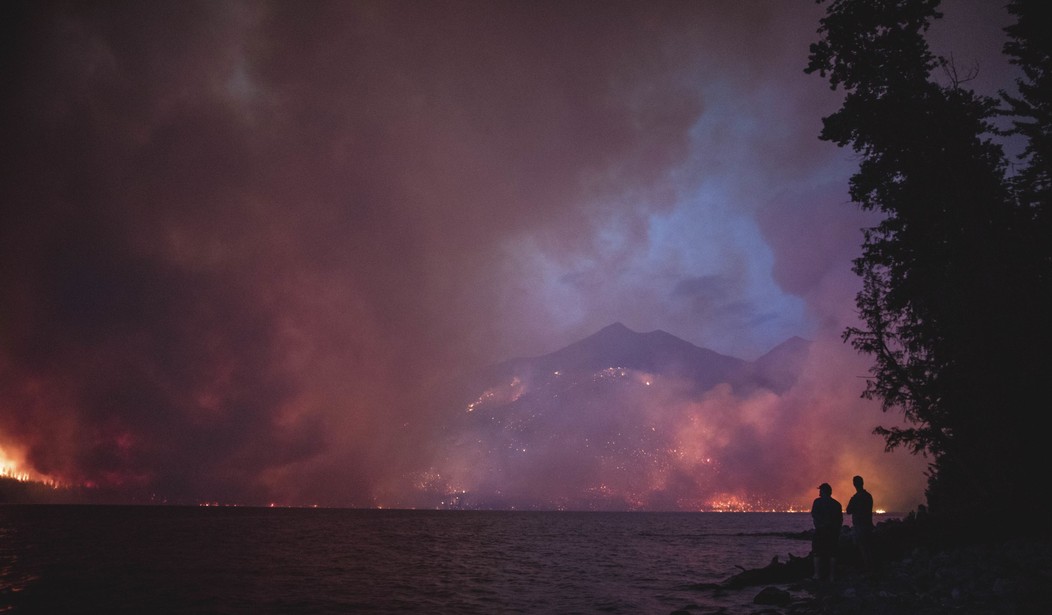
Canada had 858 active fires Thursday morning, including 111 classified as out of control. Smoke covered cities from the Midwest through the Northeast. Detroit, Chicago, New York, Minneapolis, and Toronto took turns as the worst air-quality cities on the planet. From Reuters:
What happened this week
Canadian wildfire smoke blackened skies in Toronto and covered a swath of the United States from the Midwest to the Northeast by Thursday. As of Thursday morning, 858 active fires burned across Canada, including 111 considered out of control, according to government data. Most were in the central provinces of Manitoba, Saskatchewan and Ontario.
What the numbers show
North American cities have logged some of the most hazardous air this week among major cities, Air Quality Index readings from IQAir show. Detroit surged past other daily peak readings at 11:00 p.m. local time on July 15 (0300 GMT on July 16). Chicago, New York City, Toronto and Minneapolis are among the other cities with very unhealthy or hazardous air.
What's next
Wildfire smoke can linger in the air for weeks and is more toxic than normal air pollution; studies have linked it with higher rates of heart attacks, strokes, cancer, pregnancy complications and weakened immune defenses.
The dangerous conditions come just days before the FIFA World Cup final is set to be played in New Jersey on Sunday in front of more than 80,000 fans, though rain is expected to dissipate the smoke by the time Spain faces off against Argentina.
I lay claim to my stomping ground, the Stevens Point metro area of Wisconsin. Since Wednesday at 3 p.m., we've smelled nothing but smoke, and that's saying something considering all the paper mills around me.
Nobody was arguing over a theory; we all were breathing the consequences.
Climate change, Nature's version of Orange Man Bad, produces longer fire seasons and harsher conditions and gives us Greta Thunberg doing what she does best.
But Carney still didn't answer the question put before him: Has Canada done enough to manage its forests, reduce fuel, prepare crews, and protect communities before flames become continental smoke events?
His government's material explains why management can't be waved away. Parks Canada says more than 100 years of fire suppression allowed fuels to build up, making fires larger and hotter. It also says prescribed burns create barriers, improve forest health, and reduce wildlife risk.
Indigenous cultural burning managed Canadian land long before modern fire agencies existed. From a Canadian government page:
Indigenous fire stewardship promotes the use of cultural burning practices by Indigenous Peoples in Canada. Cultural burning is an important cultural practice that enhances ecosystem biodiversity, assists with the management of complex resources, and reduces wildfire risk by reducing vegetation. Parks Canada supports Indigenous-led cultural burning in three main areas:
- works with Indigenous partners to address barriers related to the re-establishment of cultural burning practices (training, resourcing, etc.)
- establishes partnerships to revitalize cultural burning practices within national parks and national historic sites
- supports Indigenous Guardian initiatives
The difference between cultural burning and prescribed fire
Prescribed fire is a colonial adaptation of cultural burning practiced by many different Indigenous groups in Canada. While some of the objectives may be the same, there are many differences between the two.
A Canadian Senate committee recently reached an equally blunt conclusion. Canada's wildlife crisis is outpacing its response systems. Senators called for stronger federal leadership, greater investment in prevention and preparedness, and better coordination among governments.
Ottawa puts first response mainly on local, provincial, and territorial authorities, but the federal government still funds, coordinates, and supplies support.
Michigan Republican Reps. Jack Bergman, John James, Lisa McClain, and John Moolenaar asked Carney what measurable steps his government took after earlier smoke seasons. From Newser:
Four House Republicans from Michigan say their neighbors to the north aren't doing enough to keep their fires—and their smoke—at home. In a sharply worded letter to Canada's prime minister, the BBC reports that John James, John Moolenaar, Jack Bergman, and Lisa McClain accuse Ottawa of "continued inaction" on wildfires they say are fouling US air and warn that Washington may look at direct US involvement in cross-border fire prevention if things don't change. Their complaints come as more than 890 fires burn in Canada, most of them out of control, after nearly 7.4 million acres have already gone up in flames. A look:
- James: Per the Detroit Free Press, the GOP's frontrunner for governor called the smoke "as serious as a heart attack." "We might be in a great position to lead the way and cooperate with our Canadian neighbors, who quite frankly are proving they don't have the resources or the ability to handle their own affairs."
- McClain: On X, she posted that "Michiganders shouldn't have to breathe Canada's negligence. YEAR AFTER YEAR the smoke crosses the border while Canada does nothing. Stop exporting your smoke into our skies. Enough is enough!"
The smoke has driven air quality in Chicago to the worst in the world, according to IQAir, with Detroit, Washington, Toronto, and New York also high on the list, and outdoor events canceled across several states. Experts interviewed previously by the BBC said there's little more Canada can realistically do to curb the blazes. Canadian leader Mark Carney, asked about the letter, said both countries share responsibility for tackling climate change, while Ontario Premier Doug Ford defended his government's response and cited more than 150 fire crews on the ground. The fires have also forced evacuations in northern Ontario First Nations communities, with one chief saying her community was "burnt to ashes."
Their letter cited forest thinning, fuel reduction, prescribed burns, and enforcement against arson.
Carney answered with wind energy and America's climate record.
Oh, and the number of people in Wisconsin who enjoy eating puppies, which leads to the creation of human methane.
Sorry, Mark, my bad.
Ontario Premier Doug Ford offered a more useful response Friday; Ontario will spend C$650 million on five helicopters and six water bombers while more than 150 crews and 80 aircraft fight the fires.
Ford also defended Canadian crews and asked Americans to send help instead of complaints.
At least his answer contained the word “fire.”
Climate conditions influence the danger. Governments still decide whether to clear fuel, restore controlled burning, buy equipment, coordinate evacuations, and prepare for predictable summers.
Carney can blame American policy, worldwide emissions, or perhaps locusts next. The smoke is rising from Canadian forests, Canadian communities are burning, and Canadian leaders remain responsible for managing what lies within their borders.
Jake Blues had better excuses; at least HIS performance was meant to be comedy.
When leaders blame everyone else, independent voices become even more important. Join PJ Media VIP today and save 60% with promo code FIGHT.
Join the Conversation
VIP members get the ability to comment on articles.