There have been two world-shaking events in my lifetime that I witnessed, which brought grown men and women to tears.
The first was in 1989, when, after weeks of unrest in East Germany and the opening of the border in Hungary, a bureaucratic blunder by a minor official led to the mistaken belief that the border would open immediately. Within minutes, thousands of East Berliners flooded the checkpoints along the Wall, demanding to be let through. The border guards, completely overwhelmed, outnumbered, and receiving no clear instructions from senior leadership on whether to use force, chose to step down.
At around 11:30 p.m. on Nov. 9, 1989, the commander at the Bornholmer Straße checkpoint ordered his guards to open the gates. The result was an outpouring of joy that shocked the world. Thousands crossed into West Berlin, where they were met with cheers, champagne, and tears of joy. People began climbing the wall at the Brandenburg Gate and chipping away at the concrete with hammers and chisels, becoming known as "wall woodpeckers.
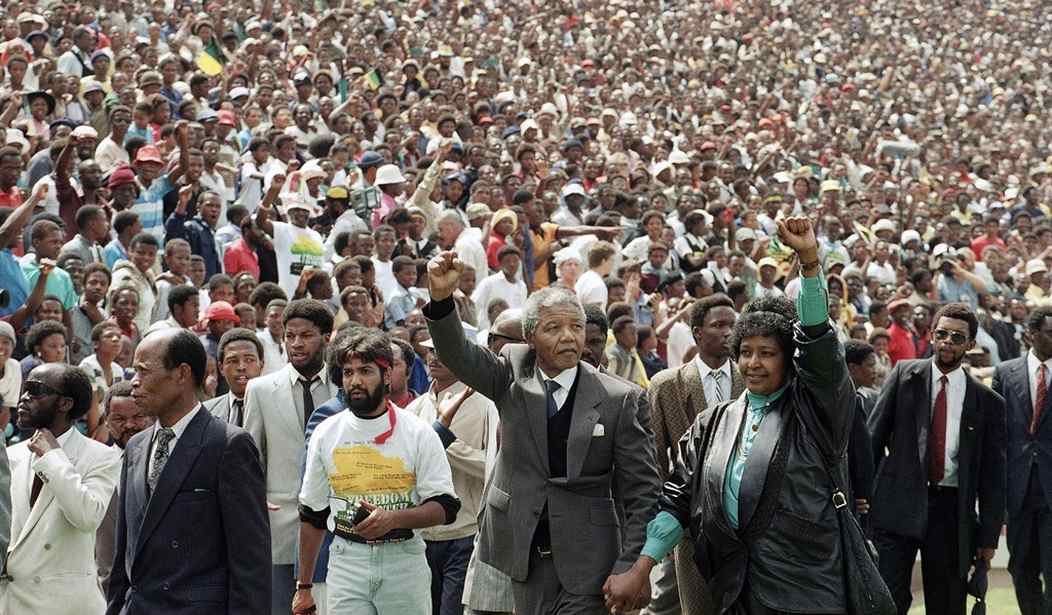
The second event that brought tears of joy to many South Africans, white and black, was Nelson Mandela's release from prison on Feb. 11, 1990, after 27 years. This event accelerated negotiations to transition the country to a multiethnic democracy.
People watching all over the world knew that this was the beginning of the end of apartheid in South Africa. Given the struggle against apartheid during the previous decades, the lives lost, the pain and suffering endured by the people, the moment was as poignant as any that I ever experienced.
Fast forward to today, and all that hope, all of that joy, has melted away. South Africa never became a "multiethnic" nation with equality and prosperity for all. Instead, the African National Congress chose to "redress" grievances and created a society that "included affirmative action, land reform, and 'black economic empowerment,' among others," write City Journal's Chris Rufo and Ryan Thorpe.
Three decades later, the South Africa model is being replicated in an unlikely place: California. The state’s leaders have increasingly embraced a radical, race-based vision of politics that echoes South Africa’s post-apartheid experiment in racialized government.
For much of the twentieth century, California was a refuge for those fleeing the racism and discrimination of the Deep South. During the Great Migration’s second wave, black families set up in Los Angeles, Oakland, and San Francisco, seeking middle-class jobs and a better life for their children. California was seen by many as a utopia, with stunning physical beauty, abundant economic opportunity, and a political culture that embraced individualism and meritocracy, rewarded risk taking, and upheld the equality of all people under the law. That era is over.
This City Journal investigation—based on an extensive review of government records, reports, and legislation, as well as interviews with leading legal scholars—reveals that during the past 15 years of one-party rule, California Democrats have worked tirelessly to import South Africa’s post-apartheid playbook to the Golden State.
During the administration of Governor Gavin Newsom, California’s racialist project has kicked into high gear. Race is becoming an organizing principle of public policy, shaping everything from education and data collection to bureaucratic decision-making and wealth redistribution. South Africa sorted its citizens by race to deny rights, and now California does the same to distribute benefits.
"The road between Pretoria and Sacramento is shorter than you would think," write Rufo and Thorpe.
Newsom could have been transplanted into South Africa's racialist government, given the similarity of his policies to the ANC's program. Rufo and Thorpe write, "In California, the governor emphasized the need to 'address disparities for historically underserved and marginalized communities.'"
"In South Africa, the government sought to 'remove discriminatory barriers of the apartheid past,'" Rufo/Thorpe observe. "Both created a permanent bureaucracy devoted to the racial transformation of society: South Africa launched the Broad-Based Black Economic Empowerment Commission to 'enhance the economic participation of black people'; Newsom’s executive order established a Racial Equity Commission to develop a whole-of-government Racial Equity Framework.'”
Newsom’s executive order was predicated on the notion that racial disparities are presumptive evidence of systemic discrimination. That notion is increasingly embedded across California government: Newsom stacked the Racial Equity Commission atop a sprawling, preexisting DEI infrastructure that had already metastasized across public institutions. It is not an exaggeration to say that California’s public institutions—from state government down to school classrooms—have been infected by racialist ideology.
Take, for example, the California Arts Council, a state grant maker that distributes funds to local art projects. In 2021, CAC published a training deck to help its members identify “the relationship between government, white supremacy culture, and racial equity practices.” CAC’s racial equity page defines “racial equity practices” as “closing the gaps so that race no longer predicts one’s success,” and claims the “power elite” in the American colonies—and apparently the modern U.S.—“constructed white supremacy (and construct it still) to define who is fully human and who is not.”
The arts, education, and every other facet of government were besotted with racialist dogma. Some of it was beyond belief.
R. Tolteka Cuauhtin was co-chair of the committee tasked with developing the new curriculum. As one of us reported in 2021, Cuauhtin has argued that the United States was founded on a “Eurocentric, white supremacist (racist, anti-Black, anti-Indigenous), capitalist (classist), patriarchal (sexist and misogynistic), heteropatriarchal (homophobic), and anthropocentric paradigm brought from Europe.”
Gavin Newsom's California reparations task force came up with 14 bills that would right the wrongs of the past and bankrupt the state. Newsom said he would have vetoed the bills if they reached his desk. Since the state was in the midst of a budget crisis in 2024, the reparations bills died abornin'.
“I don’t think California’s legislators have been terribly committed to pretending to use racial proxies [as other states do],” Dan Morenoff, the executive director of the American Civil Rights Project, said. “By and large, the California legislature doesn’t play that game. They are very transparent in telling you what they are doing: ‘We are creating a benefit for a particular race’. . . . I always work with the rule of thumb that if the California Legislature is in session, someone is proposing some insane identitarian proposal that is obviously unconstitutional. And I can’t think of a single instance where I’ve been proven wrong.”
Democrats in the state are looking to repeal Proposition 209, which forbids racial discrimination in public programs. It doesn't matter. Democrats want their own proposition, even though the U.S. and California Constitutions make discrimination based on race illegal.
“What we’re saying is we don’t care what the constitution says," claims State Assemblyman Corey Jackson. At least he's honest.
"No matter how much wealth is seized, no matter how much government spending is redirected to favored racial groups, outcomes in the real world will never look the same as a Census table," write Rufo and Thorpe. "These policies failed in South Africa, and they will fail in California, too."
A warning that will go unheeded by people who aren't interested in "equality" or even "equity." This is the racial reckoning that 1960s racial radicals like Huey Newton and Eldridge Cleaver longed for. Gavin Newsom and his crew of racialist thugs are making it happen.