


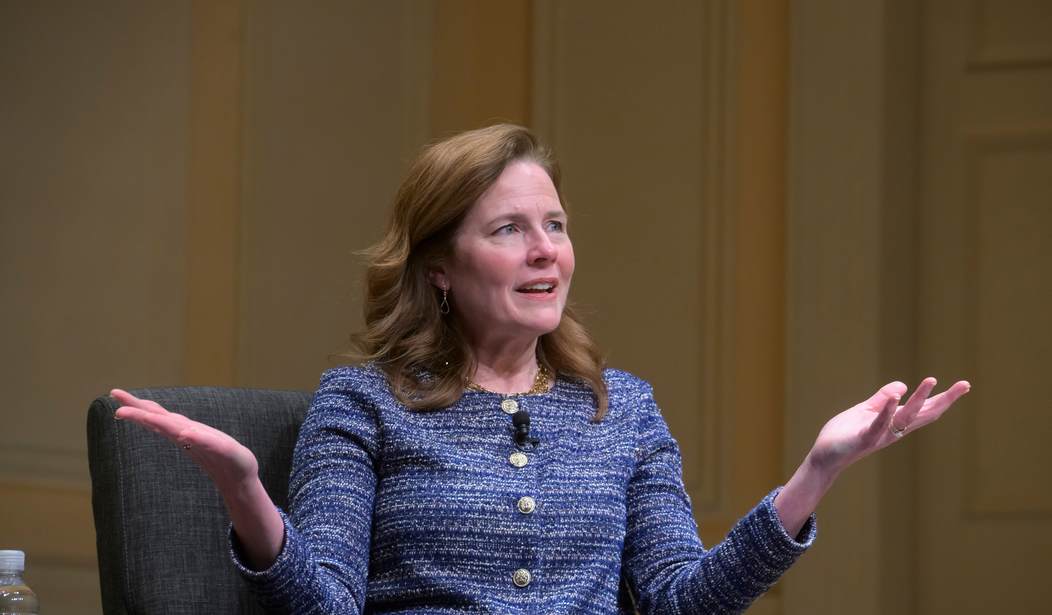
Amy Coney Barrett's 12-year-old son looked at the body armor and asked the question no kid should ever have to ask: why did his mother need the bulletproof vest?
The associate justice told Congress that Supreme Court police sent her home wearing one after threats surged following the 2022 leak of the draft opinion that overturned Roe v. Wade.
Barrett had accepted a public duty, but her children were learning the cost.
The danger followed them home again in May, when a caller falsely claimed gunshots and raised voices were coming from Barrett's house, sending local police racing to the scene.
One of her teenage sons opened the door and found the street filled with officers. Supreme Court police intercepted them before a lie built for chaos became something worse. From the Associated Press:
The appearances from Supreme Court Justices Amy Coney Barrett and Elena Kagan were the first of their kind since 2019. Their testimony came weeks after the conservative-majority court handed down a series of major opinions, including one that increased President Donald Trump’s power over federal regulatory agencies and one that rejected his wide-ranging tariffs. Those rulings and more sparked harsh personal criticism of the justices.
The main focus of the hearings in the House and Senate was a request for increased security funding for the justices. Like judges around the country, they’ve faced a surge in threats of violence and intimidation.
Barrett said she had to take a bulletproof vest home a few years ago, something she struggled to explain to her 12-year-old son. “I didn’t expect that performing this service would put me in the position of explaining to my children what a bulletproof vest was, why I had to wear one,” she said.
Barrett and Associate Justice Elena Kagan appeared before Congress to seek a roughly 10% increase in the Court's budget. The request totals $228 million for the next fiscal year. About $14.6 million would expand personal protection, adding six agents for each justice. Kagan said threats rose 25% last year and are expected to climb another 38% in 2026.
The problem reaches far beyond nine justices. The U.S. Marshals Service recorded 564 threats against federal judges in fiscal 2025. Through July 1, 2026, investigators had already recorded 370 threats involving 276 judges. Hostile communications rose more than 50% during fiscal 2025, while 808 incidents raised concern about possible danger or violence.
Chief Justice John Roberts warned in his 2024 year-end report that hostile threats and communications directed at judges had more than tripled over the previous decade.
Marshals investigated over 1,000 serious threats in five years. Judges and justices appointed by presidents from both parties have watched political fury move from speeches and social media into their driveways.
Some threats are designed to prove that a stranger knows where a judge sleeps. Federal judges have received pizzas and anonymous deliveries sent in the name of Daniel Anderl, the son of U.S. District Judge Esther Salas.
A gunman posing as a delivery driver murdered Daniel at the family's New Jersey home in 2020 and wounded his father. Barrett told lawmakers that she had received intimidating deliveries carrying Daniel's name.
Violence has already reached the Supreme Court's doorstep. Nicholas Roske traveled to Maryland in 2022 with a pistol, ammunition, zip ties, and burglary tools near Associate Justice Brett Kavanaugh's home. He pleaded guilty to attempted murder and received a 97-month federal sentence in October 2025.
Security funding can't become protection from criticism. Americans remain free to condemn rulings, question judges, demand ethics reforms, and argue that a court got the law wrong. Political leaders also carry a duty to stop turning judges into personal enemies whose homes and families become targets.
Kagan clearly drew the line when she warned against attempts by public officials of any stripe to intimidate judges. From Reuters:
Amid ethics scrutiny, the Supreme Court in 2023 adopted its first code of conduct, though critics said it lacked meaningful enforcement because it left recusal decisions to the justices themselves and created no enforcement mechanism.
Kagan reiterated on Tuesday her support for creating a judicial panel to enforce the justices' compliance with the court's ethics code, saying such a mechanism would help ensure public confidence in the court. The justices are taking the code seriously and "making every effort – and I think successful efforts – to live by it," she added.
Barrett said she was "less certain" about the need to create a means to enforce the ethics code, citing various complexities such as who would select the members of the enforcement panel.
Congress can debate spending details, staffing levels, and oversight. It shouldn't haggle over whether judges and their children need protection from swatting calls, armed attackers, and anonymous packages meant to terrify them.
Barrett's son should've been asking about school, sports, or dinner. Instead, because of the violent rhetoric that's been coming from leftist mouths, he has to learn why his mother needed armor to come home from work.
Threats against judges reveal how quickly political anger can become personal intimidation. PJ Media VIP follows the facts past the day’s talking points and holds every side to the same standard. Join today and save 60% with promo code FIGHT.




Join the conversation as a VIP Member