





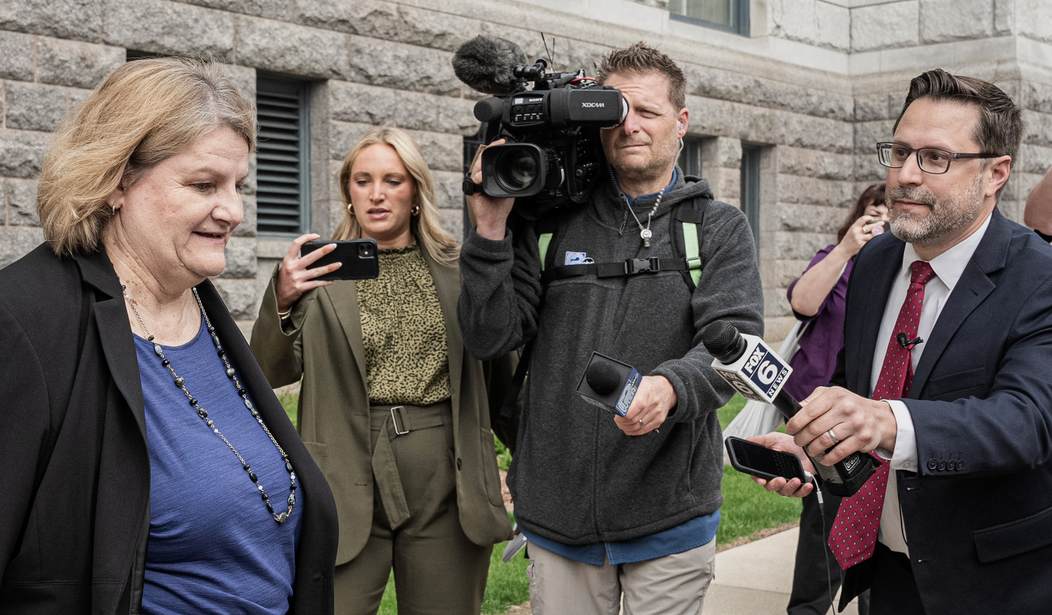
Former Milwaukee County Circuit Court Judge Hannah Dugan just discovered a remarkable sentencing principle: Commit a felony, lose at trial, watch the conviction survive post-trial motions, face a guideline range of 15 to 21 months, and still walk out without prison, probation, and a $5,000 fine.
BREAKING: Former Milwaukee County Judge Hannah Dugan has been sentenced to no prison time after she was found guilty of obstructing ICE agents from arresting an illegal alien in a courthouse last year. Federal judge Lynn Adelman (Clinton appointee) has just ordered Dugan to pay a… pic.twitter.com/RudVgCUPlt
— Bill Melugin (@BillMelugin_) July 8, 2026
Regular defendants may want to write down the magic words before the courts patch up the loophole: Otherwise good person. I hope you were sitting down for that.
U.S. District Judge Lynn Adelman sentenced Dugan on Wednesday after a federal jury convicted her in December of obstructing an ICE arrest at the Milwaukee County courthouse.
Dugan was acquitted of a separate count accusing her of concealing Eduardo Flores-Ruiz from arrest, but the felony obstruction conviction stood. The official court page lists the case, the trial's conclusion, and the July 8 sentencing.
So the question isn't whether the system had enough process; it had plenty. It just reached a result that smells like one menu for the powerful and another one for everybody else.
Flores-Ruiz, a Mexican national, was in court on misdemeanor domestic assault charges when federal immigration agents arrived to arrest him. Prosecutors said Dugan helped him leave through a non-public courtroom door, which turned a planned courthouse arrest into a foot chase outside.
Their sentencing memo argued Dugan used the power and prestige of her office to obstruct federal agents and placed the interests of a criminal defendant above the rights of his alleged victims.
Here's where the cornbread legal system starts rising in the pan. Prosecutors said Dugan understood the justice system better than the average defendant, citing statements suggesting she knew she was crossing the line. From Reuters:
U.S. District Judge Lynn Adelman noted Dugan's long history of public service in deciding to spare Dugan from prison.
"The punishment should fit the offender, and not merely the crime," Adelman said during a hearing in Milwaukee federal court, adding that Dugan "made a bad decision in the moment."
Dugan was convicted of obstructing a federal proceeding and cleared of a lesser charge of concealing a person from arrest following a federal trial in December. Prosecutors said she helped a Mexican migrant sought by federal agents leave through a non-public courtroom door.
The migrant, who was scheduled to appear in her courtroom on misdemeanor assault charges, left by a “jury door” to avoid federal agents who were positioned in a hallway outside her courtroom.
The migrant, Eduardo Flores-Ruiz, walked through a public hallway with his attorney and was arrested outside the courthouse following a brief foot chase.
In addressing the court prior to the sentencing, Dugan said her prosecution was politicized.
"I was a public servant who was just trying to do my job," she said.
Federal prosecutors did not make a specific sentencing recommendation but had argued that federal guidelines called for between 15 and 21 months in prison.
“Rather than uphold the rule of law, the defendant used the power and prestige of judicial office to obstruct federal agents carrying out their lawful duties in order to help an individual evade arrest,” prosecutors wrote in a sentencing memorandum.
The sentence should reflect the “serious nature of her conduct and its broader impact on the justice system,” prosecutors wrote.
They also told the court that similarly situated defendants in 935 administration-of-justice cases since 2015 received an average sentence of 16 months and a median sentence of 10 months.
Dugan got neither. Not a month, week, or night.
Her defense made the case for mercy. Dugan is 67, has no prior record, lost the judgeship she loved, and served the community for decades. Her lawyers argued the offense was isolated, unique, and not capable of being repeated because she had resigned from the bench. They also argued the guideline range overstated the seriousness of the conduct and that a lower range would apply if the case were viewed differently.
I'm not a fan, but fine; judges can consider age, history, service, remorse, risk, deterrence, and collateral consequences. A sentencing courtroom isn't a vending machine: push felony, receive prison.
But sentencing also tells the public what the law means when the defendant once wore the robe. If a judge can obstruct federal agents and then avoid prison because she's otherwise decent and upset by immigration policy, every courthouse lecture about accountability gets a little harder to swallow.
Adelman described Dugan as an otherwise good person who made a bad decision while upset by immigration policies.
Wonderful.
Somewhere out there, a defense lawyer just heard angels sing. “Your honor, my client is also a good person. He was just upset by tax policy, bank policy, drug policy, border policy, the thought of dogs loving mail carriers while living with cats, or whichever law ruined his Wednesday. Please update the jury instructions accordingly."
The worst part isn't mercy; mercy can be noble when paired with the truth. The worst part is selective tenderness dressed up as wisdom. Ordinary people are routinely told that intent, stress, frustration, and good deeds don't erase criminal conduct. They hear that a sentence must promote respect for the law, that deterrence counts, and that the process has consequences.
Then a judge commits a felony tied to her official power, and suddenly the system finds poetry in restraint.
Nobody should want cruel sentencing. Conservatives, of all people, should know government can overcharge, overpunish, and ruin lives. But equal justice can't mean leniency for the credentialed and iron for the rest.
A judge who breaks the law from the bench hasn't merely made a private mistake; she's damaged the very promise she once had a sworn duty to protect.
Dugan may think she acted from compassion or courtroom concern. The jury didn't buy enough of it to clear her. The conviction remains, and the fine is now due.
But any opportunity of a prison sentence disappeared. If “nobody is above the law” still means something, the public deserves to see it when the defendant already knows every hallway in the courthouse.
PJ Media VIP is for readers who still believe the powerful deserve scrutiny, not applause. Get deeper analysis, exclusive columns, and independent conservative coverage the corporate press won’t give you. Use promo code FIGHT for 60% off.



Join the Conversation
VIP members get the ability to comment on articles.