


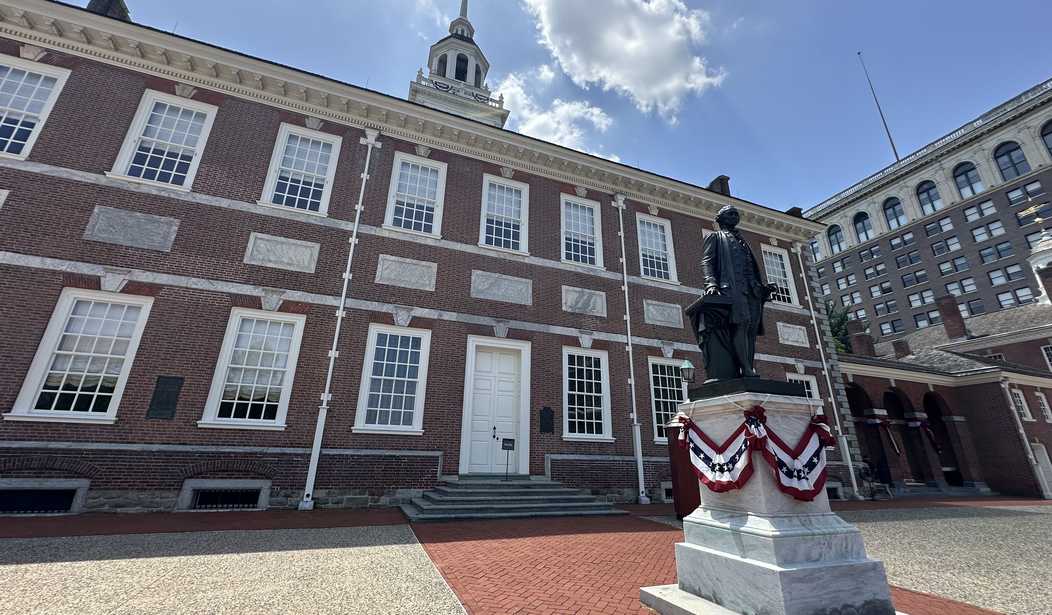
A visitor standing near the Liberty Bell should hear the truth about George Washington's household, including the slaves who lived in the President's House in Philadelphia.
A nation strong enough to face its past shouldn't flinch from slavery, hypocrisy, or human suffering. Yet a nation honest enough to tell the truth also has to tell the whole story.
A federal appeals court today allowed President Donald Trump's administration to reinstall new interpretive panels at the President's House Site in Independence National Historical Park. From the Associated Press:
The signs would be in the same area where the Declaration of Independence was adopted on July 4, 1776. A message seeking comment was left Friday with the National Park Service.
The new educational panels were designed to replace ones put up in 2010 that told the story of how nine slaves lived in the home along with George and Martha Washington in the 1790s, when Philadelphia was briefly the nation’s capital.
Their removal stemmed from Trump’s 2025 executive order calling for federally owned or controlled historic sites not to display information to “disparage Americans past or living” and to focus on the “greatness of the achievements and progress of the American people.”
Friday’s ruling from a three-judge panel of the U.S. 3rd Circuit of Appeals, which is based in a courthouse across an intersection from the President’s House site, was a technical one to allow implementation of a ruling made last month.
The earlier panels, installed in 2010, focused heavily on nine slaves who lived there with George and Martha Washington in the 1790s, when Philadelphia served as the nation's capital.
The legal fight started after the National Park Service removed the exhibit in January. Philadelphia sued, arguing the federal government had broken agreements tied to the site. From Reuters:
The Democratic-led city of Philadelphia sued, arguing that the exhibit's removal breached agreements with the city that gave it a right to be consulted on alterations and matters of importance to the park.
U.S. District Judge Cynthia Rufe agreed, granting the injunction. But U.S. Circuit Judge Thomas Hardiman, writing for a three-judge 3rd Circuit panel, concluded that the exhibit's removal did not legally constitute an “agency action” subject to court review under the federal Administrative Procedure Act, which governs agency rules.
Hardiman, who was appointed by Republican President George W. Bush, said the National Park Service has presented plans to install replacement panels that are “full of historical context,” discussing the nine enslaved people while stating Washington often expressed a desire to see slavery abolished.
“They acknowledge the evil of slavery, including its injustices and hypocrisies, and, by telling the story of the nine slaves that Washington kept in the President's House, remind us of their essential humanity,” Hardiman said.
A spokesperson for the Interior Department, which oversees the National Park Service, issued a brief statement after Thursday's decision: “Trust in Trump.”
Philadelphia Mayor Cherelle Parker, a Democrat, in a social media post vowed to “pursue every legal action possible to reverse this decision.”
“We cannot and WILL not rest until the full story of American history – including the existence of Slavery at the President’s House here in Philadelphia – is told, for our Nation and the World to see,” she wrote.
U.S. Circuit Judge Thomas Hardiman wrote for the 3rd U.S. Circuit Court of Appeals that the lower court was wrong to block the federal government. The court found the city's old agreement didn't give it control over the exhibit after ownership and management passed to the National Park Service.
The ruling doesn't give anyone a license to erase slavery; the proposed panels still discuss the nine slaves, the abolitionist movement, slavery under the Constitution, Pennsylvania's gradual end of slavery, Washington's conduct, John Adams's opposition to slavery, and the Civil Rights movement.
Hardiman wrote that the panels acknowledge slavery's evil and remind visitors of the humanity of the enslaved.
That's where the real fight begins.
The left's version of history too often narrows America until only the wound remains. Slavery becomes the key to every door, the answer to every question, the final word on men who built a republic that later had the moral tools to destroy slavery.
A republic born flawed still gave the world a Declaration, a Constitution, a Bill of Rights, a Civil War sacrifice, and a long struggle toward equal protection under the law.
President Trump's Executive Order 14253, “Restoring Truth and Sanity to American History,” directs federal sites to focus on American achievement, progress, liberty, prosperity, and human flourishing.
Interior Secretary Doug Burgum later issued Secretarial Order 3431 through the U.S. Department of the Interior to carry that policy into federal sites, including public monuments, memorials, statues, markers, and national parks.
Critics call the move censorship, of course. Many of them had little problem when exhibits, schools, and museums turned American history into an indictment with a flag attached.
They want slavery treated as the master narrative, pardon the pun, with everything else forced to kneel before it.
The country deserves better than a history lesson written like a verdict before the trial begins.
George Washington owned slaves; he also led the army that won independence, presided over the Constitutional Convention, set the model for peaceful executive power, and left office when he could've chased more of it. His life carries contradiction, sin, restraint, duty, and greatness.
Reducing him to one crime doesn't make history deeper; it makes it smaller.
Philadelphia Mayor Cherelle Parker has vowed to keep fighting the changes. She has every right to argue for a fuller telling of the site. The Trump administration has every right to argue that federal historic places shouldn't teach children to despise the country they inherited.
America's 250th birthday shouldn't become a national struggle session. Slavery must be named, but so must courage, sacrifice, invention, law, faith, repentance, and the slow, bloody work of becoming better.
A country that tells only its sins teaches shame.
A country that tells only its victories teaches vanity.
America's story is much larger than both and far larger than the left's version of it.
PJ Media is running a special right now. Get 74% off with promo code FIGHT and help keep independent conservative voices in the fight.


Join the conversation as a VIP Member