



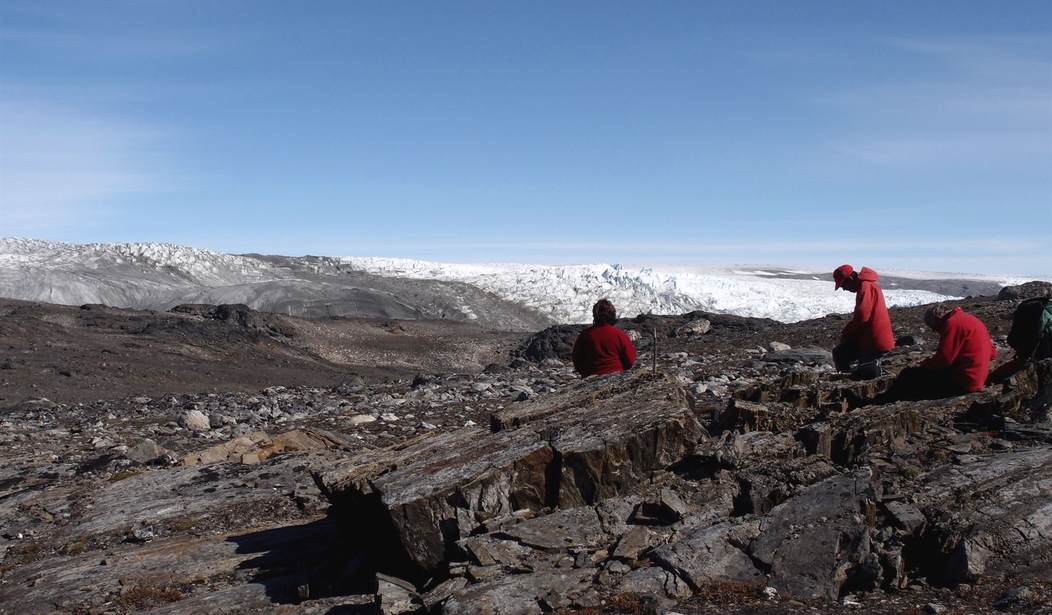
Something strange happened in September 2023, deep within Greenland's icy wilderness. Seismic stations around the world picked up a signal that wouldn’t fade: unlike a normal earthquake, it didn’t spike and vanish. Instead, it pulsed, repeated, and continued for nine straight days.
Scientists at the Geological Survey of Denmark and Greenland (GEUS) first noticed the pattern. Seismologist Kristian Svennevig began tracking the data, which looked steady, nearly musical. Where there should've been a violent jolt, the Earth seemed to hum a single tone.
The mystery deepened because no traditional earthquake was recorded, no tectonic plates slammed together, and no fault line slipped. Despite all that, instruments from Alaska to Australia showed the same slow rhythm.
Eventually, investigators traced the source to Dickson Fjord in eastern Greenland; a massive section of that mountain decided to take a swim: it fell into a narrow fjord. Rocks weren't just sent swimming; the event displaced an enormous amount of seawater instantly.
That sudden movement created what scientists call a megatsunami.Unlike tsunamis caused by offshore earthquakes, this one was the result of a landslide, and the wave heights likely exceeded what the nearby terrain could withstand. Luckily, it's a remote region with no towns sitting in its path.
But here's where things became interesting.
Instead of a giant wave rolling outward and fading, the water inside the fjord began to slosh back and forth, like your uncle at a cousin's wedding, holding his 5th Jack-and-Coke. The water hits one end, then rebounds to the other. In a narrow fjord, that motion continues for a long time.
Researchers determined that the fjord acted like a natural basin, with the water displaced repeatedly oscillating, creating a standing wave. Each surge pushed against the fjord walls, transferring energy into the surrounding rock and through the Earth as a low-frequency seismic signal.
Earth didn't simply shake once: it resonated.
That back-and-forth motion continued for nine days, with each oscillation sending another pulse through the planet's crust, with a steady tone seismic sensors recorded at around 11 millihertz, far below the range of human hearing—thank God. To scientists, however, that was a clear pattern that just stood out.
Scientists later confirmed the landslide using satellite imagery, which showed fresh scars on the mountain slope, and NASA and the European Space Agency also provided satellite data that captured the aftermath from space.
The event is linked to Arctic warming, during which glaciers retreat and erode support from steep mountain slopes. Without having that icy slope to lean on, slopes become unstable. As temperatures rose over the past few years, the number of landslides increased.
Around Dickson Fjord, the fjord system has already been seeing signs of change: melting ice, thawing permafrost, and shifting rock layers created a fragile balance. When the mountain finally gave way, the consequences echoed far beyond Greenland's coast.
Now, scientists view the event as both a geological curiosity and a warning. Remote regions still produce global signals, and as the climate changes—something that's been happening for what, 4 billion years?—landscapes are altered in ways that even seasoned researchers might not expect.
What makes the story so gripping isn't just the science, but the detective work. A strange hum appeared in the seismic data, but not for us meatsacks. Experts searched for the source, ruling out earthquakes, studied maps, satellite images, and wave models. Piece by piece, using clues where possible, they solved the puzzle.
Our Earth feels silent and solid beneath our feet. Yet beneath that calm surface, forces are constantly moving. In Greenland, a single mountainside collapse turned a quiet fjord into a giant tuning fork, carrying a sound for over a week, a tune that the Earth carried.
Sometimes, the loudest mysteries arrive as whispers that refuse to fade.