


One of the more lame arguments against the Second Amendment by leftists is that the founders never intended to give everyday Americans the right to the same sort of weaponry the government possesses.
You don’t need a gun with a mag that holds more than 12 bullets. You don’t need a rifle that looks like one our troops used over in Afghanistan or Iraq. Guns are for hunting, recreational, or self-defense purposes only. Of course, how the left defines those three categories is very narrow.
If you study the types of guns the patriots used to fight the Revolutionary War, you’ll see that the founders at the time were not on the same page as your blue-haired cousin with the nose ring from this era.
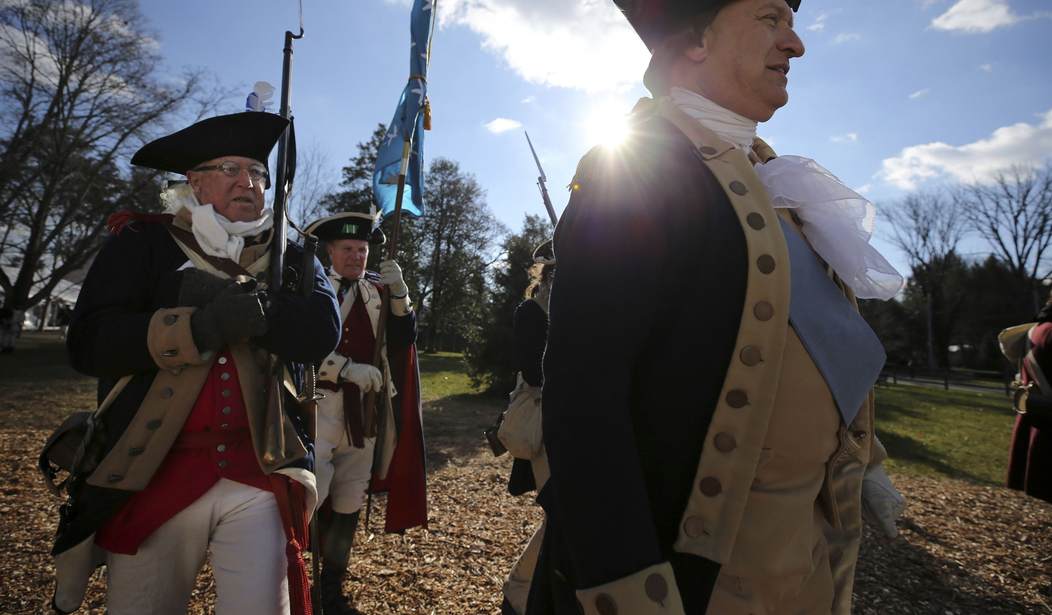
The cornerstone of the American arsenal was the flintlock musket. To wage war against the British Empire, the patriots used a combination of weapons they captured from the enemy, procured from the French, and made in America. Because the continent was largely a frontier, and this was the 1770s, the gun was often a survival tool, and it was every bit as lethal as the ones carried by British soldiers.
In contrast to most Europeans from the larger, more developed cities in the 18th Century, for most Americans, the gun was a symbol for self-reliance and independence.
The Brown Bess
Perhaps the most common gun the patriots used was called the “Brown Bess,” which was the standard musket of the British Army. They were not hard to come by, and for the time, they were the standard for their class. There are no statistics, but according to historians, it’s possible that more than half of the patriots took the Brown Bess into battle against the British regulars.
The gun had a smoothbore flintlock musket that usually fired a .75 caliber lead ball. At five feet long and roughly ten pounds in weight, it was a staple on the battlefield. The gun was made under a government contract in London and Birmingham and shipped to the British Army in the colonies.
During the runup to the war, colonial militias already had supplies of Brown Bess muskets because Great Britain had provided them to locals for defense during earlier conflicts, like the French and Indian War.
When fighting started at Lexington and Concord in 1775, colonial militias seized British weapon stockpiles. Throughout the war, patriots also captured muskets from British soldiers on the battlefield.
While the Brown Bess was sturdy and relatively reliable, it was not accurate beyond 100 yards because of its smooth barrel. Still, generals liked it because it was durable and compatible with standard British ammunition.
France’s Charleville musket
By 1778, with France formally joining the war, foreign aid gave patriots access to new weaponry, the most important of which was the French Charleville musket. It was manufactured in French royal armories that included Charleville, Saint-Étienne, and Maubeuge. After its debut, the gun became the backbone of the Continental Army’s arsenal.
The patriots liked the Charleville better than the Brown Bess because it was lighter and felt more balanced. It usually fired a .69 caliber ball and featured a smoother mechanism. To be sure, the Charleville found its way into the Continental Army before 1778 and grew in popularity throughout the ranks of the army from the very beginning. All told, France shipped tens of thousands of French muskets to America throughout the war.
This helped standardize the Continental Army, from the kinds of ammunition it stocked to the kind of training it provided to soldiers. The Charleville musket became the model early American firearms makers used to design and build the first official U.S. military muskets produced after the war.
American gunsmiths and armories
If not the first, the most notable early American military gunmaker was the Springfield Armory, which was established in 1777. While it did not make muskets in massive numbers during the war, it was a critical gun storage and repair facility, and it laid the foundation for future national arms production.
Prior to independence, the colonies had no large-scale arms factories on a par with European armories. Guns were crafted by local gunsmiths who worked in small shops. Still, some regions were known for skilled firearm production. Virginia and Pennsylvania were two of those regions.
In addition to muskets, some troops used rifles. The Pennsylvania long rifle was the standard. Unlike muskets, rifles had grooved barrels that caused bullets to spin, greatly improving accuracy. Those first rifles weren’t as easy to load, so muskets remained the mainstay for most soldiers.
The Continental Army frequently ran into problems due to the variety and diversity of guns used by the troops. American-made muskets were usually produced in limited quantities and varied in design. The lack of uniformity sometimes created problems, particularly with the need to stock equally varied forms of ammunition to match the guns on hand.
Loading a flintlock musket could be problematic. You needed gunpowder, wadding, and a lead ball. A well-trained soldier could fire three shots per minute under ideal conditions. Because smoothbore muskets were inaccurate at long range, armies relied on massed volleys. They had to get closer to the enemy, stand in lines, and fire simultaneously to increase the likelihood of hitting the enemy.
Bayonets turned these muskets into formidable hand-to-hand combat weapons as well. Early in the war, the patriots lacked enough bayonets and training in their use to be effective in close quarters. But once the French joined the war in 1778, American soldiers started to become quite proficient in their use.
Due to the nature of the guns used, 18th-century warfare was often chaotic, exacerbated by the sheer amount of smoke created every time a line fired off a volley. Still, you can’t underestimate the psychological impact of the noise and its volume, the concussion and the vibration, the smells, and the sights of war would have on each individual soldier.
Early on, the patriots did not go into battle as well-trained or equipped as their British foes, but that would change incrementally, every time a Brown Bess would drop to the ground and be recovered by a patriot. That would change as the Americans got better organized and better funded. Soon enough, the Americans were fighting against the British with equal or greater firepower, using the same weapons the enemy was using, demonstrating what the Second Amendment was really all about.
Recommended: ‘America 250’ Tuesday: Robert Morris Was the Revolution's Money Man