I mean, out of focus would be silly, right? Play the music.
Certainly this one is in focus. Is there a Pulitzer for astrophotography?
I took 1.7 million photos over 6 days to catch this photo of a commercial jet in front of the sun.
— Andrew McCarthy (@AJamesMcCarthy) May 14, 2026
The moment it happened, TWO floating prominences were visible, making this not just my best aircraft transit photo, but one of the luckiest of my career! Videos of the transit 👇 pic.twitter.com/H3BdeZNYGT
Let's get a closer look.
That’s not even full resolution 😏 pic.twitter.com/N93C9vwtKZ
— Andrew McCarthy (@AJamesMcCarthy) May 15, 2026
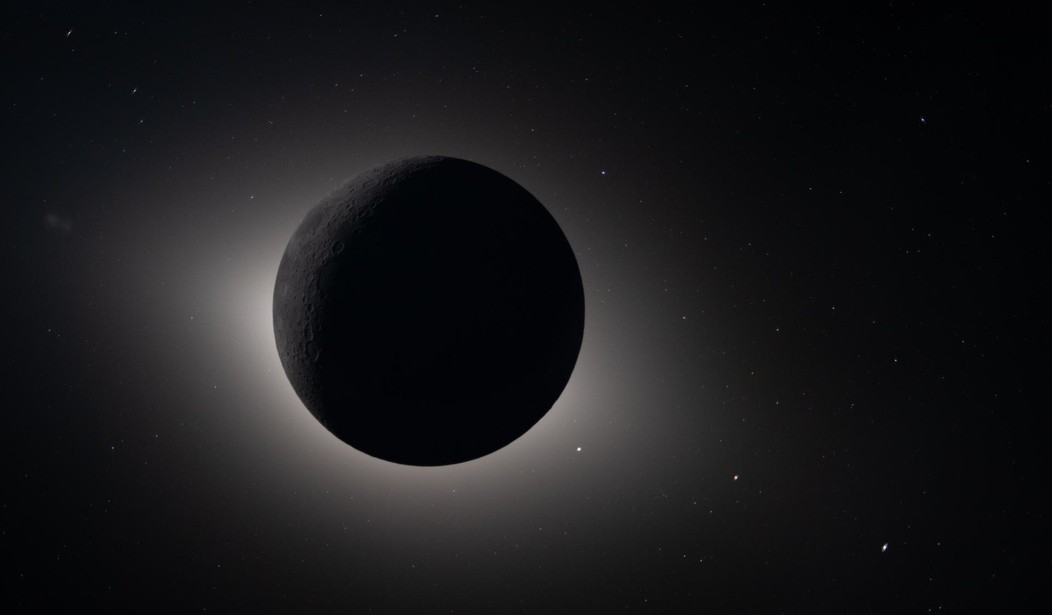
Some more color shots of the lunar far side. As I described last week, this isn't the color you would see with the naked eye, which has really limited exposure time. This is a composite of many shots to bring out the colors. I'd really like to know what the colors are seeing.
The stunning color of the far side of the moon, photographed by human hands for the first time since 1972. Advancements in digital photography over the last 54 years gives us a much better look at the moon's battered history.
— Andrew McCarthy (@AJamesMcCarthy) May 13, 2026
Photos captured by @astro_reid, processed by me. pic.twitter.com/FyGcvtGkBY
NASA's Artemis 2 commander and astrophotographer team up to capture breathtaking, never-before-seen shots of the moon's far side https://t.co/K1XRKBkIuz
— SPACE.com (@SPACEdotcom) May 9, 2026
Y'know, I'm so old I remember when we wondered if there were other planets than those in our solar system, and expected if there were they would be very much like our own.
Let's get weird with it.
— NASA Goddard (@NASAGoddard) May 11, 2026
We've confirmed more than 6,000 exoplanets, planets beyond our solar system. Some orbit with the same kind constantly facing their star; some don't orbit a star at all. But those are just the start. Meet some of @NASAHubble's weirdest exoplanet finds. pic.twitter.com/ekJoCw4oJX
And honestly, we didn't have any idea how wild and varied our own solar system was. I remember my disappointment when the first Mariner photographs of Mars didn't show any canals (I had just read Heinlein's Red Planet.) And all we knew of Neptune was that it was a dot.
For the first time ever, JWST has detected auroras on Neptune. After more than 30 years of eluding detection from Earth, Neptune’s faint polar glow has finally been caught by the James Webb Space https://t.co/lnXw2FMXJ7 observations made in June 2023, JWST’s near-infrared camera… pic.twitter.com/Hng1RcGqYI
— Black Hole (@konstructivizm) May 10, 2026
And it took a Nobel Prize to even be able to take these.
This image taken by @NASAHubble was only possible thanks to physics laureates George Smith and Willard Boyle who invented the CCD sensor – which allowed us to capture light electronically instead of on film.
— The Nobel Prize (@NobelPrize) May 10, 2026
Photo: The Hubble Space Telescope's image of the star V838 Monocerotis. pic.twitter.com/O1altu3uLk
The Webb telescope is even wilder. The "rays" are artifacts of the telescope, but that's a Seyfert galaxy, one variety of an active galactic nucleus.
Messier 77 (M77, also known as NGC 1068 or the Squid Galaxy) is a classic example of a Seyfert galaxy—specifically a Type II Seyfert.Key details:This active nature is exactly why the recent JWST images highlight its brilliant core and dust lanes so vividly.
- It's a barred spiral galaxy with a very bright, active galactic nucleus (AGN) powered by a supermassive black hole accreting material. This makes its core exceptionally luminous in X-rays, ultraviolet, and infrared.
- M77 is one of the brightest, closest, and best-studied Type 2 Seyfert galaxies, serving as a prototype for the class. In Type II Seyferts, the broad emission lines from the central engine are obscured (often by a thick torus of gas and dust), unlike the more directly visible Type I.
- It's located about 45–47 million light-years away in Cetus and stands out for combining proximity with dramatic activity, including strong star formation in its arms.
🚨 NASA's James Webb Space Telescope just dropped a new image of galaxy M77 pic.twitter.com/0M8C2uXeTx
— Latest in space (@latestinspace) May 9, 2026
Here's something else we would never see with the naked eye because a good bit of this is X-ray light. So this is false-colored to bring out the details.
A-meow-zing 😻@NASAWebb and @ChandraXray joined forces to deliver this view of the Cat's Paw Nebula. Different wavelengths combine to reveal young stars at the center of these dusty clouds. pic.twitter.com/hYYBrJ9zh5
— NASA (@NASA) May 8, 2026
Now, this one's only excuse is that it's pretty.
A breathtaking long-exposure shot captures the shimmering Milky Way stretching across a deep indigo night sky. Below, lush green trees and rolling hills are softly illuminated by a warm, golden glow from an unseen foreground light, creating a serene contrast between earth and the… pic.twitter.com/qa8AZO8SeG
— Stellarix (@Stellarixorine) May 12, 2026
Billions of stars, and each star probably has at least one planet.
M51 la Galassia Vortice nei Cani da Caccia, un ora di esposizione con RC 8” e ZWO ASI585MC-Air su Vixen GPDX. #astronomy #astrophotography pic.twitter.com/pSQ8G2sWfY
— Emilio Monelli (@monel1976) May 15, 2026
Almost 200 years ago, Eta Carinae exploded, and we're still seeing the shock.
A cosmic outburst 7,500 light-years away. This stunning Hubble Space Telescope image captures the fiery wreckage surrounding the massive and unstable star, Eta Carinae. The dramatic, two-lobed structure, known as the Homunculus Nebula, was created by a massive eruption in the… pic.twitter.com/bLoAaLzVRO
— Black Hole (@konstructivizm) May 15, 2026
The Sombrero Galaxy is always good for a look.
M104 Sombrero galaxy in Virgo constellation by Hubble telescope #NASA . pic.twitter.com/O7cEGbLoC3
— Julio Maiz (@maiz_julio) May 15, 2026
So many stars.
This isn’t static on a TV screen… it’s the Universe packed with stars ✨🌌
— The Astronomy Guy (@astrooalert) May 10, 2026
Every tiny point in this image is a real star shining somewhere deep in our galaxy — a breathtaking cosmic crowd captured by powerful space telescopes. Some stars glow icy blue because they’re extremely… pic.twitter.com/oqwddgZPjp
I love that song.
So that's it for this week. I hope you enjoyed it, and as always I love comments. Come back next week for more Sky Candy.