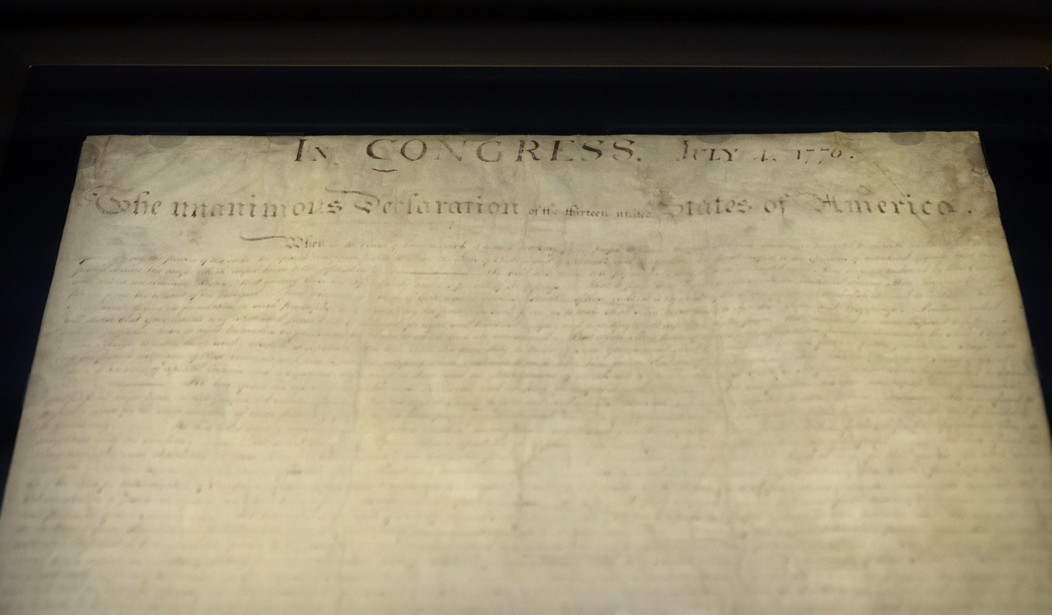
On July 8, 1776, Philadelphians gathered outside what is now Independence Hall to hear Col. John Nixon read the Continental Congress’s latest official proclamation: the Declaration of Independence.
Americans are — or at least, used to be — very familiar with certain lines of the Declaration, particularly: “We hold these truths to be self-evident, that all men are created equal, that they are endowed by their Creator with certain unalienable Rights, that among these are Life, Liberty and the pursuit of Happiness. —That to secure these rights, Governments are instituted among Men, deriving their just powers from the consent of the governed.” Perhaps we are so familiar we forget how revolutionary, in the truest sense, such a statement was.
Thomas Jefferson and the rest of the Committee of Five (Ben Franklin, John Adams, Robert Livingston, Roger Sherman) wrote that such rights were self-evident. In the sense that they are grounded in natural law, this is true.But to the extent that throughout all of history — even in republics like Rome’s — there was never official recognition of the equality in dignity of all men, by divine gift, the above statement was not self-evident. Jefferson was making a statement that most people around the world at the time would have considered insane. And yet now, in our day, so profoundly did America change the world that even dictators try to claim they believe in the equality and rights of all men.
Of course, there are also large parts of the Declaration of Independence that the overwhelming majority of Americans don’t read, especially the list of grievances against Britain. But the whole document is very important. The Continental Congress approved and later signed the Declaration specifically because the delegates wanted to explain not only to their fellow Americans, or even just to the British aristocrats across the ocean, but to the whole world why they acted thusly.
Related: America 250 Advice: Teach Kids History the Hands-On Way
Below are just a few of the grievances that Congress listed:
He [the king] has refused his Assent to Laws, the most wholesome and necessary for the public good …
He has refused to pass other Laws for the accommodation of large districts of people, unless those people would relinquish the right of Representation in the Legislature, a right inestimable to them and formidable to tyrants only … He has dissolved Representative Houses repeatedly, for opposing with manly firmness his invasions on the rights of the people … He has made Judges dependent on his Will alone, for the tenure of their offices, and the amount and payment of their salaries.
He has erected a multitude of New Offices, and sent hither swarms of Officers to harrass our people, and eat out their substance.
He has kept among us, in times of peace, Standing Armies without the Consent of our legislatures … For Quartering large bodies of armed troops among us:
For protecting them, by a mock Trial, from punishment for any Murders which they should commit on the Inhabitants of these States:
For cutting off our Trade with all parts of the world:
For imposing Taxes on us without our Consent:
For depriving us in many cases, of the benefits of Trial by Jury: … For taking away our Charters, abolishing our most valuable Laws, and altering fundamentally the Forms of our Governments: …
He has plundered our seas, ravaged our Coasts, burnt our towns, and destroyed the lives of our people.
He is at this time transporting large Armies of foreign Mercenaries to compleat the works of death, desolation and tyranny … He has excited domestic insurrections amongst us, and has endeavoured to bring on the inhabitants of our frontiers …
I think reading the full list is important because our federal government in America has, in recent history, committed some (certainly not all) of the same violations that King George III and Parliament did. In other instances, even if there’s not a perfect match, there are some parallels, such as domestic insurrections being like recent leftist riots and election rigging being an indirect change in our form of government.
It’s food for thought as we consider the meaning of America 250 to us going forward. How shall we address our crisis? True, every situation in human history is, to some extent, unique, and we cannot use the same solution every time. But we can take inspiration from the principles behind the Revolution, and we should do so.