
Note: Most Thursdays, I take readers on a deep dive into a topic I hope you'll find interesting, important, or at least amusing. These essays are made possible by — and are exclusive to — our VIP supporters. If you'd like to join us, take advantage of our 60% off promotion.
“Well, you can just stop and think of what could happen if anybody with a decent system of government got control of that mainland. Good God… There’d be no power in the world that could even — I mean, you put 800 million Chinese to work under a decent system… and they will be the leaders of the world.” —Richard Nixon, as recounted by Henry Kissinger.
It's been a while since we took a Thursday Essay dive into what's really going on with China, mostly because what Beijing publishes is mostly lies — and the non-official speculation ranges from "Are you kidding me?" to "You've got to be kidding me" and back again.
But then I saw a figure this week, a vital piece of revealing data that can't be faked.
"Wait a minute," I said to myself, maybe even out loud, "China has a national debt problem even worse than ours... and they got there how fast?"
So it seems like I've written for more than a decade [It's been 11 years, Steve —Editor] about Communist China's efforts to escape what's known as the middle income trap. China, despite serving as the world's manufacturing hub, remains mired in one.
The thing to remember is that in the post-"Miracle" age, it's actually pretty easy to lift a country out of poverty. I'll have more on that Miracle below, so stick a pin in it for the moment.
With its teeming coastal cities and ability to churn out everything from smartphones to guided-missile warships in almost incomprehensible numbers, to its status as the world's second-largest economy with a middle class larger than our entire population, it's sometimes difficult to remember how desperately poor China was — and in living memory, too.
When I was a kid in the '70s, parents still told their children to clean their plates because "children are starving in China." These days, thirsty Chinese consumers have enough spending power to help drive up the price of single malt scotch to the point where it's been years since I shopped exclusively from the top shelf like I used to.
Dammit.
The world has progressed so much since the Miracle, that in the modern world, a concerted effort is required to reduce a nation to abject poverty.
The classic example is probably Zimbabwe, AKA The Cautionary Tale Formerly Known as Rhodesia.
Sort of half-pint South Africa (and right next door, too), Rhodesia's white-minority government declared independence from Great Britain in 1965, weathered international sanctions and a guerrilla war against armed black organizations none-too-happy with being shut out of public life, and built a prosperous independent nation.
For all of 15 years, when Robert Mugabe — a communist and African nationalist — and his ZANU party took power. Mugabe ruled until 2017 and died just two years later. Renamed Zimbabwe, the country mostly muddled along until around 2000, with Mugabe's "fast-track" land appropriation program of seizing white-owned farms and turning them over to his cronies.
You know the what happened a few years after that.
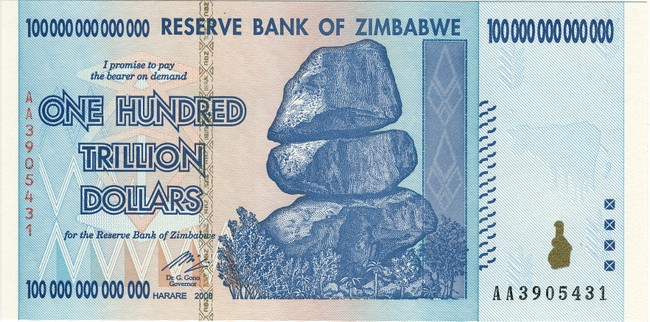 But my point is that it took a quarter century of increasingly wrong-headed mismanagement to ruin Zimbabwe — and it took comparatively little for China to bootstrap itself out of poverty right around the same time.
All Beijing had to do was let a little capitalism flourish — just enough, mind you — along with bribing, cajoling, and hoodwinking the West into integrating the no-longer-sleeping Communist giant into the First World's economic system. Politically, it was a bold move for a country once ruled by Mao's iron fist, but it was China's unleashed entrepreneurs who did the hard work.
Rags-to-almost-riches stories like China's are largely thanks to the Miracle invented in the Netherlands three centuries ago, perfected in Britain in the late 1700s/early 1800s, and brought to super-scale in the U.S. soon after.
(I told you I'd get back to it shortly.)
The Dutch pulled off the original economic miracle in the 17th century with a combination of joint-stock companies, low interest rates, commercial law, and a healthy disrespect for government meddling. Merchants made the country rich on global trade and domestic demand. It's a formula Britain duplicated on a larger scale, and with even larger global markets.
It was hardly fair when the U.S. really entered the global scene after the Civil War, because the typical American enjoyed a wealthier lifestyle than the typical Englishman did even a century earlier, at the time of the Revolution.
The global economy invented in the North Sea and increasingly integrated over the last century or so is now so rich that almost anyone can play — even a kinda-sorta Communist nation like mainland China.
It's the kinda-sorta where things get tricky.
We have serious problems here at home, including but not limited to a "progressive" deep state that acts in defiance of election outcomes, a swampy Congress addicted to debt, and an unofficial nomenklatura that cast aside any noblesse oblige notions of acting as caretakers of our culture and our fragile institutions because, if you'll pardon my English, they're all f***ing loons.
These are not, I contend, insurmountable problems. Otherwise I wouldn't have spent the last 25 years dedicating my professional life to writing about solutions.
But then there's China, where the deep state is the state, there are no elections, they're even more addicted to debt, and the loons have literally all the guns.
"Even more addicted to debt than we are?" I can almost hear you ask. "Congress puts TWO TRILLION DOLLARS on the national MasterCard every year, and that's with the Republicans in charge!"
Yes, and that's the revealing stat I teased at in this essay's introduction.
Longtime Sharp VodkaPundit Readers™ are all too aware of just how bad our debt problem is. I don't mean that TWO TRILLION DOLLAR annual deficit Congress accrued on our behalf again this year, and I shouldn't have to remind you they keep doing that when the economy is growing and we aren't fighting a near-peer war. We've got very little wiggle room — by which I mean pretty much none — should the economy turn south and Russia and/or China decide to seriously test our mettle.
It's so bad that in the 2026 fiscal year just ended, Washington spent more money servicing the existing debt than on national defense. At 15% of the budget, "net interest," as the Treasury so dryly calls our vig, is the second-largest spending item after Social Security.
I took you through those nasty weeds again to provide the necessary emphasis when I shout to the high heavens that China somehow has it worse.
And Another Thing: The nice thing about the dollar serving as the world's reserve currency is it allows us enormous buying power and matching leverage on the world stage. But it also gives Congress the ability to borrow on the cheap, which is a power easily abused — and Congress has abused it like a cheerleader in a slasher movie for the last 25 years. All we needed was the same prudent restraint Washington showed in the second half of the '90s — and who'd have thought that Bill Clinton and New Gingrich would be our last models of restraint?
Writing for Fortune last week, Jason Ma's headline grabbed me by the eyeballs and didn't let go: "China’s debt interest costs are soaring above U.S. levels and growing faster than any other budget category as Beijing struggles to prop up growth."
"Debt-servicing payments will account for 19.2% of the central government’s general public budget this year," Ma wrote, "up from 12% in 2014, according to new Conference Board estimates cited by the Financial Times."
Ma also noted that "The U.S. economy is accelerating, helped by the AI boom, and despite high inflation, resilient consumers have continued to spend."
But on the other side of the Pacific:
China’s GDP [growth] has been decelerating and is on pace to undercut its annual target of 4.5% to 5%. And while export-facing sectors are growing at a fast clip, trade partners are putting up barriers; Chinese consumers remain reluctant to spend; investment is weak; the property sector is still digging out from an epic crash; and Chinese stocks have been anemic.
What's interesting is that China's skyrocketing interest payment increase between 2013 and 2025 of 341% is very close to our own. We just seem to get more value for our funny money than they do.
"China’s youth unemployment has risen steeply," Michael A. Arouet noted on X earlier this week. "Passenger-car retail sales plunged a whopping 28% year-over-year in September. Both signal a broader domestic slowdown from the aftermath of an epic real-estate bubble and industrial overcapacity."
Good stats are hard to find (because Commies lie and obfuscate), but unlike most U.S. states with their balanced budget requirements, China's provinces are run along similar fiscal lines to California or Illinois, with jillions in debt or unfunded liabilities. There don't seem to be any provinces run like Texas or Florida, because the Commies run everything.
Beijing is doing what it always does, and trying to export its way out of its problems.
It helps tremendously that suicidal governments in countries like Germany and the U.K. pursue "net zero" policies whose main "benefit" is hollowing out domestic industrial production with sky-high energy prices. Chinese firms are happy to fill in the vacuum, and at subsidized prices. Whether Europe (and increasingly, Canada) wake up in time might prove immaterial, because there's only so much export-your-way-to-riches that a country of a billion people can get away with.
That's particularly true when Chinese trade practices tend to impoverish its trade partners.
Finally, that brings us back to the Middle Kingdom's middle-income trap, where a once-poor country tries to emulate the Miracle... and fails.
South Korea escaped the middle-income trap. Israel escaped. Singapore and Taiwan did, too. All four used to be dirt poor, or nearly so. All are now among the world's high earners. Argentina was one of the world's wealthiest countries a century ago but backslid into the middle rank under a crippling combination of economic populism and political corruption.
These countries escaped in two steps. The first was by exporting well-made manufactured goods. The second was transitioning to a consumer-based economy much like ours. That second step is where China still has trouble, even after going on a deficit-spending spree of one consumer stimulus after another.
Consumer spending is a vote of confidence in a country's future — the ability to enjoy today because the people are reasonably sure that tomorrow will be the same or even a little bit better. Chinese consumers, despite rising from "children are starving in China" to high-middle income earners in just two generations, apparently lack that confidence.
In the U.S. and other fully-developed economies, consumer spending typically accounts for something like 70% of all spending.
In China, consumers drive maybe 40% of the economy. And they stick much of the resulting savings in unproductive real estate assets — the country's infamous "ghost cities" and the resulting 2021 property bust.
And on the business side, Ma also noted, "Business debt has doubled since 2019, while revenues are only 30% higher. Creditors continue to roll over loans to keep struggling firms afloat, even as nearly a third of them are losing money."
As I've been more or less saying since 2015, "China’s state-led growth model now looks like it’s running out of steam." Additionally, Ma warned, 'the rapidly expanding mountain of debt is a warning sign as local governments often seek to boost favored industries with low-cost loans."
Beijing knows how to escape the middle-income trap: Loosen the social and economic controls that keep consumers frightened and entice those "favored industries" to double down on money-losing enterprises.
But that would mean also relaxing the political controls that keep thugs like Xi in power, and we can't have that.
If there's any comfort to take in this week's essay, it's the knowledge that in most ways, China's elites are just as short-sighted as ours. And in the remaining ways, they're even worse because they don't even face the occasional small measure of accountability that ours do.
Short of another revolution, that is.
Last Thursday: Tucker Might Be Ignorant, but at Least He's Evil