





"What happened to my trolls?" my old social media buddy Chris Loesch asked late Tuesday night on X. "Something happen to the bot farms?"
Maybe. But only maybe.
Following a series of drone hits on Russian data centers — fascinating details below — early reports indicated that Russian propaganda bot farms had gone dark.
"Funny thing," Ohio Rob posted on Sunday, "Ukraine takes out Russian data centers and 'Zelensky' rises while 'genocide' and 'Free Palestine' drops off according to X’s Radar analytics page."
"All the rabid pro-pals [Palestinians] are very, very quiet," another poster added. "Funny that."
Russian servers playing host to Palestinian propaganda bots? Say it isn't so.
More:
Ukraine just hit another Yandex data center inside Russia, and Cloudflare data shows automated traffic coming from Yandex’s network has collapsed to roughly 0.4% of its recent peak. For some perspective, researchers have previously estimated that bots generated roughly 21–29% of U.S. Twitter content. With the U.S. midterms just weeks away, the timing is pretty interesting.
— Chad Scott (@cpscott16) October 12, 2026
Finally, did something good come out of the nearly five-year-old Russo-Ukraine War?
To keep things fair and balanced, internet security expert Lukasz Olejnik strongly disagreed, calling it a "dangerous misconception" that the bot farms were taken out. "Those bots are mostly Yandex's own search crawlers, not the info-ops social media accounts. Troll farms hide behind proxies, hijacked devices and Western clouds. They're still operating."
Anecdotally, I have to say that for the last few days, X has been more pleasant and fun (and my replies free of trolls) than it has been since the Tea Party days.
So here's what happened.
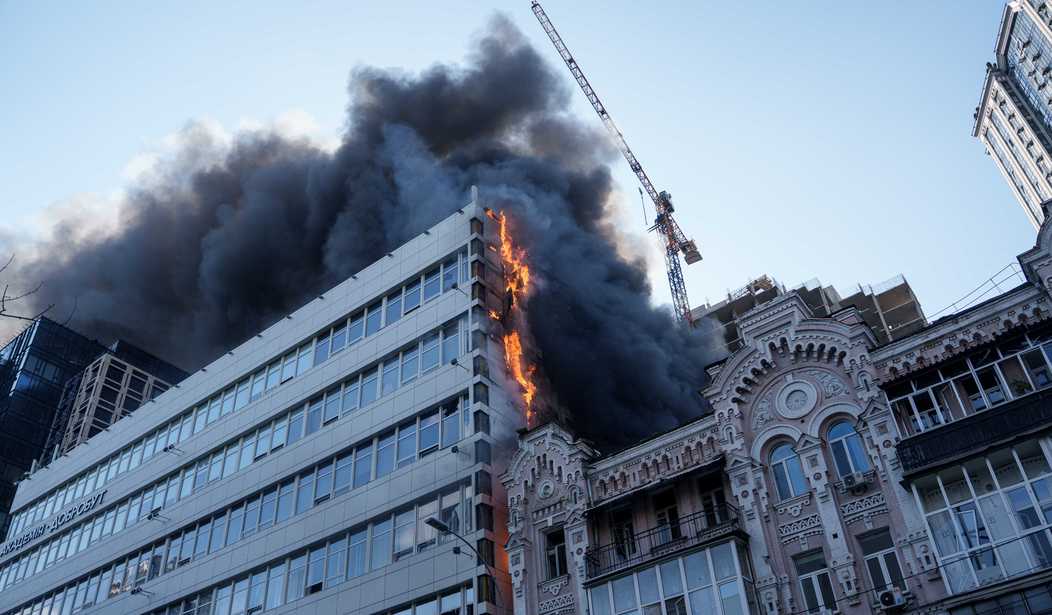
Between October 8 and 11, Ukraine launched powerful drone strikes against three of Yandex's data centers. Yandex is the rough Russian equivalent of Google, Amazon Web Services (AWS), and ChatGPT, all rolled up into one heavily censored package.
The first strike hit Yandex's Sasovo facility — home to two of Yandex’s three AI-training supercomputers — taking it completely offline. It's still offline, and Yandex has yet to say whether the facility can be repaired or is a total loss.
The October 9 strike in the Kaluga region disabled Yandex’s largest data center, resulting in a partial shutdown. Restoring full service could take months, thanks in large part to sanctions and the global chip shortage.
The final strike took place on the night of October 10-11 in the Vladimir region, completely knocking out Yandex's third and final AI-training supercomputer, along with major AWS-like hosting services. Like Kaluga, restoring the facility will likely take months.
Tom's Hardware called the attacks a "dramatic escalation" in the war, because maybe they don't read the news. Kyiv's data center strikes came two weeks after Russian attacks "destroyed or severely damaged data centers and internet exchange infrastructure across Kyiv," and "silencing the internet-dependent air raid alert notifications that warn civilians when the next wave of missiles is inbound."
What's all that mean for actual Russians? Yandex provides services similar to Uber, PayPal, Google Mail, iCloud/Google Drive, ChatGPT, Maps, Spotify, and Google Search — I told you it's a big company — and all were disrupted or degraded.
Yandex is gradually restoring priority consumer services while deliberately throttling less critical functions like Disk downloads. Restoring full capacity won't happen until those data centers can be repaired or replaced.
Talk about bringing the war home.
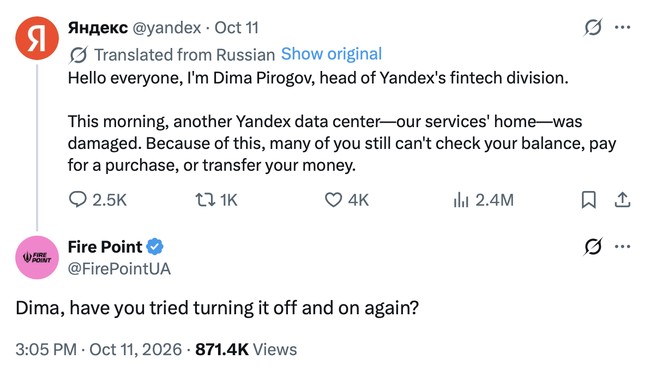
This exchange is classic, because Fire Point makes some of Ukraine's most effective drones and ballistic missiles — many of the ones that just hit Yandex so hard.
In related news — mostly because Americans ought to care a lot more about diesel prices than we do about the Kremlin's bot farms — on Sunday President Trump announced that he'd brokered an "energy ceasefire" between the warring nations. Axios noted that "Trump made a similar announcement last month, but neither party confirmed that there was a deal. Both Russia and Ukraine continued attacking energy infrastructure."
And this time around?
Ukraine President Volodymyr Zelensky said he'd never heard of it. "The ceasefire announcement is news for me," he responded to Trump's announcement on Sunday, adding that "if the Russians agree to an energy ceasefire, Ukraine will agree."
The Russians responded by conducting bombings as usual: "Russia targets Ukraine energy facilities despite Trump ceasefire announcement."
I don't even pretend to know what's going on with the energy ceasefire. And I don't see why I should, given that none of the principal actors seem to know, either.
Between the fiery but mostly peaceful energy ceasefire, the unresolved Iran War, and the Democrats' ongoing war on American refining capacity, it seems we're stuck with uncomfortably high diesel prices — and all the inflationary trickle-down effects — for the foreseeable future.
But at least the Russian bot farms seem temporarily silenced.
Recommended: So the FBI Did Another Big Raid You Might Have Missed...
No bots. Cool stuff.
PJ Media VIP members get tons of exclusive goodies, including podcasts and video live chats with your favorite writers, almost none of which are Russian or Pakistani bots — guaranteed! You can support alternative conservative news and save 60% with promo code FIGHT.


Join the Conversation
VIP members get the ability to comment on articles.