



Note: Most Thursdays, I take readers on a deep dive into a topic I hope you'll find interesting, important, or at least amusing. These essays are made possible by — and are exclusive to — our VIP supporters. If you'd like to join us, take advantage of our 60% off promotion.
“It would have been easier to take a different path. But it would have been the wrong answer.” —Gen. Hawk Carlisle, USAF
It's the strike fighter that launched a thousand flamewars, yet somehow keeps succeeding at one mission after another. And might be about to take on yet one more.
"But it costs too much," they said. "It flies too slow," which is true. "The helmet is too heavy," which is weird and also true. "It can't dogfight." And my favorite, because it's the truest: "They never should have tried to make one jet fit three branches."
Perhaps most embarrassing of all, the pilots who fly the F-35 — officially designated the Lightning II, which I always thought was a lazy name — call it "Fat Amy."
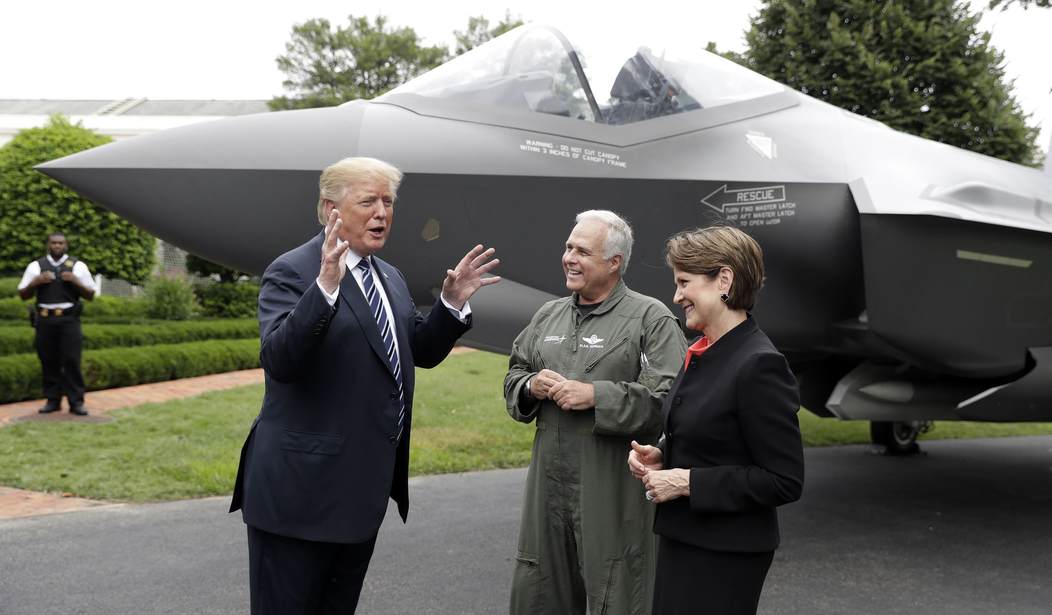
Yet just in the last week, Lockheed Martin announced another new role for the much-derided fighter: ballistic missile defense. I mean, can something called Fat Amy do that?
So exactly what is the Lightning II? An overpriced albatross? The unlikeliest-looking femme fatale?
Let's work it out.
And Another Thing: The nickname isn’t actually embarrassing. Pilots call the A-10 “Warthog,” and the B-52 “BUFF,” which almost stands for Big Ugly Fat Fellow. I’m not allowed to use the actual second word that starts with F. And whatever their nicknames, those planes are beloved.
Years ago — my now 20-year-old son still wore diapers to bed — Will and Beth Collier were in town for a concert and spent a lovely evening here at Villa Verde. Will and I met online back in the very early days of VodkaPundit, and he was my semi-regular guest-blogger back before I was fully subsumed by the PJ Media digital empire.
The thing to know about Will isn't just that he's an aerospace engineer, but that he worked on the F-22 Raptor program. I never asked exactly what he did on the Raptor, because I've known enough people over the years with serious-level clearances not to bother. My late friend Ed Lambert, for example, was an Atlas guy at ULA, and I could always tell the difference between him just coming home from a civilian launch, and just coming home from a military — or better yet, NRO — launch. If it was the former, he'd tell me all about it. If it was the latter, "The launch was nominal" was the best I'd get.
But I digress.
This was the summer of 2008, and the F-35 program was all over the news for all the worst reasons.
In 2001, the Pentagon picked the Lockheed X-35 to serve as the Air Force/USMC/Navy Joint Strike Fighter over Boeing's rival X-32. I'm not sure I'm joking when I say the decision was in no small part because the X-32 was the ugliest, ungainliest, unlikeliest would-be warplane ever to fly.
Seriously, look at this beast:
1) Boeing X-32 The loss of JSF contract to Lockheed Martin in 2001 was major blow to Boeing, as it represented most important international fighter project since Lightweight Fighter program competition of 1960s/70’s which led to F-16 Fighting Falcon and F/A-18 Hornet. pic.twitter.com/bdjJpiJitH
— Chris Bolton (@CcibChris) February 14, 2024
If I hadn't found a photo of it airborne, you'd never believe that it could fly. The X-32 made Fat Amy look like Sydney Sweeney*.
*Don't worry — someday I'll write an essay on a topic that'll give me an excuse to run a couple Sweeney pics. For America.
A GAO report from March 2008 found that costs had ballooned another $23 billion just the previous year, while the program had blown through two-thirds of its development budget with only half the work complete. Among other issues, the GAO warned that the program likely faced another year or two (or even more) worth of delays.
Those figures later proved to be mostly optimistic, and more troubles would follow. The services finally declared their F-35s combat-ready in 2015, 2016, and 2019 for the Marines, Air Force, and Navy respectively — and five to seven years late, depending on the service.
To the broader public in 2008, the F-35 still seemed unremarkably late and over-budget, nothing atypical. For those of us who follow these things more closely, the warning signs were unmistakable.
You can imagine how badly I wanted to pick Will's brain about the program. He was free to opine, because he didn't work on that program and had no secrets to spill. So I repeated my well-rehearsed rant about the program's issues. After winding myself up pretty good, I asked Will something like, "What makes this thing worth it? Anything?"
Instead of answering, Will asked me what I thought the answer might be. This was long before she was nicknamed Fat Amy, denying me all kinds of smart-aleck replies — and don't you hate that?
And Another Thing: I can't help thinking that some of the F-35's delays were due to an unearned slackitude inhabiting the Pentagon following our victory in the Cold War — particularly in procurement. "What's the rush on a 21st-century stealth jet when we're fighting guys on camels?" The China threat seems to have woken up the Air Force, if not the Navy. The USAF's F-47 and B-21 programs are both coming along nicely.
So I thought for a few seconds, and realized that if the F-35 was going to be a great platform, it would have to do the same thing that by 2008 was making almost everything else so effective. Hell, we were watching Barack Obama do it via Facebook in realtime. There could be only one answer.
"Networking."
"Exactly," Will replied.
It might help to think of Fat Amy less as a strike fighter and more of an all-seeing network node that also happens to carry some of the world's most advanced weaponry — none of which was quite apparent at the time, even to the guy who'd just guessed the correct answer.
To avoid dragging you through the weeds, I'll start and end with the TL;DR.
In its now-mature state, the F-35 isn't merely networked. The beauty under Fat Amy's skin is the combination of stealth, advanced radar, passive visual/infrared detection, secure networking, and sensor fusion. The plane the enemy has a hard time detecting has an easy time seeing most anything else in the air or on the ground, and sharing that information securely, while freeing up the pilot to fight.
In short, the F-35 has better vision than a big-city police department with a federal grant for Flock cameras, and it can also share that vision with older jets fighting in the same battlespace. That helps keep 1970s designs like the F-15 and F-16 relevant and survivable.
The fusion hardware/software does the hard work, letting the pilot perform his mission without suffering what the services call "cognitive fatigue."
And Another Thing: It isn't clear whether China has mastered sensor fusion and the related dark art of stealth combat operations for their air forces. Beijing remains tight-lipped, of course, but if the performance of China's anti-stealth air defenses in Venezuela and Iran are any indication, they might still have a ways to go.
That's a big deal because as previously discussed, stealth is just one small part of modern air-combat operations — and modern sensors make it easy, perhaps even tempting, to overwhelm the pilot with data.
The question is, does it all work? My doubts evaporated years ago, when I read about the F-35's performance during a Red Flag exercise in 2016. "This was the first time F-35s of any type had participated in an iteration of the U.S. Air Force’s most important aerial war game," TWZ reported at the time.
“If I had to go into combat, I wouldn’t want to go into combat in any other airplane,” Marine Corps Lt. Col. J.T. Bardo said, after flying mock battles during that Red Flag.
TWZ continued: "Bardo said the [F-35s] stay on station to pass information to other aircraft after they had 'expended' their mock weapons... acting as a 'quarterback' of sorts for less capable assets even after their weapons bays were virtually empty."
Even stripped of ordnance, Fat Amy acts as a force multiplier for everyone around her.
And that — at long last! — brings us to the latest news about the jet formerly known as Joint Strike Fighter.
Lockheed on Friday "outlined a missile-defense architecture in which the F-35 Lightning II can feed tracking and targeting data from the air into a network linking space-based sensors, command systems and interceptors," Army Recognition reported.
"At the center of the concept is the F-35’s potential role as an airborne sensing node that helps pass threat data into systems such as C2BMC, THAAD and the future Next Generation Interceptor," AR explained., strengthening "layered missile defense by improving situational awareness, accelerating engagements and reducing the operational gaps created when sensors and shooters operate separately."
In short: networking. But at a level and in a role almost unimaginable in 2008.
The U.S. has something like 850 or more F-35s in service — one estimate I found was as high as 1,000 — and our allies have roughly 500 more. That's an awful lot of potential eyes-in-the-sky for missile defense, and the first non-evaporated city will become eternally grateful.
That isn't to say that even now the JSF program is without problems. And the big one makes me want to get all stabby with a few very important people at some very well-paid contractors.
Pretty much every executive and procurement officer involved in Block 4, I'm looking at you.
And Another Thing: I own no shares in Lockheed or its F-35 subcontractors. My wife might have had some shares vest while she worked at Lockheed, but that was years ago.
The F-35 Block 4 will — eventually, someday, if money and patience don't run out — give Fat Amy new weapons, better electronics and sensor fusion, and a virtual data-center worth of computing power to handle threats that didn't even exist when the JSF program was laid down a quarter century ago.
There's even informed speculation that Block 4's combination of upgraded engine, souped-up radar, and America!-level cooling systems will allow the F-35 to use the new APG-85 radar to fry enemy electronics with focused microwave beams. Because the original jet that nobody seems to have gotten a good shot at wasn’t cool enough.
That's some real gee-whiz/gotta-have-it stuff, but it won't count if the contractors can't deliver. Already, Block 4 is at least five years late and more than $6 billion over budget, and that's after the Pentagon scaled back its requirements.
You see now why I get all stabby about it. As a patriotic American, I demand that our pilots get the best gear. As a taxpayer, I reach for my whetstone.
And here we are in 2026, and all three services are still short on spare parts. While every new jet has problems at first with building up inventories of spares, there's really no excuse for a jet now entering its second decade of operations. The ones that can still fly because they have the spares they need, that is.
Still, the F-35 is doing a lot of winning on price, and Lockheed for once earns some praise from me.
Thanks to big orders and bulk discounts, Lockheed has driven the F-35's "flyaway cost" way down.
"Flyaway" means for the plane only — no training, spares, or TruCoat.
The sticker price now for an F-35A is estimated $82 million, compared to about $70 million for the Block 70/72 version of the venerable F-16 that remains in high demand with certain foreign buyers. So for not much more than the price of the latest-and-greatest version of the F-16, the Air Force can get a brand-new F-35A that not only fights, but makes its existing F-16s more lethal.
But the real proof of desirability might come from countries that decided to plunk down cold, hard cash for the F-35, even though they aren't one of the JSF partner nations. Original JSF partners (minus Turkey) are the U.K., Italy, Netherlands, Canada, Australia, Denmark and Norway. But — and take a big breath because this is a big list — Israel, Japan, South Korea, Belgium, Poland, Singapore, Finland, Switzerland, Germany, Czech Republic, Greece, and Romania have all taken delivery or soon will.
Once you get past her looks, Fat Amy is one sexy broad.
Last Thursday: One Small Family, One Smaller Puppy, One Major Battle