Note: Most Thursdays, I take readers on a deep dive into a topic I hope you'll find interesting, important, or at least amusing. These essays are made possible by — and are exclusive to — our VIP supporters. If you'd like to join us, take advantage of our 60% off promotion.
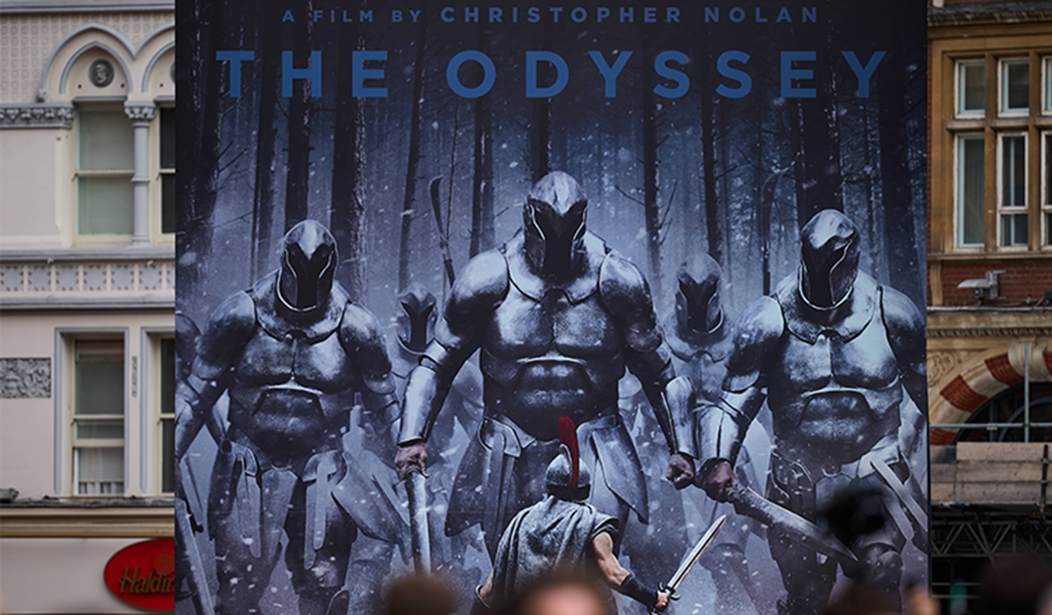
We need to talk about The Odyssey, which now looks like it's going to be writer-director Christopher Nolan's second billion-dollar picture in a row.
This isn't really a movie review. It's more of a look at how a celebrated writer-director, tasked with turning a 3,000-year-old epic poem into a modern Hollywood blockbuster, tried and partly failed to thread that needle.
I did not hate The Odyssey. I do not love it.
Mostly, I'm perplexed.
But first, let's talk briefly about Christopher Nolan, because there's no getting to the bottom of The Odyssey without some understanding of the man whose vision moves it, for better and for worse.
Nolan made a splash in 1998 with his feature film debut, Following, shot in black and white for about $14, and starring Jeremy Theobald as a writer who follows strangers around London, looking for material. He's eventually "caught" by a thief who introduces him to the underworld. I've slighted how interesting Following is, particularly given Nolan's budget constraints. But he managed to work in three of his signature storytelling elements: a nonlinear plot, a smart script, and intense performances.
But it was Memento in 2000 that first made Nolan a Hollywood force, setting him up for a string of films that eventually grossed more than $6 billion worldwide.
It says something about Nolan's talents that Warner Bros. entrusted him with Batman Begins, the studio's first effort at rebooting the franchise after the critical disasters of the previous two Batman movies.
Batman Begins was such a success that after that, Nolan could do pretty much whatever he wanted, whether it was a beloved big-budget sequel (The Dark Knight), a surprisingly intimate World War II epic (Dunkirk), or the twistiest time-travel movie I can recall (Tenet). He even tried to outdo Stanley Kubrick's 2001: A Space Odyssey with Interstellar. Whether or not he succeeded with all those efforts is a matter of (often heated) debate.
2006's The Prestige cemented his rep with critics and audiences, and for my money, it's one of the best con movies ever made, set in the world of Victorian-era magic shows. Plus, David Bowie in an extended cameo as Nikola Tesla. Genius.
I seem to be one of the few who genuinely enjoyed Tenet, and as I've joked on countless occasions, on the fourth viewing I almost understood Tenet. There comes a point in that one where the viewer simply gives up trying to follow Nolan's time-twisty plot reveals, and presumes the writer/director knew what he was doing.
But not always.
Spoilers ahead, but the movie is almost 15 years old.
Near the end of Nolan's final Batman movie, The Dark Knight Rises, the big twist is that Bruce Wayne's lover, Miranda (Marion Cotillard), was the main villain all along, and that Bane (Tom Hardy) was merely her henchman. That's bad enough, but then Catwoman (Anne Hathaway) shows up and dispatches Bane with a missile and a quip.
In his last moment, one of the great villains in superhero movie history got demoted to a Roger Moore-era Bond henchman. What a letdown. Nolan introduced a plot twist — a gimmick, really — at the last minute, and it undercut the storytelling instead of enhancing it.
That didn't ruin The Dark Knight Rises for me, but did help take what could have been a great film and reduce it to a merely good one that somehow remains re-watchable.
I tell you all of this because The Odyssey is the first time Nolan's gimmicks may have overcome his talents, starting with some (ahem) curious casting choices that seem designed to signal “modern Hollywood” more than Bronze Age Greece. It includes a middle-aged American, a young Brit, an aging Hispanic hipster, a transsexual, and a Kenyan woman.
The most generous explanation is that Nolan wanted to take a 3,000-year-old Greek story and turn it into a blockbuster for global audiences. I believe it's also the most likely explanation.
But did he pull it off?
Yes and no.
Where Nolan succeeded was in taking a pre-Christian epic and making it pure Hollywood spectacle — historical accuracy, as Hollywood so often decides, be damned.
As the Critical Drinker asked in his review, was Nolan "really supposed to show, among other things, the mythical Greek hero slaughtering unarmed suitors, ordering the execution of the household maids (after forcing them to clean up the gore from the massacre of suitors), sleeping around with nymphs, and abducting women from Cicones?"
Of course not. What works in a pre-Christian epic poem probably won't work for 21st-century moviegoers. That's usually been the case for Hollywood epics, imposing a Christian ethos and worldview on empires and eras that had neither.
That's because Hollywood wants to entertain and sell tickets. And if Nolan's Odyssey does one thing flawlessly, it's sell tickets.
No less than Federico Fellini went against the grain, committing Satyricon — a 1st-century Roman work by Gaius Petronius — to film without any Hollywood or Christian gloss. The result is gorgeous, epic, important... and having seen it once, I'm totally done with it.
Maybe what Nolan tried to do was give audiences that Fellini grandeur and the old-school Hollywood epic morality tale.
Ben Shapiro got into the Christian aspect better than I could, so allow me to quote his X review at length:
IMHO, a lot of conservatives are missing the Biblical forest for the woke trees in Nolan's Odyssey. Yes, the casting of Elliot Page is silly and egregious. But here's the thing: Nolan's "The Odyssey" is an apologia for Christian morality poured into a Greek vase.
The entire movie is rooted in what Nolan terms "Zeus' law." That law is: "Treat others as you would want to be treated, because anyone might be a god." Now, clearly, there's nothing like that in Greek mythology. It's not implicit in Homer. It's a direct rip from Biblical morality, substituting "because anyone might be a god" for "because man was made in the image of God."
Nolan then takes this rule and uses it as his moral glue: the idea is that Odysseus, in utilizing the Trojan Horse, violated Zeus' law and led to full-scale slaughter. That sin has led to the unleashing of broader globalized sin (the "sea peoples" who don't respect Zeus' law and are invading surrounding areas). This is a highly Biblical message: that sin is infectious, and that sin also affects the world at large, not just the sinner.
That element works well, too, although not for viewers expecting a more literal version of Homer's work. But as another critic noted — and I'm sorry I lost the link! — this isn't Homer's Odyssey, it's Nolan's.
But my second-biggest gripe with the movie is Matt Damon as Odysseus. Damon is actually quite good in the role. He is a gripping presence on screen, believable as the old general seeking nothing more than to return home and perhaps atone for his sins. Damon isn’t the problem. His Odysseus commands the screen. The problem is that Nolan wrote away the very qualities that made Odysseus legendary.
For that, let's go to Liel Leibovitz and his review for Tablet. And again, please excuse the lengthy excerpt:
In the Greek original, the cunning and wily hero, finding himself trapped in the cyclops’ cave, tells the supersize beastie that his name is Outis, Greek for “nobody.” Later on, when Odysseus and his men blind the monster, Polyphemus, writhing in agony, shouts, “Nobody is hurting me!” which is both a terrific joke and a decent plot device: The other one-eyed baddies take Polyphemus literally and scatter away, allowing the Greeks to escape by tying themselves to the bellies of Polyphemus’ sheep.
The whole exchange—hilarious, brutal, dynamic—reads like a filmmaker’s dream. Nolan cut it altogether. Why?
The answer is as simple as it is depressing: because Nolan’s Odysseus isn’t funny. Or wily. Or cunning. Or proud. Or anything, for that matter, that we know him to be from the three-millennia-old text that is one of the cornerstones of Western civilization.
Damon's screen presence is captivating enough, but Nolan's script leaves Odysseus with stoicism and little else. At nearly three hours, I could have used more of Homer's wit and less of Nolan's grit.
"Once you’re free of Nolan’s kinetic spell, the fatal flaws of his film creep in, one by one, like Odysseus and his men sneaking out of Polyphemus’ cave," Leibovitz concluded in an otherwise mostly positive review.
But my biggest gripe isn’t stripping Odysseus of almost everything that made him endure for three millennia — it’s the handful of over-modernizations Nolan couldn’t resist.
And Another Thing: I also didn't care for the modern, casual language Nolan went with. Hollywood adopted a form of speech I call Mock Epic English decades ago for films like The Ten Commandments, Ben Hur, Spartacus, etc. It lends an importance to how the actors say their lines that tells audiences that they're watching something important. Nolan ditched that, probably in pursuit of younger moviegoers, and ditched some of the old-school epic grandeur along with it.
Lupita Nyong'o as Helen isn't in the movie much, and no matter what the Online Anger Hype Machine tells you, she's fine in the role. I thought she was much better in Jordan Peele's Us, and of course in Black Panther. And though she might not have been my first choice for "the face that launched a thousand ships," I can at least see in her what Nolan seems to have.
Now for the really bad stuff.
There will be no apology for what I must write next, because I cannot look at Ellen "Elliot" Page without seeing the injured young woman instead of the character she's supposed to play. That's true even when I've tried re-watching her excellent early work in Juno and Hard Candy. Casting her as the young soldier Sinon... it's just so bad.
While Page has only a few minutes of screen time, they're a waste and a distraction. Viewers are left to trust Odysseus when he says Sinon is "The bravest man I’ve ever known," because Nolan didn't dare show it — not with a 105-pound faux-male in the role. Had Nolan cast an actor capable of convincingly portraying a legendary warrior, he could have shown us why Sinon inspired that admiration. Instead, we’re simply told.
A writer-director of Nolan's talent is supposed to know better than to break the "show, don't tell" rule, but having cast Page as Sinon, he left himself with no other choice. Had he tried to put Page in battle...:
Elliott Page as Achilles in Troy 🤣🤣🤣🤣 pic.twitter.com/UAzNs8viX3
— The Foxxy 🦊One (@foxxydammie) May 14, 2026
Well, at least we got the memes.
But the worst is hip-hop artist Travis Scott as the story's Bard.
Like Page and Nyong'o, Scott is barely in the movie, but his mumbling presence is so ill-suited to anything we've already discussed about how to make a Hollywood epic that I'm almost at a loss for words. Nolan explained that he "wanted to nod towards the idea that this story has been handed down as oral poetry, which is analogous to rap."
Scott does what he can with what little material Nolan gave him, but for me, that was one modernization too far.
I have to believe that Nolan made his decisions regarding The Odyssey with the same attention to detail that made mind-benders like Inception work despite their complexities. But I also have to conclude that too often, Nolan chose poorly.
Is The Odyssey a grand epic with scenes that will suck the air out of your lungs? Yes, it is. But in fundamental ways, it also lacks coherence. To my eyes and ears, Nolan's modern contrivances come across as unnecessary at best, and mood-shattering at worst.
Nolan's poor choices are bad enough to suck you out of the movie, and by the end, I was exhausted. Not from the spectacle — which is truly spectacular — or from the three-hour running time, but from trying to overcome Nolan's modern and postmodern indulgences.
The Odyssey survived for thousands of years because every generation found something timeless in Homer's words. Nolan made plenty that was epic — what skilled director wouldn't? — but in the end was more interested in making Homer sound like us than in letting Homer's ageless words tell us "Of the cunning hero, the wanderer, blown off course time and again after he plundered Troy’s sacred heights."
Last Thursday: Our Love/Meh Relationship With AI