





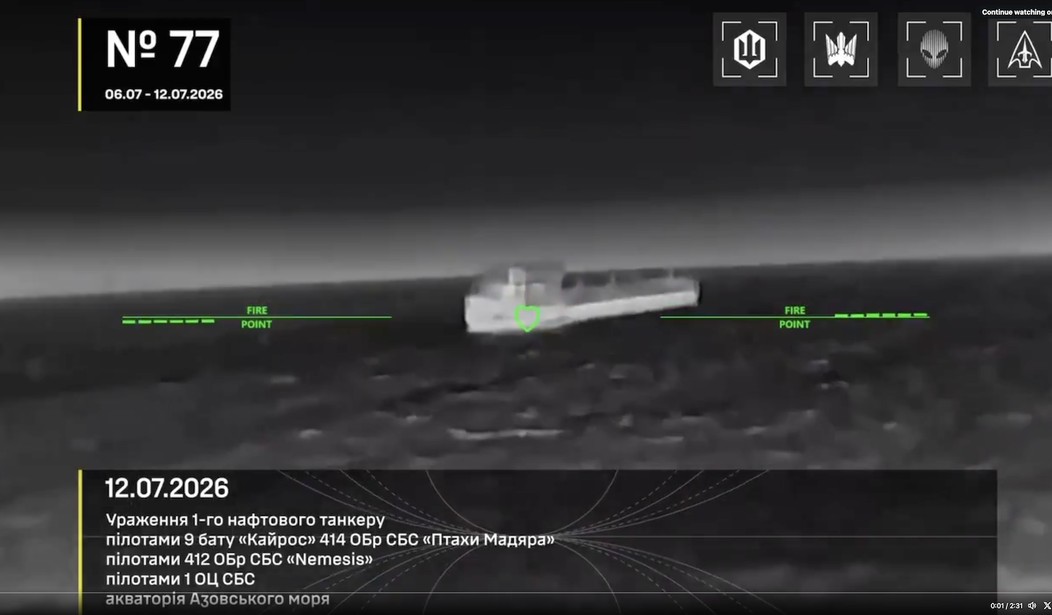
Operation Crimea Switch Off is Ukraine's attempt to make the jewel of Vladimir Putin's eye — the strategic Crimea peninsula — nearly uninhabitable, and its escalation against Russian shipping in recent days has proven remarkably effective. Late last week, Moscow ordered the Kerch Strait separating Crimea from Russia and Russian-occupied southern Ukraine shut and has yet to reopen it.
That's kind of a big deal, but it's also what happens after events like Sunday's, when "Ukrainian attack drones hit another 15 vessels in the Sea of Azov overnight, including 7 oil tankers," according to OSINTtechnical. That's a total of "105 vessels in the area over 8 days, collapsing Azov/Don/Kerch Russian shipping traffic."
Russia's "temporary" closure is about to enter its fifth day with no indication from the Kremlin when it might reopen. Some temporaries are less temporary than others, I suppose.
Ukrainian forces carried out another major maritime raid overnight in the Sea of Azov, hitting 10 oil/fuel tankers.
— OSINTtechnical (@Osinttechnical) July 12, 2026
Ukrainian drones also hit 4 immensely valuable ferries used to move vehicles across the Kerch Strait between Russia and Crimea. pic.twitter.com/AnP4IZIuKE
Meanwhile, Ukraine seems happy enough to strike ships tied up at port, too.
"Russia uses a fleet of shadow tankers to move oil and grain out of occupied Ukraine and Russia, through the Strait of Kerch and into the Black Sea," my Hot Air colleague John Sexton explained on Saturday, and then "the cargo is often moved onto larger ships which transport it around the world to buyers willing to look the other way on sanctions."
The Strait also separates Russia's second-largest Black Sea port, Rostov-on-Don, from the Black Sea. Closing it cuts off vital exports, providing even more vital hard currency.
But what about Russia's largest Black Sea port? That would be Sevastopol, illegally occupied since 2014 — and increasingly isolated by Kyiv's drone-and-missile blockade of Crimea.
Life inside occupied Crimea is becoming increasingly difficult, where gas isn't just rationed; it costs about six or seven times more than anywhere else in Russia.
Gasoline in occupied Crimea has reached 450 rubles per liter. That is about 6 to 7 times the typical Russian retail price, 5 to 6 times the US price, and around 3 times the EU average. #Ukraine pic.twitter.com/R7Bf2UGRmm
— NOELREPORTS 🇪🇺 🇺🇦 (@NOELreports) July 12, 2026
Electricity is unreliable, too, and residents face significant disruptions, shortages, and scheduled restrictions on drinking water.
With Kerch closed to ferry and shipping traffic, one of the only reliable ways in and out of Crimea is the massive road-and-rail Crimean Bridge, and drone and missile strikes have reduced its capacity significantly. There's also the "land bridge" across Occupied Ukraine, but traffic along the roads there is even easier drone prey.
Some Ukrainian sources claim — maybe they're only joking, I don't know — that Kyiv could destroy the Crimean Bridge any time it chooses, but chooses for now to let it serve as a civilian escape route.
As I reported a couple of weeks ago, Operation Crimea Switch Off is the fruit of Kyiv's year-long campaign to reduce Russian air defenses everywhere it can, but particularly in Crimea, which serves as the logistical hub for Russia's southern frontlines.
The campaign has yet to affect the battlefield materially in Kyiv's favor, but Russian advances are slower and more costly than ever.
But here's the question that's nagged at me since the anti-shipping campaign began eight days ago: What happens to those ships?
Let me show you one, and you'll better understand the question.
More and more videos are emerging from vessels struck by Ukrainian drones in the Sea of Azov.
— 414 Magyar's Birds (@414magyarbirds) July 13, 2026
They confirm what has often been visible in footage released by the Unmanned Systems Forces themselves: most drone operators deliberately aim for the bridge.
A tanker is a highly… pic.twitter.com/FCs28Fek1y
That's the bridge — or what used to be the bridge — of a Russian tanker.
These ships aren't easy to sink, particularly not with comparatively small drones. So Ukraine blows up the bridge, maybe kills some crewmembers, but certainly destroys navigation equipment and the ship's controls.
After the surviving crew gets any fires put out, the ship isn't necessarily dead in the water — there are backup ways to control the engine and steering from deep inside each vessel. But imagine trying to operate your car from the trunk, in a parking lot full of similarly disabled cars, and you begin to understand what Russia faces with 105 damaged vessels.
And counting.
There's a line of military thinking that says it's better to wound a soldier than to kill him outright. A dead man can be buried later, but a wounded man requires at least two more to get him off the field.
Similarly, every damaged tanker and ferry isn't just a lost means of getting people, fuel, and equipment where they're needed. They're added logistical burdens to a country already under logistical strain after more than four years of heavy fighting and nearly 1.5 million dead and wounded.
Those ships can certainly be repaired, but Russian shipyards are not the best (cough, cough), face labor and parts shortages, and sanctions make it difficult and more expensive to obtain replacement electronics that Russia doesn't produce domestically.
So those struck ships will likely limp home to port, eventually get jury-rigged bridge repairs, but then what?
Recommended: Paramount Plays Hardball Against Newsom's Regulatory Goons
War sucks. PJ Media doesn't.
PJ Media VIP members get tons of exclusive goodies, including podcasts and video live chats with your favorite writers. You can support alternative conservative news and save 60% with promo code FIGHT.


Join the Conversation
VIP members get the ability to comment on articles.