


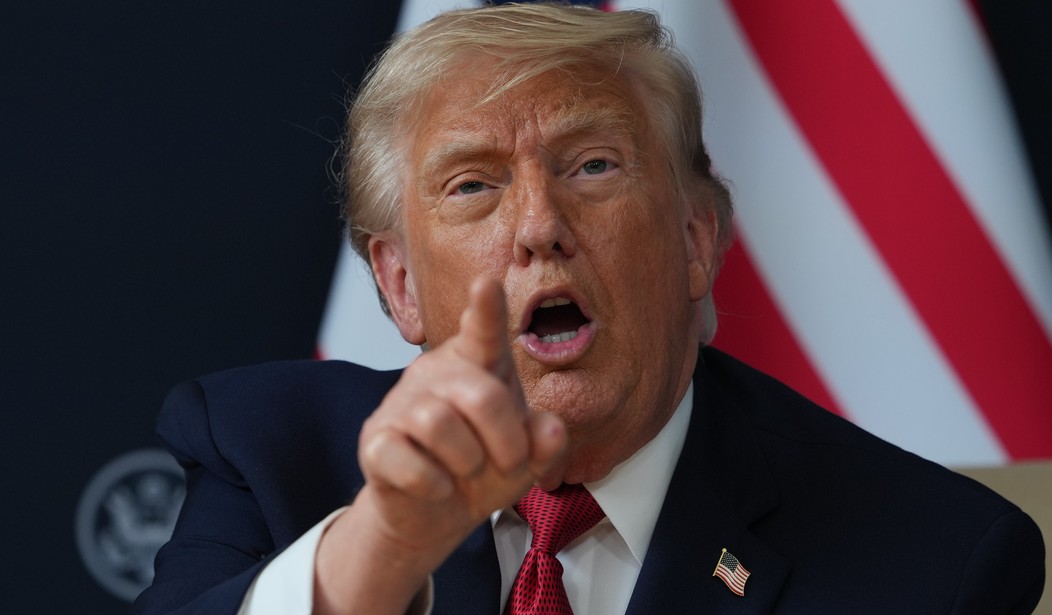
When President Donald Trump ordered the start of Operation Epic Fury on February 28, like many people I assumed a brief air campaign to further degrade Iran's nuclear weapons program. The instigator was Iran's own negotiators, who boasted to Trump advisor Steve Witkoff that they had produced enough nuclear material for nearly a dozen weapons. All Tehran needed to do was make the final uranium enrichment step from 60% to 90%, then assemble the warheads.
Neither Trump nor Israeli Prime Minister Bibi Netanyahu — whose nation former Iranian president Mahmoud Ahmadinejad called a "two-bomb country" — had a choice in the matter. It was either war then or nuclear blackmail later. Or worse.
We went to war. I cheered it on.
Milblogger and retired Navy officer CDR Salamander put it better than I did at the time, writing that "I support the strikes on Iran because it firmly fits into a view I have held on the use of national military power for decades." Sal was writing in support of the age-old Great Power custom of punitive expeditions — brief and often impressively violent campaigns to bloody a smaller enemy without all that “Pottery Barn Rule” nonsense that Colin Powell saddled our strategic thinking with a quarter century ago.
"Nation building OPLANS again? No. Not any more. Breaking their things and killing their worst leadership that endangered the USA and her allies? I’m in."
Me too.
Now the Memorandum of Understanding is public, and I must ask: How in the hell did we get to this from where we started on Feb. 28?
- Ceasefire: Immediate/permanent end to military ops (incl. Lebanon); no future attacks/threats; respect sovereignty/Lebanon integrity.
- Non-interference: Respect sovereignty/territorial integrity; no internal meddling.
- Timeline: Negotiate final deal in max 60 days (extendable).
- U.S. Actions: Lift naval blockade (start immediately, full in 30 days); withdraw forces post-deal; $300B+ reconstruction plan; end all sanctions (UN/US) per schedule; oil export waivers; release frozen funds/assets.
- Iran Actions: Safe commercial shipping (Hormuz/Gulf, 60 days free); no nuclear weapons; maintain nuclear status quo; down-blend stockpile under IAEA.
- Interim: Status quo maintained; monitoring mechanism; final deal via binding UNSC resolution.
There's so much to pick apart here, but there are really only three things that matter: "Status quo," "End all sanctions," and "$300 billion." As for the efficacy of a denuclearization plan involving the UN... I just throw my hands up in the air.
I spent weeks coming up with or sharing other people's attempts to explain what Trump was thinking, from the "rug-merchant" delay strategy to the "there's no one left there with the authority to negotiate" conundrum. But reading these bullet points, you have to wonder if they weren't having the exact same discussion inside the White House, right up until the very end.
Here's a big tell about what the MOU is worth. The two strongest foreign policy hands on Team Trump — Secretary of State Marco Rubio and War Secretary Pete Hegseth — seem to be doing their best to maintain radio silence while JD Vance does the P.R. blitz.
Axios reported on Monday that "[CIA Director John] Ratcliffe isn't the only skeptic in Trump's top team. In internal discussions, Secretary of State Marco Rubio and Secretary of Defense Pete Hegseth both expressed concerns and raised questions about the memorandum of understanding."
"As Vance emerges as the spokesman for the deal, Secretary of State Marco Rubio has raised eyebrows across the political world with his near-total absence. Rubio, who has taken on multiple roles in the administration," Mediaite reported Thursday, and "was central to the Iran negotiations up until the last week or so, in which Vance, Jared Kushner, and Steve Witkoff stepped in to rush to finalize an end to hostilities."
I've said here before that Witkoff is one of the very few weak parts of Trump 47, and if those are his fingerprints all over this MOU, then I'll say it again.
Netanyahu is also nowhere to be seen, following months of standing shoulder-to-shoulder with the administration.
The biggest mistake was a ceasefire that effectively locked in Tehran's control of Hormuz. The clock started ticking on the Islamic Republic the moment the bombs started falling almost four months ago. The clock started ticking on the global economy the moment Tehran more or less closed the Strait.
As Trump himself put it in France on Thursday, "I didn't want to see economic catastrophe. If you kept this [war] going, that could have happened." He added, "It could have caused an international depression." Once we were at war, the proper solution was to force Hormuz back open. We even learned last week that Trump ordered elements of the 82nd Airborne Division to Israel for just such an eventuality.
But either our armed forces lacked the ability to force open the Strait, or Trump lacked the will to order the Pentagon to do so. Neither option seems particularly plausible, but the third possibility — that the cost would have been too high — makes little sense once we committed to a larger and longer campaign.
A swift punitive operation would have gotten us most of what we really needed: another serious dent in Iran's nuclear ambitions. But Epic Fury was just ambitious enough to force Tehran to put all its chips on the table by closing Hormuz and daring us to call.
Instead, we didn't arm the Iranian opposition. We didn't go after the infrastructure that kept the regime on life support. We didn't force open the Strait of Hormuz.
That said, the comparisons you'll see to Barack Obama's Joint Comprehensive Plan of Action (JCPOA) are, at best, specious. Iran's economy, leadership, military, and nuclear program are all shadows of their former selves, thanks to Epic Fury. Then again, with sanctions lifted and a $300 billion "reconstruction" fund, Hegseth may prove right sooner rather than later when he warned yesterday that "If Iran doesn’t comply, then we’re more than able to reimpose an ironclad blockade." Trump himself said that we could resume the operation "if they don't behave."
"If it drags on for weeks of diminishing returns, my opinion will change," CDR Sal wrote at the start of the Epic Fury, but the diminishing returns only kicked in once Trump announced a ceasefire, leaving Iran with a stranglehold on the world's energy supplies. What good is the resumption of the bombing or even "an ironclad blockade," if we allow Iran to mine and drone Hormuz again?
It's just an MOU, not a final peace deal, so things still could improve. But we have to look at the agreement as it stands, and as my Hot Air colleague David Strom predicted, "There will be no final deal. Iran got what it wanted already."
We expended too much to get nothing better than this. The MOU is hardly the total surrender, humiliation, or whatever they're calling it on the TDS sites. But it's embarrassingly short of what we were promised — and what our fine men and women in uniform could have achieved.
Recommended: How Deep Are the Newsoms in It? THIS Deep.




Join the conversation as a VIP Member