


Note: Most Thursdays, I take readers on a deep dive into a topic I hope you'll find interesting, important, or at least amusing. These essays are made possible by — and are exclusive to — our VIP supporters. If you'd like to join us, take advantage of our 60% off promotion.
“I don't know the question, but sex is definitely the answer.” —Woody Allen
While I've lost count of the number of times we've discussed the birth dearth here on my little VodkaPundit corner of PJ Media, answers remain in shorter supply than newborns in a South Korean maternity ward. I suspect that there's no single explanation, but various causes of shifting and approximate significance, depending on the person or couple.
Two new items crossed my desk this week, related if you squint just right.
Instapundit regulars probably saw an item I posted there Monday about recent studies blaming the decrease in births on the rise of smartphones. One study attempted to isolate data based on the Apple iPhone's limited initial availability. "The first iPhone was released in June 2007," the New York Times reported, "and was available only on the AT&T network until February 2011. The study compared fertility rates in U.S. counties that had near-universal AT&T coverage with counties that had little or none."
What they found was that the first touchscreen smartphone might explain as much as half the fertility drop in the places where it was most widely available.
The actual reason? That's where neither study proves satisfactory. Maybe it was the easy access to pornography, although that was nothing new by 2007. Maybe it was easier access to information about birth control, but that hasn't been a mystery for most people since about forever. Maybe it was just easier and less emotionally risky to socialize online than in person.
That last one is the possibility that resonates most with me, and it might even dovetail with the latest "Here's the Stupid Thing Kids Do These Days" trend making the rounds through social media and the major news outlets.
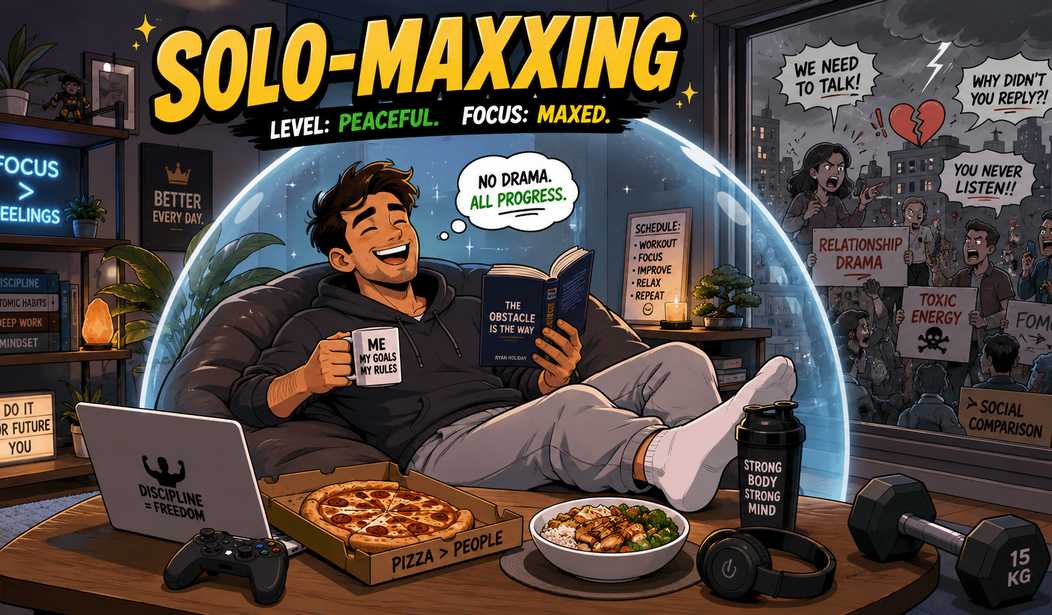
It's called Solo-Maxxing, and there's even a new song on Spotify by Kumosound called "Solo Maxxing (Silver Wolf)" that, appropriately enough, seems to be AI-generated. It's basically the excuse or maybe rationalization that if you get really good at being single — focusing instead on self-improvement, personal peace, financial independence, hobbies, travel, and career — then it doesn't really matter that you're all alone.
One TikToker — of course, it was a TikToker — talked about “the ability to do things by yourself and not depend or lean on anyone else” as “the number one skill you should learn and master in your twenties”.
Clearly, there's a lot to be said for self-improvement, personal peace, financial independence, hobbies, travel, and career...
...but if we may speak frankly with one another, weren't those the things we used to work on so we could score hotter mates?
The culprit behind Solo-Maxxing is the other usual suspect when it comes to birthrates: affordability.
"Dating has gotten so expensive that a growing share of Gen Z and millennials are deciding that the cheapest (and calmest) option is to have no partner at all," Sydney Lake recently reported for Fortune. "The average 'all-in' cost of a date in the U.S., including dinner, drinks, transportation, and pre-date grooming, has climbed to $189, up 12.5% from $168 a year earlier."
Gen Z respondents, however, reported "spending $205 a date, up from $194 in 2025, while millennials now drop $252 per outing, a 32% jump."
Whew.
Lake concluded that "for a lot of young singles, the relationship math just isn’t mathing, so it can seemingly be more rational, in some cases, to exit the dating pool altogether," but I'm not sure that's the whole story.
"Maxxing" is the current slang for maximizing a feature or activity, but you probably figured that out already.
Dating can be scary. Rejection sucks. But I just don't buy the affordability excuse, or at least not entirely.
Just like I marvel at people with starter jobs spending $8 or more per Starbucks visits...
Hang on. I need to take you on a little detour.
When I was young and learning how to pay the rent on pitiably small-market radio wages, coffee wasn't something you went out for. I either made it at home from a giant discount can of Folger's ground beans, or I drank it at work for free. Actually, I did both. I'm not a morning person, but I had to be at the studio by 5 a.m. and energetic and on the air 30 minutes later. So I slammed two cups of homemade before leaving, and then pretty much drank my body weight in the free stuff at the station.
Anyway, just like I marvel at people with starter jobs spending $8 or more per Starbucks visit, it seems impossible to me that Gen Z young adults in their early or mid-20s feel like they need to drop $200 on a date, or roughly $80 in 1990, the year I turned old enough to buy drinks.
Speaking of which, I was involved back then in an improv troupe and a couple of other things, and semi-regularly threw cast parties. My entertainment budget was about $25 for a 1.75 of Absolut, because even young and poor, I wasn't going to serve the cheap stuff. My party prep consisted of putting the vodka in the freezer. My party decorations consisted of removing the bottle from the freezer.
Everyone had a great time, I swear. And when you're 21 or 22 and just starting out, there's something to be said for A) developing a hobby (in my case, improv) that allowed you to meet available and sometimes surprisingly attractive girls while making a (very) small amount of money on the side, and B) partying with them and your friends for nearly nothing.
Today I learned that some young women won't even consider going out with a man unless he sends an Uber to pick her up. Not that the guy is picking her up in the Uber along the way to the movie or whatever, but that he arranges for what amounts to limo service.
“One of my rules is, if a man doesn’t at least offer to send you a car for the date, whether you take it or not, no date!” said Savannah Pagnozzi, a Big Apple lifestyle influencer, in a viral vid reported on by the New York Post. “No. Absolutely not. We don’t do that.”
Click through, and you'll see that Pagnozzi is maybe a 6, and about the only thing she might properly influence me to do is get the Absolut out of the freezer.
That's just one recent story in a broader, years-long trend of young people apparently believing that they have to do — and somehow afford — all the things that they see influencers do on social media.
And where do they see these social media influencers?
More likely than not, on the very same smartphones those two recent studies concluded are at least partly to blame for the fertility crisis.
There's more than smartphones or even totally mid influencers behind today's virtual epidemic of unrealistic expectations.
I believe in free markets, growing the pie, lifting all the boats, innovation, dynamism, and all the rest. I get my internet service beamed down from Low Earth Orbit to a transceiver equipped with a phased array antenna that, in many countries, would probably be impossible (or maybe even illegal) to produce at SpaceX's cost and scale. I hope to see a permanent human presence on the Moon — and maybe even footprints on Mars — in my lifetime.
Wealth creation is freakin' awesome.
But I wouldn't be the first to wonder what it does to set kids' expectations too high, too soon.
Let me give you an example spanning three generations.
And Another Thing: To anyone offended — for reasons inexplicable to me — by Monday's column on so-called "hoarding" by Boomers, let me remind you of something vital. Yes, it is possible to find broadly true trends among large groups of people, and age cohorts are one of many ways to group people. But finding a trend among a group tells you nothing about any particular individual from that group, so please just relax already.
My Dad spent his first two years of college at Purdue, until my grandfather wondered why his grades were so weak and discovered that Dad had spent his time largely majoring in billiards and beer. My grandfather's career was going well, so they weren't hurting for money. Nevertheless, Dad once told me about his group dorm room there — basically a barracks — that was so cold in winter that everybody slept with just their noses sticking out from the blankets.
That was around 1958 or so.
By 1988 at Mizzou, I shared my dorm room with one other guy, and it was comfortably heated and air-conditioned, even if the cement brick walls and linoleum floors hardly impressed. Then again, my full freshman year there — including tuition, books, housing, and meal plan — cost maybe $4,500 altogether.
That's a little over $13,000 in today's dollars.
Try searching for images of state university dorm rooms on social media. If they don't exactly qualify as luxury apartments, some of the ones I found are pretty damned close. And they're all nicer than any apartment I could afford until I was well past college age.
The typical freshman at CU-Denver — same tuition, books, housing, and meals — pays up to $33,000, or two-and-a-half times more in inflation-adjusted dollars. The rooms had better be nice, right?
And if you want to send your kid to a private school, or have to pay out-of-state tuition, you both might be better off buying them a starter home and welding classes. I'm not kidding.
Of course, what makes a $140,000 degree (plus that luxury room) "affordable" is federally guaranteed student loans that have schools piling pricy amenities on top of everything else.
How is a freshly minted Bachelor of Arts supposed to stoop to life in a cheap apartment after living the good life for four years, seemingly for free?
The expectations game is real, and the current system is more than just financially rigged. Setting out on your own for the first time is difficult enough without universities, iPhones, and influencers setting disappointment traps along the way.
On the flip side, I found this comment on an older Reddit thread where Curly Edi laid down the hard truth to recent college grads dissatisfied with life on the outside. "The fact here is that you cannot afford anything better until you're financially secure," Curly wrote, and "the personal growth thing is a bit of a misdirection. You need to figure out how to support yourself and through doing this you will 'personally grow.'"
Emphasis added.
Also: Well said, Curly Edi.
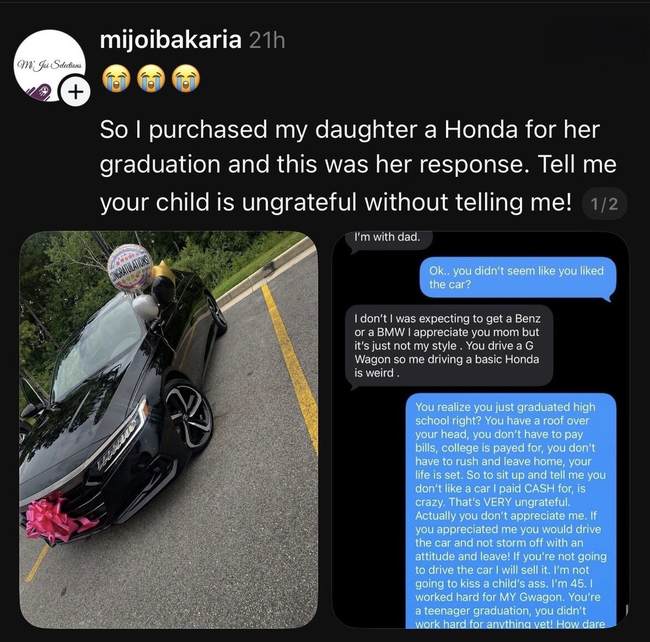
Then there are just the ingrates, like this one from Instagram — but I suspect kids like this one have always been with us and always will.
In debt, perhaps not employable, and with influencers telling them they have to have it all just to go on a simple date, is it any wonder so many young adults opt out of adulting?
We all want our kids to have it better than we did, but maybe parents ought to consider putting a hard floor on the amount of "hardship" kids must learn to cope with. Because out of all of these studies and stories, what strikes me most is what looks like a lack of coping skills.
And Another Thing: Parenting is hard, and there's no one rulebook that works all the time, even for children of the same happily married parents. We have one son who needs constant pushes, and another who's such a social butterfly that when he gets his license later this year, I might break my rule about not buying cars for them, just so I can see my car every now and then.
Look, I get it. Dating can be awkward, and rejection hurts. But we've reached a stage of wealth, ease, and social connectivity unimaginable (yet eminently enviable) by any generation in human history. Yet somehow in all of that, we've managed to create a global phenomenon where young people can't be bothered to procreate, in part because it's too expensive.
For the Solo-Maxxing crowd, they've given up — performatively on social media, naturally — even trying.
Every creature is hard-wired to reproduce, yet we've somehow unwired two generations of human beings.
And we still don't have any fully satisfactory answers to how we got here or how we get out. Sex used to be the answer, but maybe now it's the heart of the question.
Putting down the phone might help. So might teaching kids to avoid the university debt trap, and that not every casual date has to measure up to prom night at The Fortescue-Bankworthy Academy for the Sons of Fortescue-Bankworthy Men.
But that's as close as I have to any answers today. How about you?
Last Thursday: When the Land of Monty Python Stopped Laughing