


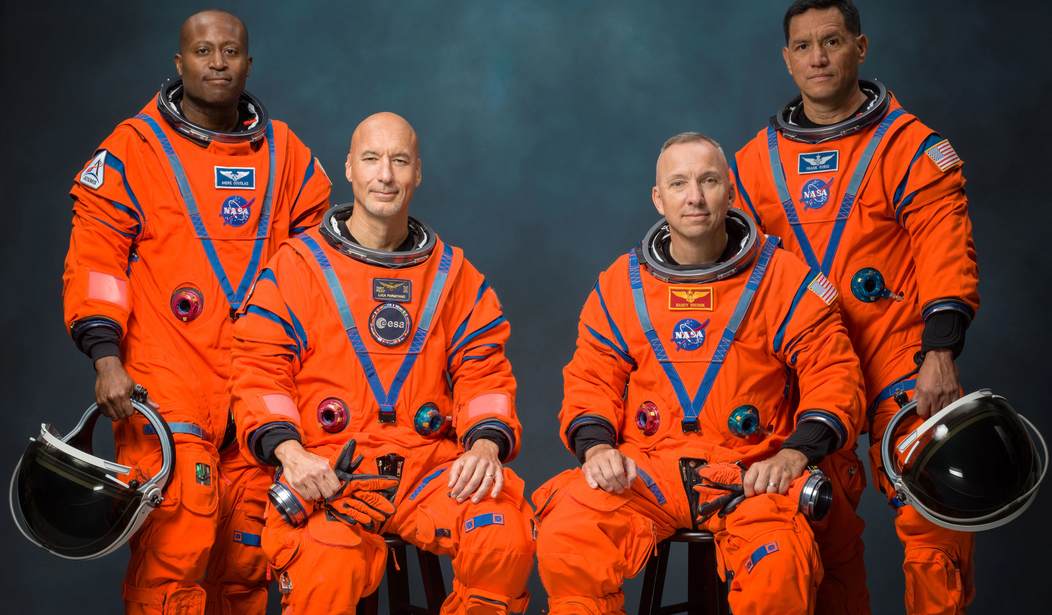
NASA on Tuesday revealed the four-man crew of the Artemis III lunar program, tentatively set for sometime in 2027, and there's so much more riding on this mission than you might suspect.
Commanding the crew is retired Marine Corps flyer (and combat veteran) Col. Randy “Komrade” Bresnik, who, according to NASA, "has logged more than 7,000 hours in 95 types of aircraft/rotorcraft/gliders and an additional 3,600 hours in spacecraft." Bresnik's nickname comes from taking Russian in high school, not because he's a Commie or anything. But his language skills certainly came in handy aboard the ISS.
Italian astronaut and former test pilot Luca Parmitano will pilot the mission. Parmitano has been an ISS crewmember twice, including a long-endurance 201-day mission in 2020, and a lifetime total of six spacewalks.
They're joined by mission specialists Frank Rubio and Andre Douglas.
Rubio is a U.S. Army flight surgeon and serious NASA spaceflight veteran holding the American duration record for the longest spaceflight at 371 days aboard the ISS. According to NASA, Rubio also likes to jump out of things, first as a member of the West Point Parachute Team, then as a Jumpmaster with over 650 freefall skydives. Hopefully, that skill set won't come into play during Artemis.
Artemis III will be Douglas's first spaceflight, but when NASA selected him for astronaut duties, he was already "a senior professional staff member at the Johns Hopkins University Applied Physics Lab (APL) working on maritime robotics, planetary defense, and space exploration missions."
Jeremy Parsons, NASA's Deputy Associate Administrator for Communications, said that Artemis III is "deliberately designed to take calculated risks," and this looks like the crew to make them look easy. All of these men have more awards, degrees, and experiences than I could possibly list in a single column.
If you're looking for a single word for four astronauts, it might be "studly."
During his presentation, NASA chief Jared Isaacman outlined a bold and busy next few years for the space agency, including Artemis, unmanned lunar landings, orbiting the Nancy Grace Roman Space Telescope, an enlarged and reinvigorated X-Plane program, and more.
Artemis III is not the mission it once was, but that doesn't make it any less vital to NASA's goal of establishing a permanent American presence on the Moon.
Artemis I was an unmanned test flight undertaken in 2022, which seems like a lifetime ago. The goal was to make sure the Space Launch System (SLS) works — which, at $4 billion per booster (and $20 billion in development costs), it had better — and the Orion space capsule, as well. In April, we all held our breath for Artemis II, NASA's spectacular return to human spaceflight beyond Low Earth Orbit (LEO) and into deep space. That crew traveled farther from Earth (and I believe, faster) than any humans in history.
Artemis III was originally supposed to be our first manned landing since Apollo 17 in 1972, but circumstances forced Isaacman to shuffle things up.
And Another Thing: I started to write, "a permanent human presence," but quickly thought twice. Apollo was a massive Cold War win, but technological limitations limited its scope to quick visits and small sample returns. So we could afford to be magnanimous and talk about going there "for all mankind." But now we (almost) have the means to deliver tons and tons of material to the Moon on the cheap, and that ups the stakes from "Cold War prestige" to "national defense priority."
Instead of a lunar landing, Artemis III is a planned demonstration flight, including rendezvous and docking tests between Orion and both commercial Human Landing Systems (HLS) — SpaceX’s Starship HLS and Blue Origin’s Blue Moon.
Neither vessel is ready yet, however, and the clock is ticking. Our Artemis III crew members will also test some spiffy new spacesuits from Axiom (also not quite ready) and validate various systems and procedures necessary for getting back to the lunar surface.
Artemis III might lack the drama of II, but I'd say it's possibly the most technically demanding crewed mission since the completion of the International Space Station.
Under Isaacman's revised schedule, the next American footprints on the Moon will be left by the crew of Artemis IV, hopefully sometime in 2028. But that might prove optimistic.
Launches beyond Artemis V will almost certainly rely on SpaceX's massive (and fully reusable) Starship vehicle. That one isn't ready yet, either — and without it, we won't have the lift to establish a meaningful presence on the Moon.
But that's tomorrow. Today, let's wish godspeed to the crew of Artemis III, and to the men and women here on the ground tasked with delivering them the tools and ships they need.
Recommended: Score Two More Big Wins for Israel Vs. Iran... Maybe
I can't send you to the Moon, but I can deliver you tons of PJ Media exclusives.
PJ Media VIP members get tons of exclusive content, including podcasts and video live chats with your favorite writers. You can support alternative conservative news and save 60% with promo code FIGHT.







Join the conversation as a VIP Member