



Russia's well-regarded 4th Motor Rifle Brigade has just the tool for bringing armored warfare back to Ukraine's battlefields: up-up-up-armored tanks covered with everything from wood to steel chains and spikes.
It's called the Giga Turtle, and military analyst David Axe calls it the result of "years of trial and error by Russian troops desperately innovating to protect their vehicles and themselves from Ukraine's first-person-view drones."
It's pretty simple. You start with a standard Russian T-72B3M tank, add "a frame for drone-defeating metal plating and spines, installs floors under the plating to support infantry and hatches for the infantry to ingress and egress." And don't forget the dangling steel chains to cover any gaps.
But we're not done.
Troops also added "a rear extension for extra infantry, frontal rollers to safely detonate mines, and top-mounted radio jammers for protection against wireless drones."
The result: a land-based amphibious assault ship that travels at a turtle-like 6 miles per hour on roads, and even slower over open terrain. Although I'm not sure you could take that thing off-road, even under nearly ideal conditions, without it getting stuck. An un-festooned T-72 tank has a top road speed of about 37 MPH, and 25 MPH or so off-road.
Here it is. Sorry for the fuzzy screencap, courtesy of 4th Motor Rifle Brigade.
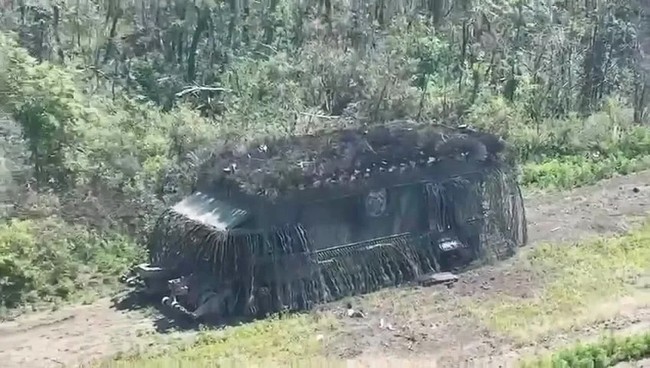
It looks, as my eagle-eyed PJ Media colleague Athena Thorne put it, like a food truck. Well, maybe Satan's food truck.
Russian troops' hope was that Giga Turtles would be enough to end the stalemate over Kostiantynivka, where Ukraine still holds firm after more than a year of heavy fighting.
Here's a slightly older model from last fall in action, if you can call it that:
One of the best turtle tank i've seen so far , actually using main gun , quite decent entrance to load and unload shit and people . Really act as a ad-hoc Heavy IFV pic.twitter.com/JU7VORjjHT
— Helvegen (@Helvegen29) October 17, 2025
Still, you have to credit the soldiers who came up with the Giga Turtle for trying to make the best out of a bad drone situation. On the other hand, even if the crews survive, the Giga Turtles proved ineffective so far in budging Ukrainian troops out of Kostiantynivka.
"The Russians' initial vehicular assaults have all failed — not just along the Kostiantynivka axis but also along the Lyman axis farther to the north," Axe reported. A 54-vehicle assault near Lyman earlier this month ended in what one Ukrainian drone operator called "a massacre."
A tank that can barely see or move isn't much of a tank.
The Giga Turtle's failure in 2026 goes back to something James Dunnigan wrote more than four decades ago in How to Make War: A Comprehensive Guide to Modern Warfare.
It's a great book, updated with revised editions multiple times in the two decades after its 1982 debut. Since then, Dunnigan (along with Austin Bay and others) has run StrategyPage as a virtual version of the book with daily updates. Highly recommended.
Anyway, there's an entire chapter of How to Make War devoted to the never-ending battle in armored warfare between tougher armor and more powerful warheads. "The history of tanks and anti-tank weapons is a story of an endless race," Dunnigan wrote. "Whenever a new type of armor appears, someone develops a warhead that can defeat it. Then someone develops better armor, and the cycle repeats itself."
Antitank missiles "forced tank designers to use composite armor, reactive armor, and other expensive solutions. But each improvement in armor is eventually matched by a bigger or smarter warhead."
The essential problem remains that a tank has to be able to move. You can only up-armor so much — even with comparatively lighter-weight solutions like composite Cobham armor — before a tank simply weighs too much or is so large that it presents an unmissable target.
That's why the Army dropped development of the latest version of the venerable M1 Abrams main battle tank (the M1A2 SEP V4) that would have pushed it to 80 tons. That's up from 60 tons for the original 1980 model, which was already a beast for its time. But as Dunnigan noted in '82, each effort to protect the Abrams against more advanced threats led to more and more weight. Had the Army gone ahead with the M1A2 SEP V4 improvement package, the new tanks would have been unable to cross most bridges, even in first-world battlefields like Europe.
Instead of tacking on more and more stuff, the Army will bake anti-drone systems, advanced networking, and AI into the heart of the M1E3 prototype, which it hopes will get the weight back down to 60 tons.
Drones are the high-tech solution to today's armor, just like shaped-charge missile warheads were to the armor of yesterday. In the never-ending battle between armor and warhead, there's surely a high-tech solution to drones — at least until better drones come along.
But low-tech steel cages and dangling chains aren't it.
Recommended: Slave Labor Returns to Russia, but It Has to Be Imported
Want more like this?
Get exclusive content and support independent journalism with 60% off a PJ Media VIP membership. Use promo code FIGHT and join today.








Join the conversation as a VIP Member