





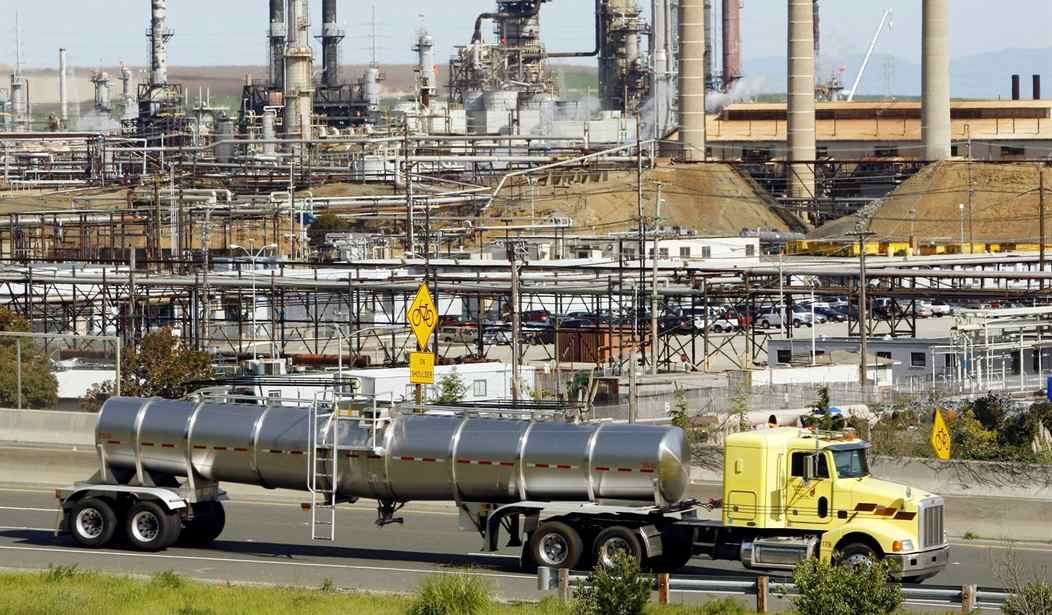
For the first time in half a century, the United States will witness the construction of a brand-new oil refinery. Located at the Port of Brownsville, Texas, this facility promises to supercharge domestic markets, guarantee national security and trigger billions of dollars in localized economic growth.
President Donald Trump’s refinery masterstroke with India’s Reliance Industries is more than a commercial agreement; it is a political and moral rebuke to the climate industrial complex’s war on affordable energy. And it was possible because Asian energy giants refused to bow before climate alarmism when political elites at the United Nations and elsewhere tried to shut down their businesses.
To understand why America needs an Indian conglomerate to build its first refinery in 50 years, you must look at the crippled state of Western infrastructure.
The United States manages about 132 operating refineries capable of processing 18 million barrels per day. The problem lies in their design. Engineers built these facilities decades ago to digest heavy, sour crude imported from places like Venezuela or Canada. They are entirely unsuited for the massive volumes of light, sweet crude currently exploding from American shale formations.
The fracking revolution handed the United States a profound geopolitical weapon: endless reserves of light shale oil. Yet, environmental litigation and climate alarmism prevented the construction of facilities required to process it. The Brownsville project solves this bottleneck.
Trey Griggs of America First Refining calls it “one of the most important energy infrastructure projects in America today.” Planners expect the site to process 1.2 billion barrels of light shale oil valued at $125 billion. Operating with a 60-million-barrel annual capacity, the facility will utilize a deepwater port to dominate global export distribution.
Choosing Reliance Industries for this historic task is the smartest decision the administration could make. Reliance did not succumb to the United Nations' demands to phase out fossil fuels. They ignored the fearmongering. Instead, they chose to build an advanced energy infrastructure.
Reliance runs the Jamnagar refinery complex in Gujarat on India’s western coast. A supersite that processes up to 1.4 million barrels of crude per day at a single location, Jamnagar is the largest single‑site refining center on the planet.
Jamnagar’s Nelson Complexity Index – a measure of its ability to convert lower quality crude into high‑value products – ranks its refinery far above most advanced facilities in North America and Europe.
In practice, that means Reliance can source over 200 different crude types, including poor‑quality barrels, which many Western plants cannot handle, and transform them into low‑sulfur gasoline, diesel, jet fuel, and petrochemical feedstocks.
So when Trump says the Brownsville facility will be the “cleanest refinery in the world” and will power global exports while supporting domestic markets, he is drawing on a track record established over decades in India’s coastal refineries.
The U.S. government is not importing an abstract “capacity” from India; it is importing decades of know‑how accumulated in a political culture that did not demonize hydrocarbons.
While much of Western Europe has treated fossil fuels as a transitional evil to be shrunk as fast as possible, the U.S.–India partnership is moving in the opposite direction. Both India and the current U.S. administration have chosen what can be described as pro‑energy, pro‑people policies instead of appeasing pressure groups that treat hydrocarbons as a moral stain.
President Trump has framed his agenda as “America First” energy dominance, pairing tax and permitting reforms with explicit political support for oil, gas, and coal – from drilling to pipelines to refineries.
India’s leadership, for its part, has rejected binding net‑zero timetables and continues to prioritize reliable energy sources, industrial growth, and job creation over symbolic emissions targets. Prime Minister Narendra Modi recently celebrated a massive national milestone, calling the production of 1 billion metric tons of coal a profoundly proud moment for the country. Analysts expect India's annual coal production to surge by 6%-7%.
This open ecosystem — where oil and gas projects can proceed, and coal remains part of the mix — has allowed regional champions like Reliance to hone skills in complex refining, logistics, and large‑scale project execution.
Asia’s refusal to go along with climate fearmongering has allowed Western countries to now partner with its firms to rebuild energy and manufacturing strength eroded by policies divorced from physical reality.
Enjoying PJ Media? Get exclusive content and support independent journalism with 60% off a PJ Media VIP membership. Use promo code FIGHT and join today.



Join the Conversation
VIP members get the ability to comment on articles.