


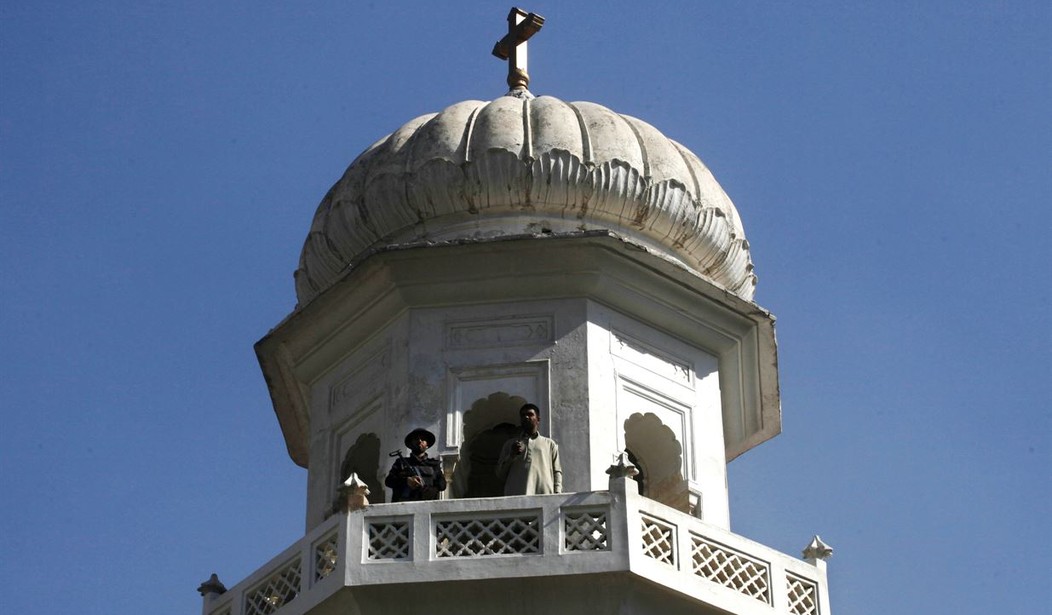
Eleven members of Congress have called on Pakistan’s justice minister to intervene in the case of Neha Faqir, an apparent victim of forced conversion to Islam.
Rep. Chris Smith (R-N.J.), the Co-Chair of the Tom Lantos Human Rights Commission (TLHRC), on August 26 called upon the government of Pakistan to protect the safety and fundamental rights of Neha Faqir, an 18-year-old Pakistani Christian woman, who was reportedly abducted in March and subsequently converted to Islam. A Pakistani court has rejected a petition brought by her family seeking her return.
"The circumstances surrounding Neha Faqir’s disappearance and subsequent conversion raise profoundly troubling questions about her safety, freedom of religion, and ability to exercise her rights without coercion or intimidation,” said Smith.
On August 20, Smith and ten other Members of Congress sent a letter to Pakistan’s Federal Minister for Law and Justice Azam Nazeer Tarar, expressing concerns over Faqir’s case and urging “the Government of Pakistan to take appropriate action to ensure a just resolution of this matter.”
In addition to Smith, the bipartisan letter was also signed by Reps. James P. McGovern (D-Mass.), French Hill (R-Ark.), Gus Bilirakis (R-Fla.), Andy Harris (R-Md.), María Elvira Salazar (R-Fla.), Riley Moore (R-W.Va.), Randy Weber (R-Texas), Michael Cloud (R-Texas), Brad Sherman (D-Calif.), and Blake Moore (R-Utah).
In the letter, the lawmakers urge Pakistani authorities to take the necessary steps within their judicial system to “ensure Ms. Faqir’s physical safety and well-being; ensure she has confidential access to independent legal counsel and an opportunity to communicate freely and privately with her family; and ensure that any further judicial proceedings are conducted under conditions that allow her to express her wishes freely and without intimidation or undue influence.”
The Members also refer to Pakistan’s own constitutional protections, including Article 20, which guarantees freedom to profess, practice, and propagate religion, and Article 25, which guarantees equality before the law.
“Pakistan’s Constitution protects religious freedom and equality before the law—but this means little if a young woman cannot safely and freely express her own beliefs,” continued Smith. “This case is particularly important for Pakistan’s religious minorities, who have been subject to abduction, forced conversion and forced marriage.”
A leading religious freedom lawmaker, Smith has long raised concerns about the abduction and forced conversion of religious-minority women and girls, as well as the failure of authorities to hold perpetrators accountable.
Smith is the author of the Frank R. Wolf International Religious Freedom Act of 2016 (PL 114-281), which significantly enhanced and upgraded the State Department’s toolkit to better promote and advance religious freedom throughout the globe. In July of 2025, Smith chaired a TLHRC congressional hearing on human rights in Pakistan.
The letter said in part:
We are particularly concerned by reports that her family was not permitted to speak with her before or during those proceedings. This case has attracted international attention not only because of the disturbing nature of the underlying allegations, but because it appears to reflect a longstanding pattern documented by Pakistan's own civil society, the U.S. Department of State, the U.S. Commission on International Religious Freedom, United Nations experts, and other independent observers concerning allegations of abduction, forced marriage, and coerced religious conversion of members of Pakistan's religious minority communities.
"Members of Congress from both parties are following this case closely," the letter added.
Christian Solidarity International (CSI) brought international scrutiny to Faqir’s case on June 10, reporting that she disappeared on March 24 after attending a sewing course. She was later found at a madrassa (Islamic school) in Lahore, where she had been converted to Islam.
According to CSI, Faqir appeared before the Lahore High Court on June 9. Her family requested an opportunity to speak with her privately, but the request was denied, and the court subsequently rejected the family’s petition seeking her return.
On June 16, CSI presented Neha’s case at a meeting convened in the UK House of Lords by David, Lord Alton. Lord Alton later wrote to the United Kingdom’s Minister for the Middle East and Pakistan, Hamish Falconer, to ask him to intervene in the case.
Also in June, CSI’s president, Dr. John Eibner, wrote to the Pakistani ambassador to the United States, Rizwan Saeed Sheikh, asking his government to “enable Neha to return freely to her family.”
Every year, an estimated 1,000 Christian and Hindu women and girls are abducted, raped, forced to convert to Islam, and “marry” their abductor. The police rarely act, and the courts frequently fail victims. Survivors endure shame, PTSD, and social stigma.
In April, a group of UN experts expressed serious concern about the “continued and widespread patterns of abduction and forced religious conversion through marriage affecting women and girls belonging to minority communities in Pakistan.”
Joel Veldkamp, CSI’s Director for Public Advocacy, said:
We are grateful to these members of Congress for taking this stand for Neha and for all persecuted Christians in Pakistan. This is an opportunity for the government of Pakistan to end the impunity that fuels violence and extremism in their country, and show that attacks on Christians and other religious minorities will not be overlooked. It is time to bring Neha home.
Hundreds of other Christian and Hindu girls and young women who have been abducted by Muslim men await the day they will return to their families.
A report titled “Stolen Girls” presented by the advocacy organization, Jubilee Campaign, at the European Parliament on July 14 documented 210 cases involving abduction, forced religious conversion, child marriage and sexual violence against Christian and other minority girls between 2019 and 2025.
The report stated that the cases reflect a broader pattern of abuse facilitated by fraudulent documentation, manipulation of legal processes and institutional failures.
The report put the average age of victims at 12.8 years and the average age of perpetrators at 35.8 years. In several of the documented cases, the age difference between the victim and perpetrator exceeds 30 years.
According to the report, more than 83 percent of the victims are under 18.
One of those victims is Maria Shahbaz, 13-year-old Christian girl from Lahore, who was abducted by a Muslim man in 2025. Pakistan's Federal Constitutional Court ruled to leave her in the custody of her 30-year-old abductor, accepting claims of a voluntary conversion and marriage despite birth certificates proving her age. In July 2026, the European Parliament passed a resolution condemning the ruling and highlighting the broader pattern of abductions, forced conversions and child marriages in the country.
Pakistan ranks eighth among the 50 countries where Christians face the most severe persecution in Open Doors’ 2026 World Watch List, which cites systemic discrimination, mob violence, forced conversions, bonded labor and gender-based abuses as examples of Christian persecution in Pakistan.
96% of Pakistan's population is Muslim, making Christians a minority. Christians in the country are exposed to many challenges, from the threat of deadly violence to everyday discrimination.
Christian women and girls in Pakistan face severe gender-specific persecution. They are targeted with acid attacks, workplace harassment, blasphemy allegations, and honor killings. Many remain trapped in debt-bonded labor, such as brick kilns, where they face additional sexual violence and exploitation.
Sanctions against Pakistan for human rights violations—such as the reported abductions, forced conversions, and forced marriages of women and minority girls—are legally and politically possible through specific international mechanisms.
Individual countries or unions (like the United States, Canada, the UK, and the European Union) have global human rights sanction frameworks. These laws allow governments to freeze assets and impose travel bans on specific officials, judges, or police commanders complicit in abuses, without punishing the entire civilian population.
International bodies can also restrict trade benefits. For example, the EU monitors human rights compliance under trade arrangements like the Generalized Scheme of Preferences Plus (GSP+), which gives developing countries duty-free access to markets. Violations can lead to the suspension of these trade preferences.
As Christians suffer from existential threats and abuses in Pakistan, words of condemnation should turn into concrete action to protect the victims and punish the perpetrators. The U.S. government should finally impose sanctions on officials, judges, and other individuals who are complicit in those grave violations against Pakistan's religious minorities.
Editor's Note: Do you enjoy PJ Media's conservative reporting exposing the radical left and woke media? Support our work so we can keep bringing you the truth.
Join PJ Media VIP and use promo code FIGHT to receive 60% off your membership.




Join the conversation as a VIP Member