





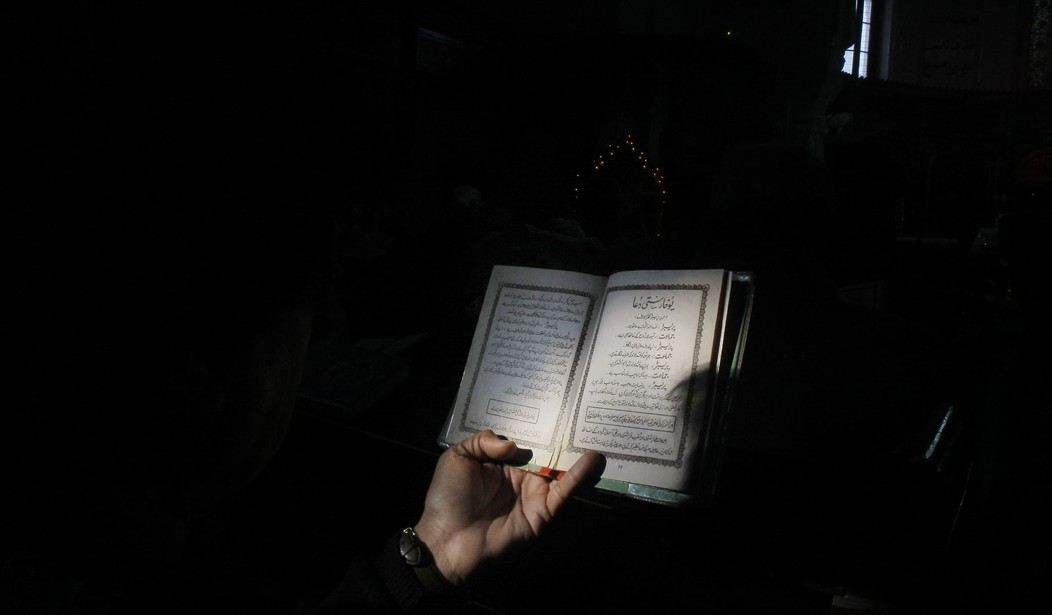
Pakistan's blasphemy laws are among the world’s most egregious tools of religious repression. They enable abuse, mob violence, and the targeting of individuals and religious minorities (including Christians) for criminal prosecutions that carry life sentences and death penalties.
Pakistani professor Junaid Hafeez, for instance, is imprisoned and sentenced to death for alleged blasphemy.
In 2013, police in Punjab Province arrested Hafeez, who was then an academic in his twenties. The professor has remained incarcerated ever since.
In 2019, a court sentenced Hafeez to death under Pakistan’s blasphemy laws following a trial whose delays spanned several years. The trial finally took place inside a high-security prison amid fears of mob violence. Hafeez's appeal has yet to be heard.
According to the United States Commission on International Religious Freedom (USCIRF),
In March 2013, authorities arrested Hafeez, a lecturer at Bahauddin Zakariya University, after his students accused him of blaspheming Islam on social media. In 2014, authorities placed him in solitary confinement after other prisoners repeatedly attacked him. That same year, two gunmen shot to death Hafeez's lawyer, Rashin Rehman, in his office.
In December 2019, a district and sessions court in Multan sentenced Hafeez to death for "insulting the Prophet Muhammad" (Sec. 295-C PPC). He was also sentenced to life in prison for "desecrating the Qur'an" (Sec. 295-B PPC) and 10 years' imprisonment for "intending to outrage religious feelings" (Sec. 295-A PPC). United Nations experts swiftly condemned Hafeez's sentence.
Prior to his arrest, Hafeez received a master's degree in the United States on a Fulbright Scholarship. He specialized in American literature, photography, and theatre.
On February 26, Human Rights Watch (HRW) issued a statement about Hafeez's case. In it, HRW said:
“Junaid Hafeez’s case is emblematic of the unjust and abusive nature of Pakistan’s blasphemy laws,” said Elaine Pearson, Asia director at Human Rights Watch. “The authorities should quash Hafeez’s conviction and safely release him and others held under the blasphemy laws.”
The blasphemy laws, section 295-C, and other provisions of Pakistan’s penal code carry what is effectively a mandatory death sentence. Although there have been no executions, several people are currently on death row, while dozens are serving life sentences for related offenses. Hundreds have been charged under the law in the past three decades.
On February 27, the European Centre for Law and Justice (ECLJ) submitted an official contribution to the U.N. Special Rapporteur regarding summary, extrajudicial, or arbitrary executions in Pakistan. In it, the ECLJ denounces the mandatory and automatic imposition of the death penalty for blasphemy against Islam in the country:
Those accused of blasphemy in Pakistan are sentenced to death by hanging. The death penalty, let alone by hanging, is egregious and disproportionate in blasphemy cases. It clearly amounts to torture. Notably, the Pakistani government has never carried out the death sentence in blasphemy cases. However, the accused spend years on death row. Additionally, many accused, their families, and communities have faced mob violence…
The authorities have also failed to stop mob attacks by private actors, such as fundamentalist individuals and organizations in blasphemy cases. In many cases, mobs gather and attack the accused, their families, and their communities. Where the accused are arrested and tried, fundamentalist organizations continue to pack the courtrooms to intimidate judges. As a result, trial courts rarely acquit the accused, leaving their fate up to the higher courts.
Even an accusation of blasphemy can provoke mob violence against victims, as well as their families and the wider Christian community. On Aug. 16, 2023, allegations of blasphemy against two Christian residents in Jaranwala (Faisalabad district of Punjab Province) led to a Muslim mob vandalizing and destroying over 20 churches and more than 80 Christian houses.
Pakistan’s government has failed to deliver justice for the Christian community in Jaranwala, as well as to prevent further misuse of blasphemy laws, Amnesty International said in 2024:
More than 90% of the suspects of the attack in Jaranwala are still at large… Meanwhile, the trials of those arrested in connection with the attacks, triggered by false allegations of blasphemy against two Christian residents, are yet to start. In addition, around 40% of the minority Christian families affected by the violence are still awaiting government compensation.
The debate concerning blasphemy against Islam has also resurfaced in Europe. The ECLJ notes that in 2023, following public burnings of the Qur’an in Denmark and Sweden and the diplomatic tensions that ensued, the Danish Parliament adopted a law prohibiting the “improper treatment” of writings or objects of essential religious significance, commonly referred to as the “Koran Law,” as it was widely understood to primarily aim at protecting the Qur’an.
In Sweden, authorities authorize demonstrations in the name of freedom of expression, while occasionally invoking public order considerations to restrict some. Iraqi national Salwan Momika, whose Qur’an burnings were protected and supervised by Swedish police, was shot dead at his home in the suburbs of Stockholm on 29 January 2025. He had previously reported threats against his life but did not receive permanent protection. According to the ECLJ, his assassination underscores that criticism of Islam, whether real or perceived, can expose individuals to violence, including extrajudicial killings, even in Europe.
Tragically, instead of urging Pakistan to amend its legislation regarding blasphemy by using diplomatic and economic tools such as the EU Generalised Scheme of Preferences (GSP), from which Pakistan greatly benefits, Europe is importing the very ideology behind the deadly blasphemy laws to the Old Continent. Extrajudicial violence and laws banning or limiting alleged blasphemy against Islam now exist in parts of Europe. Will Europe wake up before university professors there are also sentenced to death according to Sharia law for criticizing Islam on social media?
Editor’s Note: Here at PJ Media, we’ve been dealing with real government suppression of free speech for YEARS. Despite the threats and consequences, we refuse to go silent and remain committed to delivering the truth.
Help us fight back against government censorship by joining PJ Media VIP and using promo code FIGHT to receive 60% off your membership.

Join the Conversation
VIP members get the ability to comment on articles.