





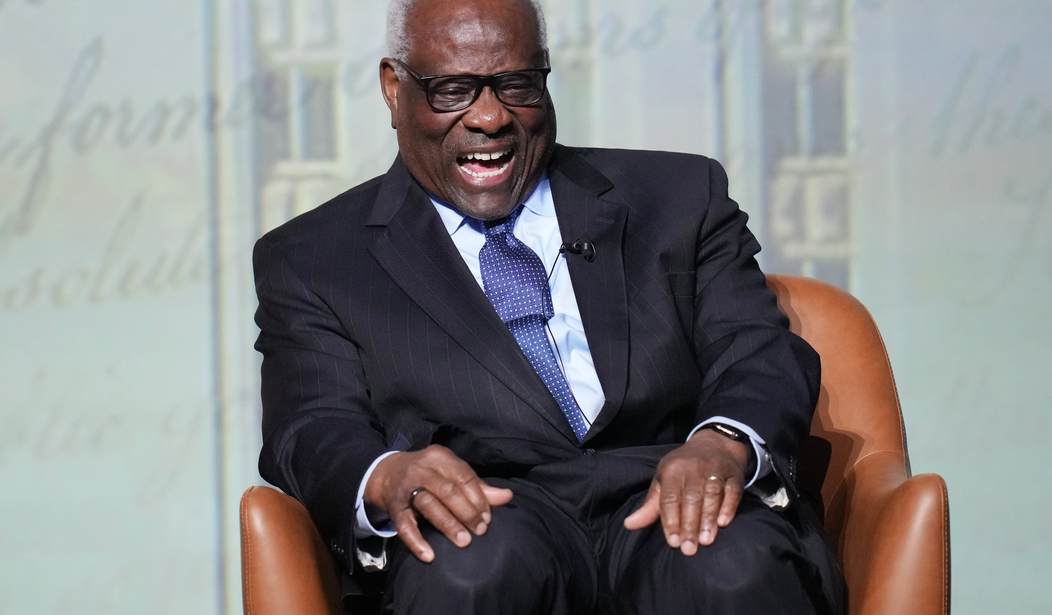
Marijuana stinks, enervates malaise into America’s youth, and even has a tendency to induce panic attacks. But let it not be said that marijuana has no benefits. After all, thanks to marijuana, or more accurately, Congress’s regulation of it, Justice Clarence Thomas has written opinions reminding Americans, and his fellow Justices, that Congress’s powers are not unlimited.
In a recently decided Supreme Court case called United States v. Hemani, the Court reversed a conviction of a man who had been prosecuted under a federal statute that prohibits anyone who uses a controlled substance from owning a firearm. The government prosecuted Ali Hemani under the statute because, while owning a firearm, he used marijuana.
The majority opinion in Hemani asked whether Hemani’s prosecution violated his Second Amendment rights and found that it did. Justice Thomas agreed with that conclusion but wrote a separate concurring opinion in which he asked the more fundamental question: Did Congress have the authority to pass this law in the first place?
The Constitution vests in Congress certain powers, and Congress has no power not vested in it by the Constitution. When Congress passes a law, it must be able to point to a specific power enumerated in the Constitution that allows it to do so. When a representative introduces a bill, he must point to the specific section of the Constitution that permits him to do so, called a Constitutional Authority Statement. Although the Bill of Rights, including the Second Amendment, does place further limits on those congressional powers, the Bill of Rights is irrelevant where Congress lacks the power to pass a law in the first place.
As Justice Thomas’s concurring opinion explains, Congress likely lacked authority to pass the law at issue in the Hemani case.
The Commerce Clause empowers Congress to “regulate commerce with foreign nations, and among the several states, and with the Indian tribes.” As scholarship has made clear, and as Advancing American Freedom has argued several times in amicus briefs, at the time of the founding, the word “commerce” simply meant the trade of goods and “among the several states” meant — well — among the several states.
In other words, the Commerce Clause allows Congress, as Justice Thomas put it, “to regulate the buying and selling of goods and services trafficked across state lines.” By the time Hemani owned his firearm, it was no longer in interstate commerce — it was not being bought or sold across state lines. As such, Congress had no power to regulate it under the Commerce Clause.
Nor is this the first time Justice Thomas has had an opportunity to remind Americans about the Commerce Clause in a case involving marijuana. In a 2005 case called Gonzales v. Raich, federal officials, acting under a statute enacted by Congress supposedly under its Commerce Clause power, seized marijuana plants that individuals were growing in their backyards for personal medical use.
How is growing something in one’s own backyard within the scope of Congress’s power to regulate trade across state lines? It’s not. And yet the Court upheld the seizure, relying on a line of cases starting with one of the Court’s most consequential and harmful decisions: Wickard v. Filburn.
Wickard was a 1942 case in which the Court found that the Commerce Clause empowered Congress to set quotas for wheat production, even when that wheat never entered the market at all. In that case, Roscoe Filburn was penalized because he grew more wheat on his farm than he was allowed under the quota. Filburn did not grow the wheat to sell but for use on his farm. The Court nonetheless claimed that, in aggregate, farmers’ growing of wheat in excess of the quota could have a “substantial effect” on interstate commerce and thus was within Congress’s purview under the Commerce Clause.
Not only did the Court’s decision conflict with the plain language of the Clause, but it also directly contradicted the Founders’ assurances to the Antifederalists during the ratification debates. The Antifederalists were concerned that the proposed national government would swallow up state power. In response, Alexander Hamilton assured readers of Federalist No. 17, “the supervision of agriculture and of other concerns of a similar nature, all those things, in short, which are proper to be provided for by local legislation, can never be desirable cares of a general jurisdiction.”
Justice Thomas was thus on firm footing when he dissented in Raich, arguing that Congress lacks the power to prohibit wholly local, noncommercial activity under the Commerce Clause. As he explained, “If Congress can regulate this under the Commerce Clause, then it can regulate virtually anything—and the Federal Government is no longer one of limited and enumerated powers.”
Justice Thomas’s opinions in Hemani and Raich are reminders that the Court’s job is not to impose the policy outcomes a majority of its justices prefer but to interpret and apply the law as written. Whatever Justice Thomas, or anyone else, thinks of marijuana, the question for the Court is whether a law before it is within Congress’s power to adopt.
The Court’s reading of the Commerce Clause since Wickard has had wide-ranging consequences for Americans’ liberty and the powers the Constitution reserves to the states. Much federal overreach is accomplished in the name of this Clause, a provision that virtually no one, not even the Antifederalists, objected to at the time of the ratification debates. It’s well past time for the Court to reassert the Clause’s original meaning. Justice Thomas is leading the way.
Editor's Note: Do you enjoy PJ Media's conservative reporting that takes on the radical left and woke media? Support our work so that we can continue to bring you the truth.
Join PJ Media VIP and use promo code FIGHT to receive 60% off your membership.
Join the Conversation
VIP members get the ability to comment on articles.