



To get my start in my chosen profession, which during college was the radio business, I felt fortunate to have landed a job working as a janitor at a radio station during the summer going into my junior year, and then manning the on-air studio overnights on the weekends.
I had my broadcasting license and was in charge of the pre-recorded programming and other things during those shifts. While the job paid less than I was making during the daytime at a parking lot, this felt like important work to me, and it was a step on the lowest rung of the ladder of my career. But hey, at least I was on the ladder, I thought, and I was still two years from graduating.
This started a pattern for me of piecing together a number of different types of communications jobs to meet my nut that I needed to pay for college and living expenses. In the process, I learned that if you’re willing to sacrifice sleep, you can get a lot done in a day. That’s also when my lifelong love of coffee started.
The radio station’s building housed it and a sister station. My station was on the first floor. It was the bubblegum Top 40 leader in town. On the second floor was the market's top “elevator music” station.
The first floor was what you might have imagined an AM Top 40 station to be like. The smell of coffee from thousands of micro-spills and bigger ones gave the on-air studio its dominant olfactory aura. Ubiquitous ashtrays, filled by chain-smoking jocks, complemented the stale coffee smell. And a discriminating nose might also have picked up traces of Hawaiian Gold embedded in the fibers of the shag carpet that lined the studio’s walls.
Upstairs, they called the people behind the microphones announcers, not jocks. They were older, more accomplished announcers whose deep, rich, smooth voices matched the “beautiful music” they played over the FM airwaves.
The owners placed the sales force for both stations upstairs, and so when I went up there to perform my janitorial duties, there was a distinct sense of a corporate class system.
One night, at the end of the workday, that was painfully brought home to me as I went from desk to desk in the open-office sales department, dumping ashtrays, coffee grounds, half-consumed paper cups of Coke, and Twinkies into my receptacle.
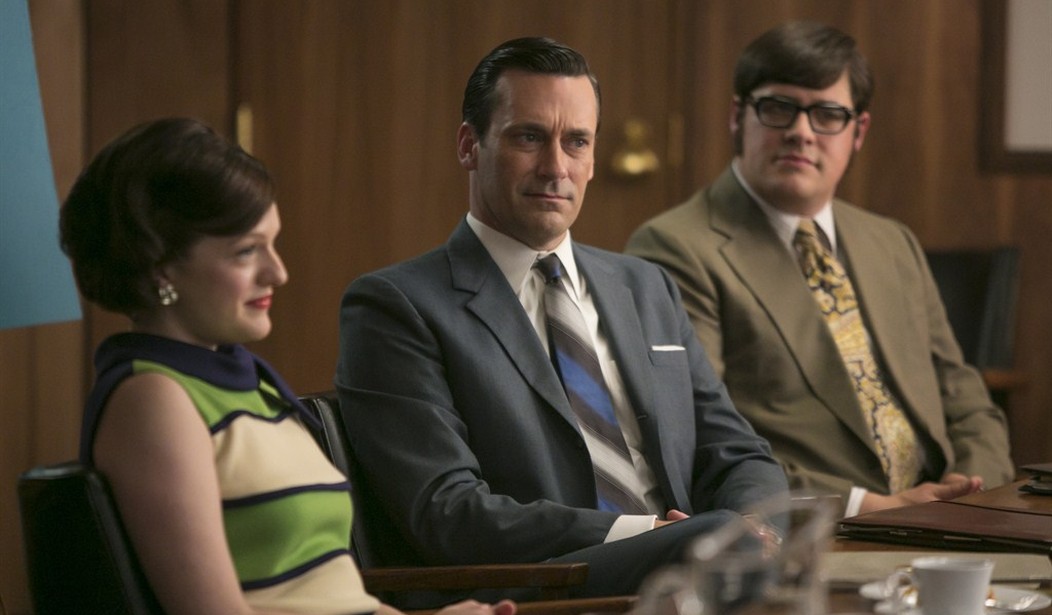
One of the elevator station’s announcers was kicked back in an office chair at one of the desks in the center of the room, holding court with a group of station account executives and secretaries in suits and nice dresses. Think Mad Men.
As I moved around the room, from desk to desk, emptying trash cans, I could hear that he was telling stories and jokes, punctuated by the laughter of the group. I didn’t want to interrupt whatever was going on, and so I attended to every workstation but that one, which I thought I’d get to last.
But then the elevator music announcer directed his attention to me, and not in a good way. Being a professional announcer, he used the best Elizabethan accent he could pull off to command me to come over and empty his garbage can. “Over here, boy,” he said, to the amusement of the group surrounding him, who reflexively laughed at his comedy at my expense.
This episode caught me by surprise, but I knew why I was there and that I couldn’t lose this job, and so I ignored my gut instinct to charge over there and knock him flat off that reclined chair. Instead, I felt a surge of blood rush to my head, which meant my face was probably pretty red with quiet anger as I slowly approached the group surrounding the workstation to empty his garbage can.
I said nothing, but I made a point of making eye contact with each and every one of them. The group was silent as I left the office. For the rest of that summer, I left his garbage can untouched, which meant that the foul mess he was making for someone else to clean up every day fell back on him to clean up himself.
As a college student, I had not given much thought to snobbery before. Quite frankly, it just wasn’t something I’d run into much of before. But this experience and a series of others like it reinforced something my dad often said to me: “You’re not better than anyone else, and no one is better than you. No one.”
By the time I graduated from college two years later and entered the professional workforce, this had become a core tenet of mine. By then I had already moved up into a producer role at the market’s largest radio-TV combination, one of the youngest people to do so at the time, and so I was starting to manage others even before I got my college diploma.
About a year later, I made the jump to an ad agency, where I was a copywriter and producer for radio advertising, and it just so happened that, out of the blue, a local announcer contacted me to see if I would hire him to do some radio spots for my big national client. It was Mr. Elevator Music, the same man who had humiliated me about three years earlier. He didn’t remember me, but I couldn’t forget him.
He wanted to send me an audition tape if I was interested. I said, “Sure.” I wanted to see if he’d remember me if we met, so I asked him to drop it off in person.
A couple of days later, he showed up in our reception area, handed me his tape, and tried to schmooze me for about a minute until I could tell that he didn’t remember me in the least. So I politely thanked him for stopping by, we shook hands, and he left. That's when I walked his tape over to the nearest trash can and went about my day.
Oddly enough, once my career started to accelerate pretty quickly, I really didn’t find myself on the receiving end of such blatant snobbery, but like anyone, I’ve run into my share of more subtle forms. And it’s always been a peeve of mine.
To this day, if emptying a garbage can at a work location is called for, I’ll do it, and I’ll do any other menial task required to get the job done if that’s the way it works. And so, I always figured that as a manager, if I can do it, you can do it.
Prior to starting my own firm, which has always been just a small consultancy, I hired and managed lots of people in a large agency and a major corporation. I expected every person I hired to have the same attitude about work as I did, and if I sensed I had hired a snob, they didn’t last long on my team. Such an attitude was toxic for teams, I felt.
I remember one instance with someone who reported to me who was complaining that he had to do a certain type of work that I, as his manager, was still doing myself, but he didn’t realize it. He felt the tasks were beneath him, and he was making life miserable for those around him for just this reason.
While I didn’t fire him, his time with us ended soon enough, and we were all the better for it.
Over the years, I’ve seen many people who are much better than I am at suffering snobs. I just can’t and won’t. Their toxicity is communicable, and it brings groups down.
In the end, the best way I’ve learned to deal with snobs and elitists is simply not to deal with them. This sometimes drives my wife nuts in social circumstances, but at this point, for me, it is what it is.