


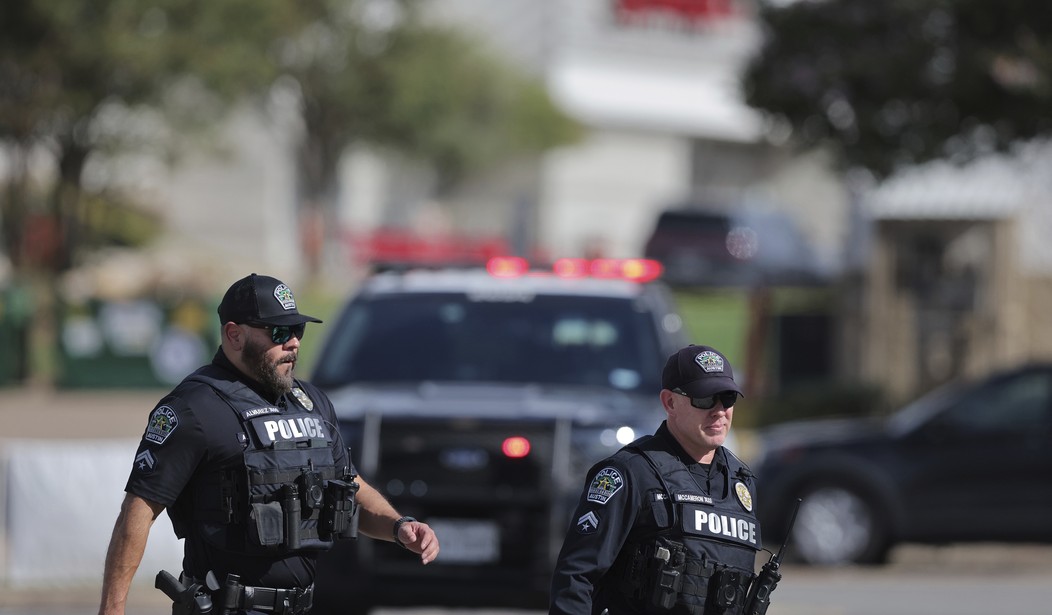
One of the first things you learn about your dad if your dad is a law enforcement officer is that he has a target on his back. You learn that in the world, there are people who wish to do him harm even if they’ve never met him. Just because he wears a badge.
I’ve been thinking about this recently after reading this piece from my colleague Athena Horne: The Super-Simple Solution to Masked ICE Agents — and Why It Will Never Satisfy the Left. She being the wife of a cop, and me being the son of a cop, we shared a couple of bits of our experiences in the comments section to her article.
My father and two of his brothers were City of Pittsburgh police officers. Another brother worked in security for the federal government. Their dad was a cop in the same force. My father-in-law and his father-in-law knew my dad before I even met my future wife because they, too, were cops on the same force.
At my youngest ages, the concept of danger eluded me. I’d watch my dad get ready for work, putting his uniform on, strapping his utility belt to his waist. I'd often take mental inventory of what he was carrying: a revolver, a black jack, sometimes a wooden mace, handcuffs, spray mace, bullets. And yet, the danger of his work wasn't yet real to me.
Still, these aren’t the tools of someone going to a boring “desk job,” as my dad and his brothers used to call them. I still remember my dad’s badge number.
As I grew up, I realized that he saw things in the course of his day that he never talked about, but all too often it was the worst of humanity. Whatever it was he dealt with, he counseled himself and always had a smile and a joke or a funny story for us when he came home.
My wife had a similar experience with her father. One of the only times he talked to her about his work was after one evening shift where he worked the scene of a tragic car accident. All four of the teenagers in the car were pronounced dead at the scene. They were headed to or from their prom, and they were the same age as his daughter, who earlier that week went to her own prom. She said that the accident scene and its timing shook him.
There was one summer in our town that wasn’t a whole lot different than the 2020 "Summer of Love" in Minneapolis. Riots were the thing, and so my dad had to don extra protection, which included a military-style steel helmet and body armor, and that was the first time I ever saw an actual shotgun in our house.
The neighborhood in which we lived wasn’t all that far from the epidemic of violence in the city, and so my dad coached us kids on how to “mind ourselves” since some of the perpetrators of that violence in the neighborhood knew our dad was a cop. Quite frankly, he didn’t want us to get ambushed or baited into a confrontation that would end up with us being “ganged up on.”
We moved after that summer as far away from the danger as possible while still staying within city limits so that my dad could keep his job. These days, if you go by that neighborhood, you’d still think you were in the center of an urban area.
What turned out to be my dad’s last day on the job started like any other. He put on his uniform as he always did and ventured out for what he called “light duty.” He was directing traffic outside of Pittsburgh’s Liberty Tunnels, better known as the “Liberty Tubes.” It was a beautiful May day, as I recall.
I was in school when my dad was standing on a small island just outside of the “traffic booth,” where he could manually control the stop lights if needed. That’s when a city-owned, old-fashioned garbage truck was crossing the busy intersection. Instead of a steel latch to hold the back doors closed, the garbage men had jerry-rigged a rope for the task. As the truck approached my dad, the last strand of rope snapped, and the doors swung open, crushing my dad’s head against the traffic booth.
He suffered a fractured skull, broken ribs, and a number of internal injuries. Within an hour, the radio news in town was reporting that he had died from the accident, and they mentioned his name.
I knew none of this until I made it home at the end of the school day, and two neighbor moms were on our front porch, waiting to greet my younger brother and me. My mom was already at the hospital. No one knew my dad’s condition, but the one thing I was told was that he was still alive.
Something I had learned over the years, hearing the stories of my dad’s fellow officers, was that the danger of law enforcement isn’t like what you see in the movies. Sure, you have to know that bad guys with guns are a major concern. But as a kid, I also heard so many stories of cops who were hit by cars, one who fell from some great height while in pursuit of a criminal, and another who was stabbed by a contaminated hypodermic needle while conducting a search on a suspect.
My dad survived that accident, but it sent him into an early retirement. He had permanent inner-ear damage, which sometimes affected his balance. I watched him rehab himself back to health every day using a rope, a pulley, a metal bucket, and some rocks on our back porch. This was to get his range of motion back, but it did more than that. The daily discipline gave him the mental focus he needed to will his entire being to come back from his injuries.
I was too old to call something like this a core memory, but I can say his example stuck with me. He embedded in me a belief that sounds cliché but is so true: It’s not the getting knocked down part that’s most important; it’s how you get back up.
While we always knew my dad worked in a dangerous profession, it was the most innocuous of scenarios – while still dangerous – that retired him and almost killed him.
As you continue to see reports of ICE agents and federal officers making news for just trying to do their jobs, and as we get closer to the 25th anniversary of 9/11, I’d like to share a couple of things to think about.
First, those feds aren’t doing it for the money or the power that comes with a law enforcement job. Most are doing it out of a sense of service. It’s the one way that many of them feel qualified and capable of making a difference so that you and I have a safer world in which to live. I truly believe this, because I’ve seen it.
Second, when we talk about sacrifice, we’re not just talking about the men and women on the front lines; we’re also talking about their families, who share their loved ones with the general public.
As we start to see the steady stream of 9/11 commemorations, I’m sure you’ll see your share of tributes to those firefighters, EMS professionals, and police officers who charged into danger to help others. Do not brush this off. That was the mindset of those people who gave their lives, willingly, that day. And it’s still the mindset of nearly every law enforcement officer you come across in your day, along with all of the first responders you meet along the way.
When you see an officer in uniform, you have to know that earlier in that day, before you crossed paths, when he or she put that uniform on, the officer mentally and knowingly braced himself that from that moment on, anything could happen. He knew and accepted that the chance of being called upon to risk his very life for someone else just went up.
That’s the risk law enforcement officers are taking for you and me, and all they really want from us is our gratitude.
Also for our VIPs: Rush Limbaugh’s Parting Advice to Conservatives: We Can’t Let Them Win Again