


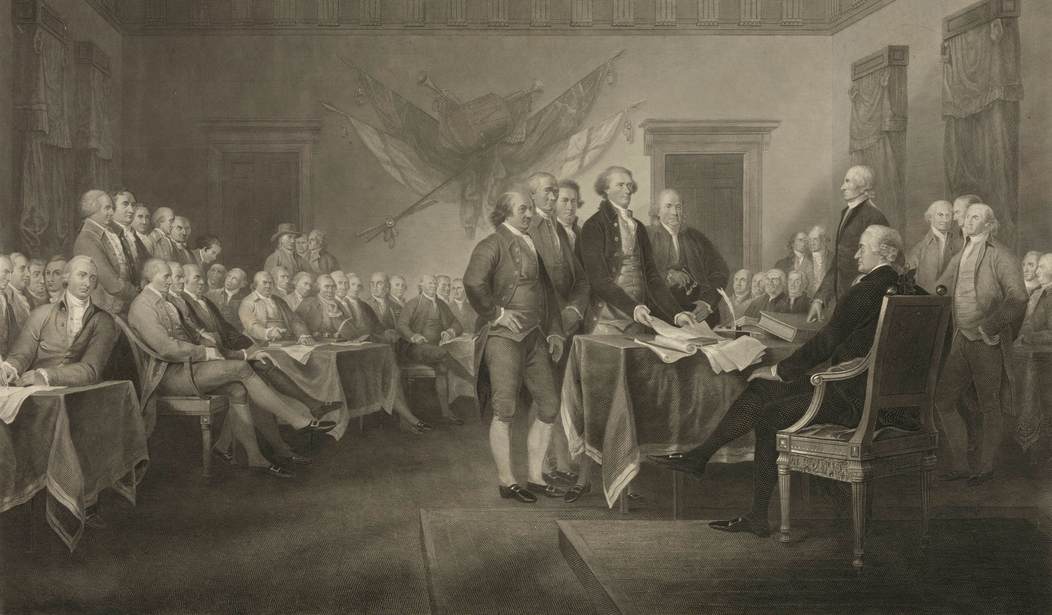
Did you know that on July 4, 1776, only 12 of the original 13 colonies had endorsed the Declaration of Independence? The delegation from New York did not give its endorsement on that day.
Here’s what happened. On July 1, 1776, the Second Continental Congress met in Philadelphia. The next day, all of the original colonies with the exception of New York voted in favor of a motion for independence from Great Britain that was put forth by Richard Henry Lee.
Over the next two days, those in attendance debated and kept revising the language of the Declaration itself, which Thomas Jefferson famously wrote.
It was on July 4 that Congress officially adopted the Declaration of Independence, which is why we celebrate Independence Day on that date.
According to the historical website The American Founding from the Ashbrook Center, still only a little over half of the delegates were actually present on the Fourth to adopt the Declaration: “Based on the limited evidence, and in light of Jefferson’s note on the debates on July 4, it is likely that between 34 and 41 delegates were present to approve the Declaration of Independence on July 4.”
Other sources say it may have been as many as 49.
It would be another month before those iconic signatures would find their place on that parchment. In that time, New York’s delegates had to seek authorization from their home assembly to officially endorse the Declaration. So, while on July Fourth the Continental Congress adopted the Declaration, New York abstained. On July 9, New York officially adopted the Declaration of Independence at a meeting of its own Fourth Provincial Congress in White Plains.
Before the Declaration could be signed, it had to be written on parchment paper clearly and legibly, which took about two weeks to accomplish. And so, it wasn’t until Aug. 2 when the bulk of the delegates actually signed what was then an enlarged copy of the Declaration.
By then, New York’s delegates – William Floyd, Philip Livingston, Francis Lewis, and Lewis Morris – were able to join the others and sign the Declaration. But even then, not all of the Congress’s delegates had signed. Matthew Thornton of New Hampshire was the last to sign and became one of what historians consider the original group of signers. You’ll find his signature today at the bottom of the document.
Harvard University’s Graduate School of Education operates the Declaration Resources Project, which maintains resources about the Declaration.
Eight men who were present on July 2nd never signed the Declaration, including most of the Pennsylvanians who either abstained from voting or voted against independence: John Dickinson, Charles Humphreys, and Thomas Willing. The other Pennsylvanian delegate who abstained -- Robert Morris -- signed on August 2nd. The New York delegation abstained from voting on July 2nd, and four delegates -- John Alsop, George Clinton, Robert R. Livingston, and Henry Wisner -- never signed the Declaration of Independence. Remember, Robert R. Livingston was a member of the Committee of Five, and yet not a signer.
Conversely, eight men signed who weren't even elected to Congress until after July 4th: Matthew Thornton (NH), William Williams (CT), Benjamin Rush (PA), George Clymer (PA), James Smith (PA), George Taylor (PA), George Ross (PA), and Charles Carroll of Carrollton (MD). Thornton famously requested permission to sign the Declaration of Independence, even though he wasn't elected to the Continental Congress until September 1776.
The one delegate who voted for independence and never signed the Declaration of Independence was John Rogers of Maryland. The one delegate who voted against independence and still signed the Declaration of Independence was George Read of Delaware, the Resources Project wrote.
If you look at the signatures on the Declaration, you’ll find that there is an order to it all. States are mostly grouped geographically, from north to south, starting with New Hampshire and ending with Georgia. Josiah Bartlett of New Hampshire signed at the top, and George Walton of Georgia signed at the bottom.
“The Declaration of Independence was signed by the majority on August 2nd, but it took several months if not years for all of the signatures to be added. This makes the Declaration of Independence a little different from other documents from the Continental Congress,” recounted the Declaration Resources Project.
So, as you prepare to celebrate July Fourth and America’s 250th birthday, just know that it didn’t all happen in one day, and that it took about a month to give us that iconic document we celebrate today. Maybe that will inspire you to spread your celebrations of America's independence throughout the month and not just on the Fourth.