


America’s founding fathers shaped the form of government that would serve the United States of America after much debate and deliberation, but not before a tremendous amount of study of other forms of government and learning from some of the world’s great thinkers and philosophers. They studied ancient Rome and its republic. They examined Athens and its democracy, which most of the founding fathers felt was an unstable form of government, where leaders tended to make decisions based on emotion.
They studied the thinking of John Locke, who was born in 1632 and died in 1704. He came up with the radical idea of self-ownership and the right to own property. Most Americans today may be surprised to learn that not very long before the American Revolution, no one seriously considered a world where the individual citizen was not a subject to a king, and who had a fundamental right to own his own house or land.
Locke believed that if you work for something, you should own it. For example, if you’re a farmer, you should have the right to own the fields on which you work. Not that they should be granted to you, but that you should have the chance to earn the right to own them. He maintained that the role of government should be restricted to protecting the life and the property of its citizens, and that government itself is only necessary because there has to be a way to mediate issues and differences that arise within a society.
Locke also wrote about the need for tolerance so that citizens can have the right to freedom of religion and freedom of conscience.
Having lived under the thumb of the British monarchy, the founding fathers knew what they didn’t want, as well. They didn’t want to live under a ruler or a ruling class. And so, when they set out to create the blueprint for the American form of government, they drew upon all of this to come up with something unique - an American republic.
The founding father credited with best visualizing and articulating the American republic is James Madison. This is specifically tied to one of his contributions to The Federalist Papers, his Federalist No. 10, which he penned in 1787 after the U.S. Constitution was drafted.
For context, the Constitutional Convention adjourned in September 1787. That’s when certain founding fathers engaged in a passionate public debate over the specifics. Every state had yet to vote on ratification of the contents of the document.
New York newspapers published a series of articles by different authors using the collective pseudonym “Publius.” The authors were Alexander Hamilton, James Madison, and John Jay. While the three debated their vision for America, all advocated in support of the Constitution. In all, there were 85 articles written and published by the summer of 1788. John Jay wrote five of them. Madison and Hamilton wrote the rest.
In Federalist 10, Madison advocated for a form of republican government described in the Constitution. Opponents of the Constitution as drafted felt that the government proposed was too large and that it would be unresponsive to the public.
Madison, for his part, focused on majority rule versus minority rights in Federalist 10. The thrust of Madison’s argument was that as the new nation grew, it would be the diversity of the population, combined with many different factions in society, that would save the country from tyrants, dictators, and monarchs.
He felt that as specific groups would have to negotiate with each other and make compromises, the minority factions would be protected. Keep in mind that when we talk about “minorities” in this context, it’s not about race but rather a specific segment of the population and perhaps a geographic area, like citizens from rural parts of a state, as opposed to those who live in the cities. Or those states with fewer citizens than the ones with more densely populated towns and cities.
Madison believed that as America became a nation of factions and groups with distinct interests, given the country’s size, it would be next to impossible for one faction to gain absolute control over another or all of the others.
“The influence of factious leaders may kindle a flame within their particular States, but will be unable to spread a general conflagration through the other States,” Madison wrote.
In Federalist 10, Madison compared a pure democracy with a republic. He said that in a pure democracy where the people assemble and run the government directly through majority vote, society “can admit of no cure for the mischiefs of faction.” In other words, he felt that a faction could hijack and dominate the decision-making and policymaking process. This, he felt, would step on the rights of those in the minority, or even the public good.
Madison called this “the tyranny of the majority.”
He and the other founding fathers favored a representative republic where the people elect leaders who then run the government and deal with all of the issues of governance in service to the people who voted for them.
The theory was that elected representatives would be selected by the people for their wisdom and virtue. (cough, cough). And the process itself would minimize fleeting public sentiment, mass emotional response to issues, and collective impulse. In other words, the system would be designed to require time for deliberation, debate, and collective analysis. This, Madison and the majority of the other founding fathers believed, was more in keeping with the common good.
John Adams agreed with Madison on his concern over the tyranny of the majority. He said that “Democracy never lasts long. It soon wastes, exhausts, and murders itself. There never was a democracy yet that did not commit suicide.”
And so, to ensure that the republic fulfilled its potential and its purpose, the founding fathers decided to make this a nation of laws as opposed to the popular will of the people at any given time.
They built in separation of powers, along with checks and balances. Three branches of government: the Executive, the Legislature, and the Judiciary. They created a Congress that ensured localized representation in the federal legislature. And they created a Senate that, by comparison, focused more on national and federal issues, and one that, with only two senators from each state, ensured that no matter how small or large a state may be, it’s on equal footing with other states in the Senate.
For presidential elections, they created the Electoral College, which further ensures that a small group of more densely populated states, counties or cities can’t dominate those who live in smaller or more rural areas.
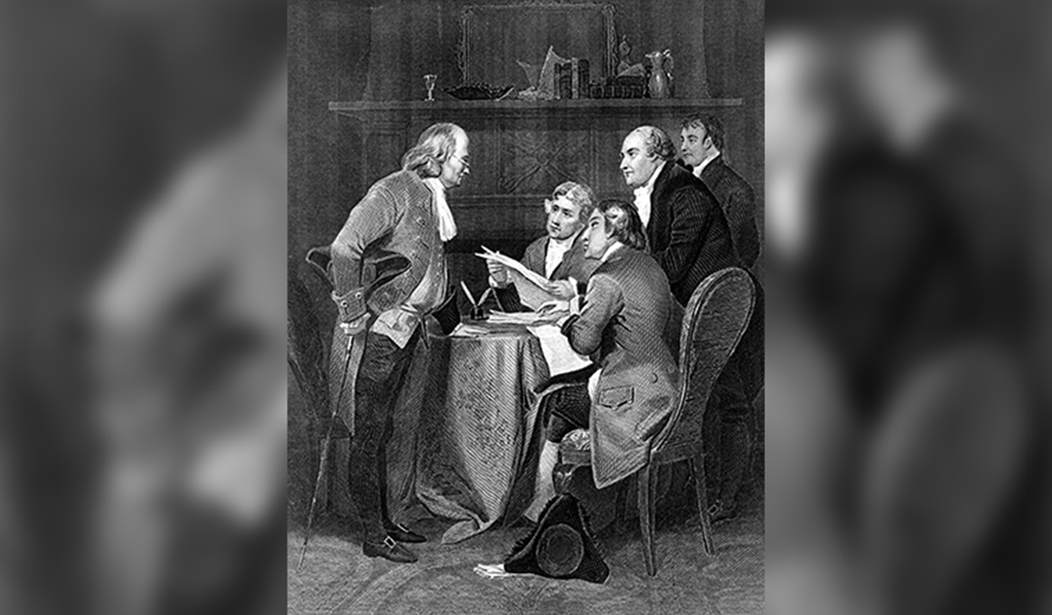
On Monday, Sept. 17, 1787, the delegates met for the final time to complete the drafting process of the Constitution. They engaged in some final debating and negotiation before most of them signed the document. Their signatures had no legal weight. They were more symbolic than anything, because in order for the Constitution to become the law of the land, it had to be ratified by all 13 states.
That’s when that campaign started to try to persuade all of the states to get on board, part of which included those Federalist Papers.
Benjamin Franklin, the 81-year-old elder statesman from Pennsylvania, was on hand. James McHenry was a Maryland delegate, and he kept a journal. In it, he wrote about what he saw and heard on that last day of the convention. He recounted one exchange between a Philadelphia socialite named Elizabeth Willing Powel and Franklin, where she asked, “Well, Doctor, what have we got, a republic or a monarchy?"
Franklin replied directly, “A republic, if you can keep it.”