


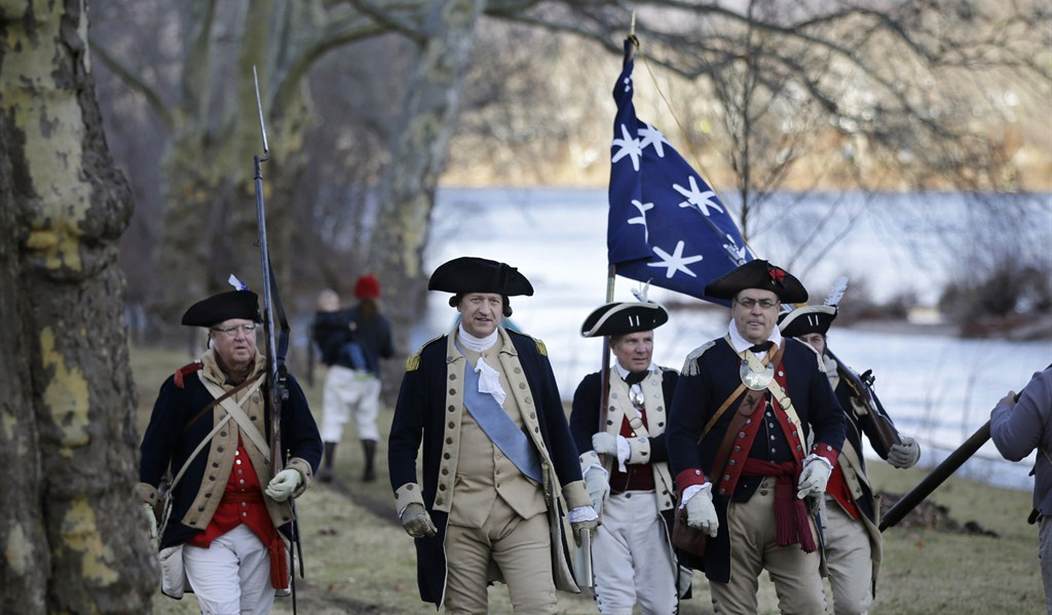
No matter who you are, if you have even a passing knowledge of the American Revolutionary War, you can picture the British regulars in their red coats and the rebellious American patriots in blue. So, what’s the story behind those first uniforms of the U.S. Army?
As we’ve talked about in other installments of this series, the Continental Army struggled to keep its troops armed, fed, clothed, and protected from the elements throughout the war.
Since the first fighting units were militias and not populated by enlisted men just yet, many of them came into the war with their own uniforms, and just as often, they wore the clothes on their backs – civilian clothes.
Because the commander of the Continental Army, Gen. George Washington, came from one of the most sophisticated and respected fighting forces in the world – and the enemy he now faced – he instinctively understood the importance of the uniform, and in uniformity and conformity in shaping a cohesive fighting force.
Hunting shirts were some of the most common fighting apparel for the men since the shirts were made of linen, which breathed and absorbed their perspiration in the literal heat of battle. They also had looser or roomier sleeves that allowed for better range of motion when trying to load and reload those muskets.
The shirts were also an inadvertent innovation in battlefield attire in that they typically were light brown, tan, gray, or a dirty off-white, which, when compared to the British red coats, provided a rudimentary amount of camouflage. In the process, they provided some of that uniformity as well, making it easier to distinguish between friend and foe. Though, to be sure, the methods of warfare of the day called for armies to fight out in the open often as not.
The soldiers could make the shirts themselves, buy them, or simply bring them into battle with them, without relying on and waiting for the newly formed American government to provide them.
On their heads, the troops wore black tricorn (“three-pointed”) hats that were made of a variety of materials, from felt to leather. An important detail was the presence of a black cockade, or a knot of ribbons, that the soldier wore on his hat.
In full uniform, the soldier would wear a waistcoat overtop a linen shirt. In the very beginning, the color of that coat had not yet been decided. The trousers they wore, which we might call knickers, were called breeches. They were cream in color, typically, and they ended just below the knee. The troops wore wool stockings if they could get them.
Leather shoes with a buckle (instead of laces) were the most common footwear. In terms of fit, the shoes were usually custom-made, but still cumbersome and uncomfortable at first. As the soldiers would break them in, the leather would mold itself to the contours of the individual soldiers’ feet. Toes were squared, and both left and right shoes were identical when new, only adapting to the specific foot over time.
By default, the original color of the Continental Army was a mosaic of brown, gray, and tan in those early days. On the other side of the lines, the British “Redcoats” wore those red waistcoats, made of wool. Sometimes, certain British troops did wear blue, but it was uncommon. White breeches, a white wool vest, and black buckled leather shoes finished the outfit off.
Related: ‘America 250’ Tuesday: Who Was John Hancock?
While the British wore a black tricorn hat, just like the Americans, they also wore other headwear, depending on the rank of the one wearing the hat.
After July 4, 1776, the Continental Army introduced and outfitted the majority of its members in more distinctive uniforms, with blue as the dominant color. Historians say this is because Washington liked the color blue, and so the army adopted it as its most prevalent uniform color. The hue had common appeal among the troops and stood in contrast to the red coats worn by their enemy.
Regiments started to stitch patches on soldiers’ headgear to distinguish the troops in one regiment from another. They’d also display these symbols on regiment flags.
Soldiers would attach an ammunition box to a white cross belt they wore over their blue coats. They wore white breeches, and over their lower legs, they’d wear gaiters, which were a type of covering garment that protected the lower legs and the upper part of the shoe. They were usually made of canvas, and soldiers liked them because they helped keep mud, dirt, and sand out of their shoes.
Cavalry troops and officers often wore black leather boots that covered the leg up to the knee.
After the French joined forces with the Americans in 1778, Washington was able to better standardize his army’s uniforms while integrating the French influence on uniform design.
That was when American officers started to wear the “chapeau de bras,” a bicorn (“two-pointed hat”) that the officer could fold and carry under his arm more easily than the tricorn hat.
The net effect on the uniforms from the French alliance was a more professional-looking army. Fabrics and materials were more durable and resilient, which overall reduced problems associated with the need to keep restocking and distributing cheaper and less durable uniform pieces. This made it easier for the army’s leaders to spend more time organizing and training the troops.
Because it wasn’t until late in the war that Washington was able to outfit his entire army in the standard uniform, the brown uniforms and hunting shirts were adopted as an unofficial variation of the standard uniform of the army.
After 1779, Washington was finally able to institute uniform standards throughout the entire Continental Army.
Enlisted men wore the black tricorn hat throughout the war. The cockade on the hat became black and white, while the French wore a white cockade.
The army standardized the dark blue wool coat. The coat, in turn, featured different colors, depending on which colony the wearer might be from. If you were a soldier from a southern state, your “facings” on the front of the coat would be blue. Facings were your lapels and sleeve cuffs. If you were from the “middle colonies,” your facings would be red. If you were from New England, your facings would be white. Soldiers from New York and New Jersey wore light brown facings.
The standardized breeches were white or beige with gaiters.
Washington decided that to tell what rank a soldier was, based on his uniform, it all started simply by making sure the officers actually had uniforms. In the early days, if someone had a full uniform, chances are he was an officer.
As more and more enlisted men received their uniforms, officers were given colored epaulets that would be sewn onto the shoulder of the coat. Sometimes, in combination with or separate from those epaulets, an officer would carry a saber or hunting sword to indicate his status.
Other times, officers would have a different color of cockade on their hats.
Original artifacts of those first Continental Army uniforms are still around today, mostly in museums and private collections. At the same time, there is a cottage industry of recreations of those uniforms for a large community of living historians and reenactors.
You’re sure to see some of this on your travels this year if you do any amount of American Revolution tourism. When you do, you’ll now be able to tell which state the reenactor is supposed to be from, his rank, and perhaps what period of the war he represents.
I love that our honor guard was dressed in Continental Army uniforms!
— ScottO USA ISTJ I/III/IV/iv (@gscottoliver) April 28, 2026
via @wayward_okie https://t.co/EDWOBtURga