


While the Revolutionary War officially started on April 19, 1775, with the battles of Lexington and Concord, it can be useful to go back to years before that to better understand some of the people and dynamics that would come to play later during the revolution.
The Battle of the Monongahela, which happened 20 years earlier is one such event, primarily in how it shaped George Washington. This was during the French and Indian War when Washington was in service to the crown.
As an aside, I became familiar with this story as an 11-year-old Boy Scout when our troop, along with many other troops, participated in a rainy, muddy campout throughout the woods and battlefield surrounding a fort that figures into this story – Fort Necessity. At least once or twice a year, I have reason to drive by it on Pennsylvania’s Route 40. If you’re traversing the state any time soon, and you have the time, I’d recommend ditching the highway if you’re in the neighborhood and checking it out.
Fort Necessity is best remembered as the site of the first battle of the French and Indian War, and one of the few blemishes on Washington’s military career, though he may have described it more as a learning experience. The small round fort he built was hurriedly constructed near what is now Route 40, about 60 miles from the confluence of the Ohio, Allegheny and Monongahela rivers – now Downtown Pittsburgh.
Washington was an inexperienced 22-year-old officer at the time when both the French and the British were trying to lay claim to the Ohio River Valley, which encompassed western Pennsylvania and into Ohio.
The French had established a presence in the region, and Virginia’s governor sent Washington to the area to check that presence. Washington was allied with a group of American Indians when he decided to attack a French scouting party.
The first shots happened at the crest of a steep mountain, which is now called Jumonville Glen, named after French-Canadian Joseph Coulon de Jumonville, who was killed in the fighting. The French didn’t believe Jumonville was just a casualty of war, but rather the victim of an assassination.
They responded with a much larger force than Washington led. Once he realized what he was up against, he retreated and slapped something together that barely meets the definition of a fort. To make matters worse, it was on lower, flat ground. Sitting in that fort with the French army coming down on you had to make Washington and his troops feel like sitting ducks. This feeling was made only worse by the weather. The two sides fought in a downpour for a day before a disgraced Washington surrendered. This was his only surrender in his career. Still, he lived to fight another day.
The British had not been able to capture the French Fort Duquesne at the head of the Ohio in what is now Downtown Pittsburgh. Still, they were persistent and intent on doing just that, and so a year later, the army assigned British Gen. Edward Braddock the job of purging the French forces from the region. Washington accompanied Braddock as they led their troops westward toward the three rivers in the Ohio River Valley.
Battle of the Monongahela
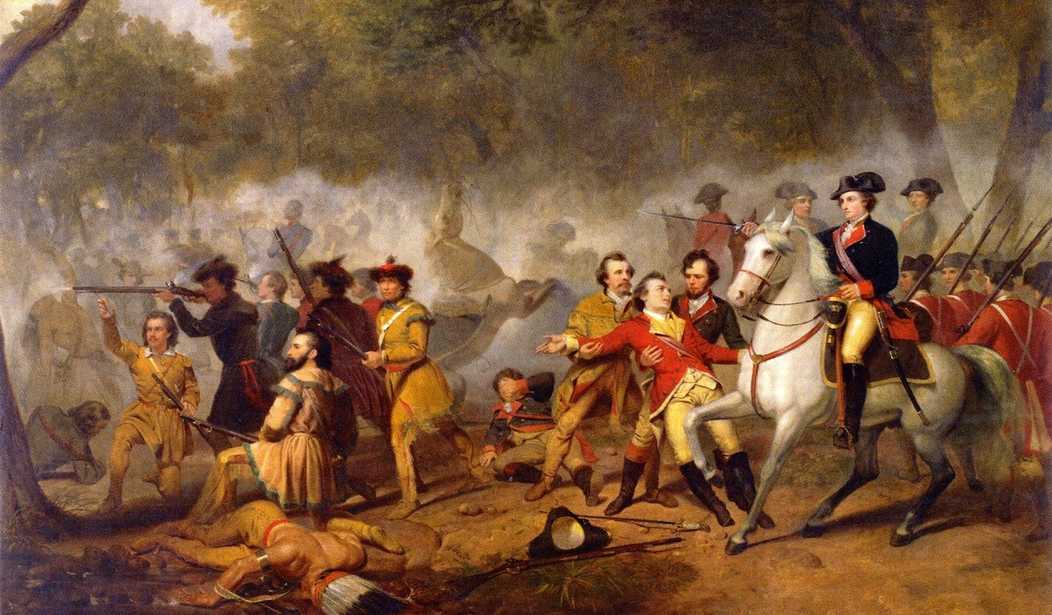
On July 9, 1755, Braddock’s troops were working to clear the way to build a wider road for the army when the French and a group of Indians attacked them.
When the French attacked, the Indians hid in the woods and fought from both sides of the road. The British troops tried to fight back the only way they knew how – as a long army column. But the terrain, combined with the unconventional tactics used by their attackers worked against them. With an enemy on all sides and no way to really spread its forces out, it started to look like the British army had only one option – retreat.
The two sides fought for hours. The French almost completely annihilated Braddock’s army. In order to salvage what he had left, Braddock ordered a retreat. Not long after that, a bullet from an enemy gun hit Braddock in the right arm, but then continued into his lungs.
Braddock did not die instantly and he remained conscious, but he was gravely wounded, and so the baton was passed to Washington. He had to execute Braddock’s orders and carry out the retreat.
The first thing Washington did was to make sure to get his general out of harm’s way. The British troops made their way back across the Monongahela River, while their enemies got sidetracked by looting what was left on the battlefield.
Washington gathered roughly 200 men, which would not do if a counter-attack was required. Braddock knew that Col. Thomas Dunbar was nearby, and he likely had more men and supplies that would be invaluable for a counter-attack. He ordered Washington to find Dunbar.
Young Washington was able to locate Dunbar who was about seven miles away. Braddock’s men took him and what was left of their force to Dunbar’s encampment, where Braddock turned over command to Dunbar, who planned a more deliberate retreat. Braddock then died from his wounds on July 13, 1755.
The next day, Washington found a place along the road to bury Braddock. To keep the French from identifying the gravesite and desecrating it, Washington made sure it was in the road, literally, where the tracks of wagons and horses would better conceal its location.
Before he died, Braddock passed along his officer’s sash to Washington.
Historical accounts are that 977 of Braddock’s 1,459 men were killed or wounded. Under Dunbar's command, the remnants of Braddock’s army made it to Fort Cumberland in Maryland. From there they went to Philadelphia for the winter.
British settlers in western Pennsylvania had to wait years before the British would successfully attack Fort Duquesne and take it, which happened on Nov. 24, 1758. They then renamed the outpost Fort Pitt.
That location where the three rivers meet was of huge strategic importance for a number of reasons. First, it would give the British control over the water transportation and shipping routes that go into the country. Second, while no one knew exactly how far west the western civilization could expand from here, the head of the Ohio was largely seen as the gateway to national expansion, along with access to all of the riches the wilderness could provide.
Today, a fountain and a park mark the spot where Fort Pitt was located, feet away from where the old Fort Pitt blockhouse still stands.
None of this may have been achieved had it not been for a resilient and decisive young officer in his 20s named Washington. He earned tremendous respect throughout the army after that. It put him on track for a military career that set him up to be the logical choice to lead the Continental Army in the 1770s when the colonists decided to for and form a new nation.