Let's get a little unserious for a moment, shall we?
There's been a lot of talk about what the various members of Donald Trump's Cabinet eat lately. Many have noted that Vice President JD Vance has slimmed down a bit in recent months. He said part of it was giving up sugar for Lent, but he also called up Robert Kennedy, Jr., who told him he had some diet ideas that were "better" and "more intense."
Secretary Kennedy then suggested a diet of mostly protein and sauerkraut. Vance concluded that "if you want to lose weight, call Bobby Kennedy. But if you want to enjoy what you eat, do not call Bobby Kennedy."
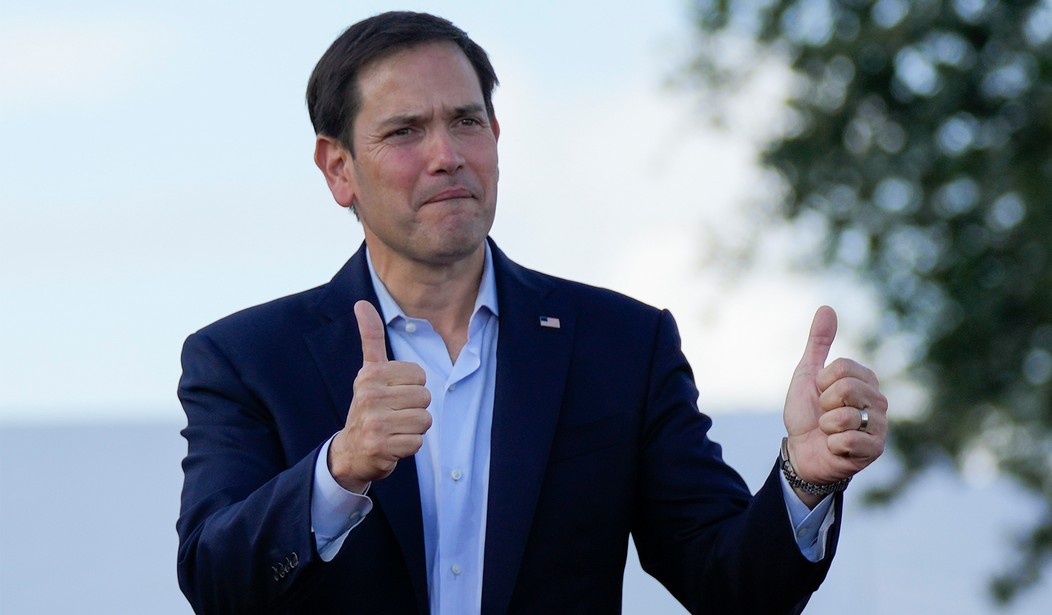
Marco Rubio's favorite foods have also received attention lately, particularly after he appeared on The Katie Miller Podcast last month. Miller asked the Secretary of State if he's a follower of "MAHA" — Kennedy's Make America Healthy Again movement — and Rubio replied that he's "in favor of MAHA" and thinks "people should be healthy," but his wife Jeanette caught that lie and cut him off.
"No, he isn't," she said. "He is completely not."
"What does he eat?" Miller asked.
"Pop-Tarts," Jeanette replied.
"No, I don't eat Pop-Tarts every day," Rubio corrected her, before giving us a lesson on his favorite processed pastry. "The Pop-Tart is one of the great American innovations in the history of the world, if you think about it. It comes in this beautiful foil package."
That's when Jeanette jumped in again and confirmed that our dear Secretary of State has a horrific diet and eats all the things he should not be eating and will "take down" anything with sugar.
On Monday, when I learned September 14 was the 62nd anniversary of the debut of Rubio's favorite snack, I knew I had to share the details. It's actually a little more interesting than I ever realized.
According to History.com, "It all started when one of Kellogg’s biggest competitors, Post Consumer Brands, trumpeted to the press that it had created an innovative new breakfast item: a shelf-stable, fruit-filled, handheld toaster pastry called 'Country Squares.' It sounded like the ultimate grab-and-go convenience food. Anticipation ran high."
But Post was slow to actually get the product to market, so Kellogg's got competitive.
"William Post (no relation to the company), a plant manager at the Michigan-based Hekman Biscuit Company, later described how a handful of Kellogg's execs showed up at his workplace out of the blue: They were waving two pieces of dough with some filling in it, saying, 'We’d like to put that in a toaster.' They asked if he could develop and manufacture it on the quick," reports History.com.
Over the next few months, Post and his team began working on a product similar to the "Country Squares," even bringing their own kids in as taste testers. Within six months, Kellogg's beat Post to market with a product it called "Fruit Scones." The company later renamed the product with the moniker we're all familiar with today, Pop-Tarts, "lending it some of the kitschy cachet of Pop Art, a buzzy art movement of the time made famous by Andy Warhol and his Campbell’s soup can paintings."
Kellogg's debuted the new product in Cleveland with four flavors: Blueberry, Strawberry, Apple Currant and Brown Sugar Cinnamon. They sold out almost immediately, and the company had to take out ads that said, "Oops! We Goofed. (Will you excuse us, please) We ran out of Pop-Tarts."
A few years later, the company added frosting, then sprinkles, and eventually, dozens of new flavors. I believe Rubio said Cherry is his favorite. I'm an OG Brown Sugar Cinnamon girl myself, though honestly, I don't think I've had a Pop-Tart in over a decade.
According to Smithsonian magazine, the heated rivalry between Post and Kellogg's wasn't the only thing that drove the invention of the Pop-Tart. It was also a sign of the times.
"In the 1950s, there was a specific messaging around the idea of spending less time in your kitchen. Efficiency was the real name of the game," Jessica Carbone, a former member of the food history team at the Smithsonian’s National Museum of American History, told the magazine. "The idea of eating breakfast outside of the kitchen was a completely modern innovation. You don’t have to be in a kitchen at all to enjoy a Pop-Tart. But what allowed people to be more efficient was science and innovation."
And the foil packaging that Rubio thinks is genius actually has its roots in World War II:
Pop-Tarts’ ingredients mean that they don’t need to be refrigerated, and their foil packaging ensures they can be stored for months. But while Pop-Tarts and their packaging might look like something an astronaut would eat in space, the content inside is more closely linked to food innovations from World War II.
"After the end of World War II there was a massive effort within the United States to repurpose and mass market wartime food processes," explains Carbone. "There were different preservative-orientated ingredients and formulas that had been in circulation that were spoil-proof, heat-proof, condition-proof. A lot of the industrialized food products of the mid-20th century come from wartime food processes being reconfigured to appeal to the mass markets."
Throughout the 1950s and 1960s, hyper-sweetened food products that could be eaten on the go exploded in popularity, especially among children. "The Pop-Tart was marketed very clearly to children and teenagers," says Carbone. "Because the idea is that it was extremely fun, sweet and a creative, delightful experience."
All this talk about industrialized food products is making me want to follow the much-talked-about MAHA diet. The Smithsonian article goes on to interview a pediatrician about just how bad Pop-Tarts actually are for you — I'm sure Secretary Kennedy would agree — so let's hope Rubio doesn't eat them as frequently as his wife implies. We don't want anything to happen to the busiest man in the Trump Administration.
That said, I'm kind of craving one now. I suppose just having one won't kill me. It's for journalistic research. Yeah, that's it!