


In July 2000, Bill Clinton signed Plan Colombia into law. It was a partnership between our two nations that had a goal of ending the Colombian armed conflict, cutting coca cultivation and cocaine exports, training police and military, and helping the South American nation remain a democracy rather than a failed state. While it wasn't perfect, Colombia was able to take back territory from the FARC and remained one of our closest and most important allies in the Americas.
Until 2022, at least. That year, the country elected its first left-wing president in modern history, and it went with the biggest clown of them all, former guerrilla Gustavo Petro, whose strengths include *checks notes* tweeting, writing erotic poetry, and standing in the streets of New York City, calling for the U.S. military to overthrow Donald Trump. In the four short years of his presidency, armed groups were treated like neighbors, coca production reached record highs, and his anti-U.S. rhetoric grew so strong that the Trump administration decertified Colombia and sanctioned Petro himself.
As I've been documenting over the last few months, Colombians grew tired of this and voted against Petro's hand-picked successor in this year's presidential elections, opting instead for Abelardo de la Espriella, a pro-U.S., pro-Israel businessman who promised a Nayib Bukele-like hardline approach to the criminal organizations that plague Colombia and the entire Western Hemisphere.
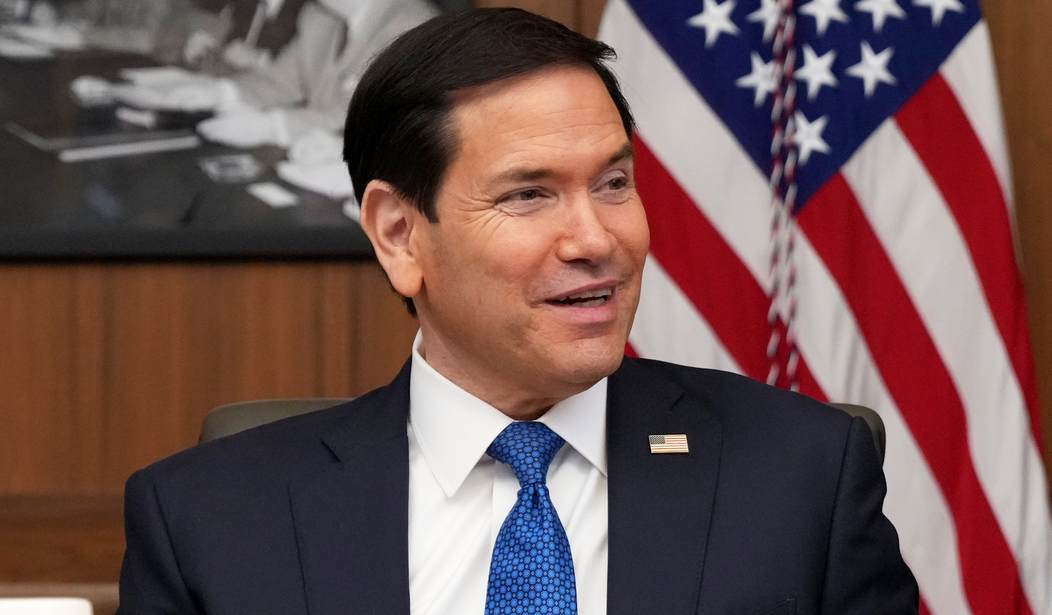
President de la Espriella, who took office on August 7, welcomed our dear Secretary of State Marco Rubio to Colombia on Tuesday, and it was a moment that represented much more than what it looked like on the surface. It was a reset of the important relationship between the United States and Colombia, and it was yet another signal to the criminal organizations in the region that there will be no more games.
Before Rubio even boarded the plane to South America (where he's also visiting Ecuador and Peru), he spoke to the press on the tarmac in Homestead, Fla., called this an "important trip," and pointed out that a stronger presence in the Western Hemisphere —a Western Hemisphere that is largely lining up with U.S. interests in recent years — is a major part of current national security strategy:
We’re going to go visit three countries strongly aligned with the United States. We have a lot of common interests with them, both taking on regional transnational criminal terrorism and also economic engagements. We’re hoping to wrap up good, solid trade deals with all three of these countries in the foreseeable future. And of course, a lot of strong cultural links.
So, I think it’s part of a trend that you’re seeing in the Western Hemisphere of alignment with the U.S. and U.S. interests. If you read our National Security Strategy – I’m sure all of you have read it very carefully page by page – it outlines one of our priorities is strengthening our presence in the Western Hemisphere. And I think this trip and these meetings, as much as anything else, is continuing to further that goal as part of that strategy.
And so, Rubio and his wife, Jeanette, spent much of Tuesday with de la Espriella, First Lady Ana Lucía Pineda, and their four children, proving to the world that the U.S.-Colombian relationship has reached a new post-Petro era and is possibly even stronger than it ever was before.
For Rubio, the connection is also personal. His own mother-in-law was born there and still has relatives in the country. He also knew de la Espriella long before the new president "lost his mind and went into politics," as Rubio put it. The two met a few years ago when they were both seated at the same table at a wedding in Florida. The Rubios even joined the new first family of Colombia for a private dinner at their home.
El presidente Abelardo de la Espriella recibió ayer en su casa al secretario Marco Rubio para una cena familiar. pic.twitter.com/GYBK2OBd4R
— Orlando Avendaño (@OrlvndoA) September 9, 2026
"This is a man of energy. This is a man of strength. This is a man of vision and of courage because he’s confronting a very difficult situation. He has inherited many disasters," Rubio said of de la Espriella on Tuesday.
But the visit wasn't just a diplomatic photo op. They actually got some things done, too. Sources say that Rubio's directives from Trump were to get cocaine eradication back and go after the trafficking groups, and it sounds like he made good on those promises. The two men sat down for a closed-door meeting at a military compound in Barranquilla that De la Espriella is using as a second presidential office away from Bogotá, followed by a bigger meeting with various government officials. Topics discussed included drugs, security, trade, tariffs, the August 10 earthquake, Venezuela, minerals, migration, and nuclear cooperation.
After the meetings, Rubio and his Colombian counterpart, Minister of Foreign Affairs Omar Bula, signed two documents: One was a framework on critical minerals and rare earths, and the other was a memorandum on civilian nuclear cooperation.
Productive meeting with President @ABDELAESPRIELLA in Barranquilla, where we discussed security cooperation, trade, and ending illegal immigration in our region.
— Secretary Marco Rubio (@SecRubio) September 8, 2026
I also signed MOUs on critical minerals and civil nuclear cooperation with Colombian Foreign Minister Bula.
It's a… pic.twitter.com/fudjht40fX
Rubio and de la Espriella also spoke about the renewed relationship. The Colombian president thanked the United States for its help with earthquake recovery and promised he will be a great partner going forward:
From this meeting there is a guideline that we’ve called the Barranquilla agreements, and they follow three main topics that are highly relevant for our country and for the hemisphere. We are going to rebuild the homeland, we are going to recover the economy, and we are going to protect the hemisphere. And we’re initiating a historical and close relationship that was interrupted during four years, but it has always been there in the deeper areas, in the deeper basis of Colombia, because the United States has been our partner. We have been their ally and partner, and when the United States and Colombia have worked together, the only thing that we have had, it’s development, security, and progress.
He also promised that Colombia will resume fumigating coca (Petro thought it was bad for the environment), destroy drug labs, and go after the biggest narco-bosses, and requested U.S. assistance with "airplanes, drones, radars, helicopters, anti-drone systems, aerial defense, mobility, intelligence, cyber defense, special forces, and the maintenance and the operationality."
President de la Espriella confirmed that Colombia is now a member of the Shield of the Americas and that the country "is going to fulfill its responsibilities."
He added: "We’re going to have the site in Medellín, and we’re going to do whatever it takes to be able to attack and to be able to give them the place that they deserve, which is either a prison or a tomb. And I say it: If a criminal doesn’t follow the law, he’s not going to get it his way."
The president even spoke about Venezuela, stating that "we share more than 2,000 kilometers of borders with the neighboring countries, and everything that happens in Venezuela has a direct consequence in Colombia regarding security, migration, smuggling, and armed groups, and also energy. Colombia will participate along with the United States in a very responsible manner in the focused efforts to be able to ensure regional stability."
Today marks an important and renewed commitment to our long-standing relationship with the great people of Colombia.
— Secretary Marco Rubio (@SecRubio) September 8, 2026
🇺🇸 🤝 🇨🇴 pic.twitter.com/RYaBuSaaON
On Wednesday morning, Rubio left for Ecuador — I'll have more on that visit later — but I'll admit the trip to Colombia gave me a little bit of renewed hope for the future.
I've not been shy about the fact that I'm a bit skeptical about this oil deal in Venezuela, given that Delcy Rodríguez and other assorted criminals are heavily involved and given the things I'm hearing from Venezuelan side, and I know there are many Venezuelan people who, for years, have counted on Rubio as sort of their guiding light from the U.S. and have grown skeptical of his motives. I think seeing him in the region, where he did talk to the press more about the need for elections in Venezuela (though, he still didn't give any sort of timeline or sense of urgency), was hopefully somewhat reassuring.
If I'm not mistaken, it's been about a year since the secretary traveled to any part of Latin America (he did make a trip to the Caribbean in February), and I don't think it should be another year before he goes back after this trip. Trump's much-needed plan to take criminal and narco threats (and our international adversaries like China) within the Western Hemisphere more seriously than any president has before works best when the administration is consistently visible there, and no one knows the region like Rubio does. He speaks the language. He knows the players. He knows the people. They know him. They largely respect him.
I'll take more of this, please.
Editor’s Note: Thanks to President Trump and his administration’s bold leadership, we are once again respected on the world stage, and our enemies are being put on notice.
Help us continue to report on the administration’s peace through strength foreign policy and its successes. Join PJ Media VIP and use promo code FIGHT to receive 60% off your membership.

Join the conversation as a VIP Member