



"We have fallen heirs to the most glorious heritage a people ever received, and each one must do his part if we wish to show that the nation is worthy of its good fortune." - Theodore Roosevelt.
Here's some cautiously optimistic news that proves that government overreach and "they sky is falling" environmental alarmism aren't necessary to solve a problem.
In December 2024, I wrote about how the United States decided to provide federal protection to monarch butterflies under the Endangered Species Act. Many spoke out against the move, claiming it wasn't necessary and that, among other things, it would cause problems with agriculture and development.
Texas Agriculture Commissioner Sid Miller called it a "parting shot from the Biden Administration, a desperate move to impose its heavy-handed, radical climate agenda on hard-working Americans." Other agriculture commissioners admitted that protecting the monarch is important, but that the government and citizens need to work together to do it, not just put it under some blanket law that may or may not help and could hurt humans worse. A group called Farmers for Monarchs encouraged farmers to push back but also continue with their own voluntary conservation initiatives.
Before officially deciding to protect the butterfly under the Endangered Species Act, the U.S. Fish and Wildlife Service (USFWS) allowed for a 90-day period of public discussion, which was eventually extended and ended in May 2025. It then had until December 2025 to review the public comments and any new scientific evidence and make a decision, but that deadline came and went without any real action taken. No further action is expected until this fall at the soonest, but the idea is not off the table — just delayed.
A USFWS representative told the Associated Press last year that "the administration remains committed to a regulatory approach that is transparent, predictable and grounded in sound science.... At the same time, the administration continues to emphasize voluntary, locally driven conservation as a proven tool for supporting species and reducing the need for additional federal regulation."
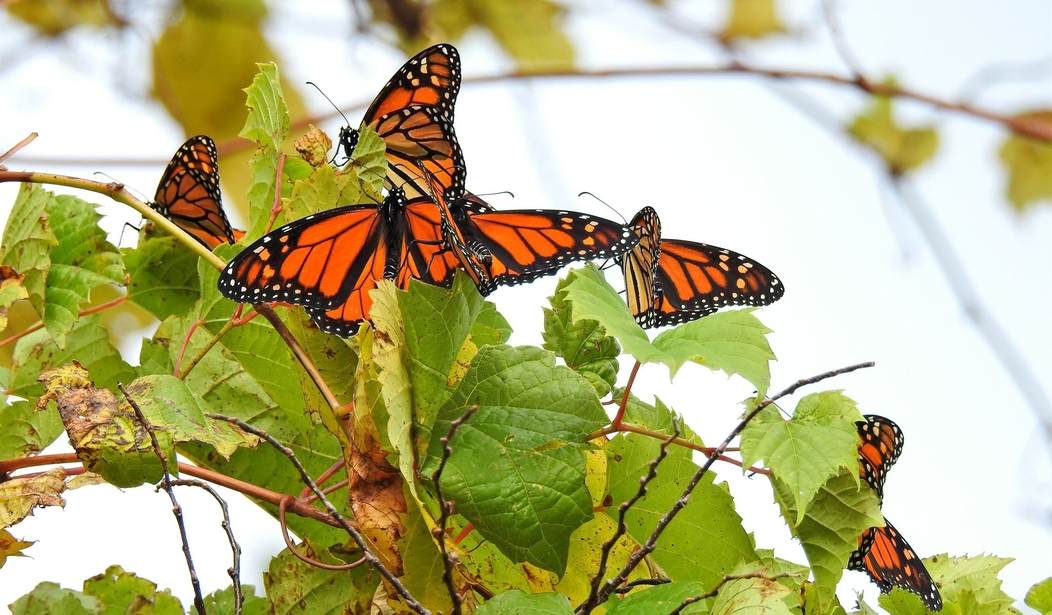
Well, here's some good news: monarch populations are seemingly on the rise again. The World Wildlife Fund in Mexico "measures the area of forest where monarchs establish their colonies to hibernate each winter, providing a scientifically robust indicator of their population status. This year, scientists found monarchs occupied 7.24 acres of forest compared to 4.42 acres the previous winter — indicating a 64% increase of monarchs during this period."
Here's some more precise information:
During the overwintering season 2025-2026, nine colonies of monarch butterflies – three in Michoacán and six in Estado de México - were recorded occupying a total of 7.24 acres of forest, this represents an increase of 64% in relation to the area recorded in the 2024-2025 winter with 4.42 acres. Five colonies were located inside of the Monarch Butterfly Biosphere Reserve (MBBR) occupying 5.61 acres of forest, and 4 were located outside of the MBBR occupying 1.63 acres. The colony of Atlautla, outside of the Monarch Region, occupied 0.005 acres of forest.
I believe these are the best numbers we've seen since the 2017-2018 season.
The eastern population of monarchs in North America leave Canada and the United States, where they come to breed, at the end of the summer and go to Mexico to "establish hibernation colonies in the forests of Michoacán and Estado de México, at the Neo-volcanic System, known as the Monarch Region." This particular group of monarchs has declined by 80% since the 1990s (the western group that overwinters along the forested groves on the California coast has declined by 95%).
Some environmentalists have tried to blame climate change, citing that warmer temperatures trick the butterflies into believing there's no need to return to their hibernation destinations, as well as the influence of "extreme weather events." Herbicides and construction that reduces the amount of milkweed plants in North America are, in my opinion, more likely contributors. Milkweed is the exclusive host plant where the butterfly will lay its eggs, and it's the only food source for its larvae.
A fairly recent study from the University of Georgia also found that people planting non-native milkweed along the migration route was a big problem. Planting the wrong type of milkweed has led to an increase in the prevalence of a "debilitating monarch parasite" that leaves infectious spores on the leaves. They infect the monarch caterpillars, and many don't make it to adulthood; if they do, they don't survive long enough to reproduce.
While historic numbers are still down, this 64% increase is an incredibly encouraging sign that things are changing for this magnificent species, and it didn't take big government. It took the private citizens of the United States and Mexico making an effort on their own and nature showing us just how fast she can heal herself when we don't try to regulate her.
In the U.S., farmers, ranchers, and citizens are planting native milkweed along roadsides, on working land, and even in private backyards. In Mexico, Ejido landowners are cracking down on illegal activity and deforestation via community patrols and promoting ecotourism.
Only time will tell how the monarch butterfly's story ends, but right now, it's getting a major boost from concerned citizens in two different countries, who are coming together to save it at a time when it feels like we're all so divided. No bureaucracy necessary.