


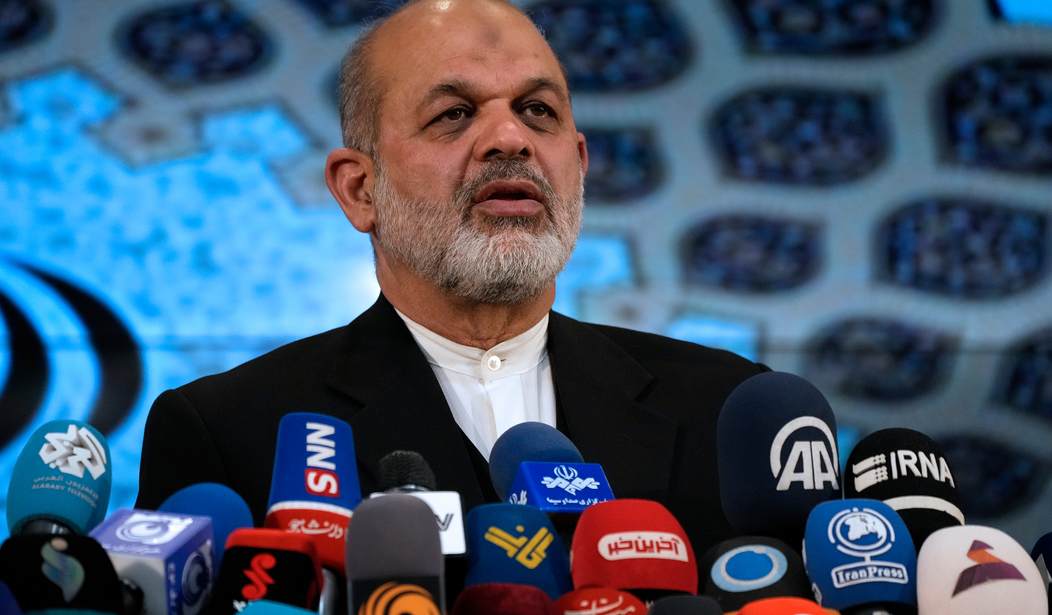
Ahmad Vahidi is the commander-in-chief of the Islamic Republic of Iran’s Islamic Revolutionary Guard Corps (IRGC), which may mean that he is the man who is actually running the country. The Islamic Republic recently released video of Supreme Leader Ayatollah Mojtaba Khamenei having an informal chat with students, but many derided the video as old, recycled footage, and certainly there has been no definitive proof of life from Mojtaba since he was reportedly severely injured in the February 2026 airstrike that killed his father and predecessor.
Mojtaba may be alive, as the Islamic regime in Tehran continues to insist, but even if he is, there is no clear indication that he is the man who is actually calling the shots. That man could be Vahidi, as the IRGC has always been the Islamic Republic’s ruthless enforcement arm, and now, in this moment of immense crisis, the hardliners may have gained control over the entire state apparatus.
To hear them tell it, however, there is no crisis at all. Mojtaba is alive and well and running things, and just too busy to bother with something so mundane as an actual public appearance. And Vahidi on Saturday went even farther. According to the dissident news site Iran International, he is behaving as if the war has been won and the Islamic Republic is in the driver’s seat. He “told Iran’s armed forces that their performance during six months of war had demonstrated that “Islam can be made to rule the world.”
Skeptics should just look at the amazing victory Allah just gave to Iran. Vahidi “praised IRGC, army, police and Basij forces, saying they had ‘brought the most heavily armed army in the history of the world to its knees.’” If you missed America being brought to its knees, don’t be concerned: So did everybody else. The Islamic regime in Tehran, however, is committed to Muhammad’s famous dictum, “War is deceit,” and apparently believes Josef Goebbels’ contention that if one repeats a big lie often enough, people will believe it.
Vahidi, however, was not just engaging in vacuous chest-thumping. “He compared their operations to the early Islamic battles of Badr and Khaybar.” The Battle of Badr was, according to Islamic tradition, the first great battle Muhammad fought against the non-Muslims of Mecca. Because the Muslims relied on Allah, he granted them a tremendous victory over the numerically superior Quraysh tribe. The lesson Islamic tradition draws from this is that righteousness, not military might, brings victory.
Vahidi is thus saying that if the Iranians remain faithful to Allah, he will give them victory over the United States and Israel, no matter how unlikely that victory may seem. And he also refers to the Battle of Khaybar, which was less an actual battle than Muhammad’s unprovoked attack upon the Jews of the Khaybar oasis in Arabia. There were only Jews in Khaybar because Muhammad had exiled them from Medina, but now he had come to destroy the exiles, and accomplished this so thoroughly that even today, pro-Hamas protestors chant “Khaybar, Khaybar, O Jews, the army of Muhammad will return.” And more Jews will be murdered.
Related: Islamic Republic of Iran Claims It Has Some Friends in Extremely High Places
Thus Vahidi is emphasizing that for the Islamic Republic, this is a religious war. Islamic law only allows an Islamic force to make a truce with a non-Muslim force when the Muslims are losing and need a breather to gather their strength. That means that there will be no lasting negotiated settlement, and if any negotiated agreement is concluded, it will last only as long as the Iranians think they need it.
Vahidi was telling the Iranians that this war was about massacring more Jews, and ultimately about establishing Islamic rule — solidifying it in Iran and extending it elsewhere. The regime’s identification of itself with Islam means that those who dare to protest against it are doing nothing less than rebelling against Allah, a crime for which the Qur’an prescribes crucifixion or other forms of execution (5:33).
Foreign policy “experts” continue to dismiss the Islamic character of Iran’s Islamic regime, and to assume that its leaders can be dealt with the way they would deal with the leaders of any secular state. This is not the case, and it hinders our ability to deal with the challenge that the Islamic Republic presents on a global scale. That challenge, as Vahidi has made clear, will continue for as long as the Islamic regime exists.