







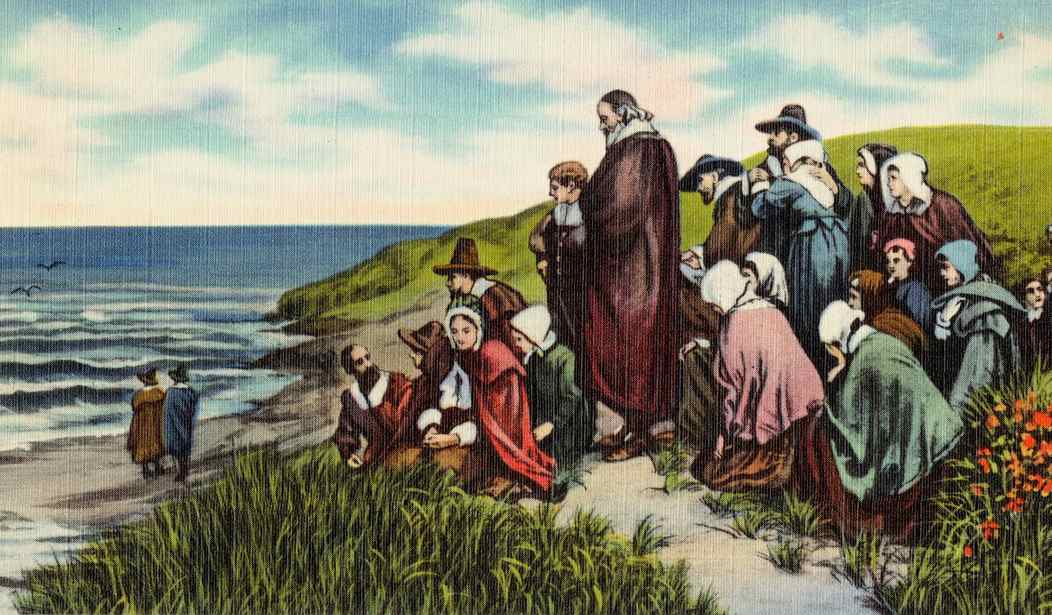
The first Thanksgiving in 1621 came after the brutal winter of 1620. The colonists arrived too late to plant and were forced to live off shipboard provisions: salt meat, dried fish, and peas. Even fresh water was scarce.
Of the 103 colonists who landed in the autumn of 1620, just 53 survived. In March 1621, the Wampanoag and the colonists signed a mutual defense treaty that benefited both sides. The Native Americans taught the English how to farm the rocky, sandy soil, which yielded a bountiful harvest that fall.
The Wampanoag were not helping the colonists out of altruism. In the two years prior to the arrival of the colonists, a deadly plague (probably smallpox originally brought to America by the French) decimated the tribe, giving their bitter rivals, the Narragansett, the upper hand. They needed the colonists as much as the Englishmen needed them.
What the Wampanoag didn't teach the English colonists was socialism. In fact, most Native American tribes practiced a sophisticated barter system. But Governor William Bradford and other leading members of the community wanted to create a "New Jerusalem" where no one went hungry, and everyone's labor was equally important. They created a communal system in which no matter what someone contributed, they received an equal share of what was produced.
Most Native American economies emphasized use rights, social obligation, gift exchange, and barter, with high-value items (such as copper, obsidian, turquoise, and dentalia shells) serving ceremonial, diplomatic, and exchange roles alongside direct trade in goods.
Not so the colonists.
Their first year in America, they pooled and shared the harvest equally, regardless of how much anyone worked.
The results were disastrous.
Few Pilgrims worked hard. People relied on someone else to do the heavy lifting.
Gov. William Bradford wrote that some pilgrims faked illness, claiming "weakness and inability," and "much was stolen."
The communal system, Bradford concluded, "was found to breed much confusion and discontent and retard much employment." Nearly half the colony died that first winter.
Had the Wampanoag Native Americans not helped them, more would have starved.
Economists call this the "tragedy of the commons."
Governor Bradford observed what every socialist government in history has seen shortly after imposing it on populations.
"For the young men that were able and fit for labor and service did repine that they should spend their time and strength to work for other men’s wives and children, without recompense," Bradford wrote. "The strong, or men of parts, had no more division of food, clothes, etc. then he that was weak and not able to do a quarter the other could; this was thought injustice."
So this is how the Democratic Party began!
Able-bodied young men resented working hard without extra reward for others' families, while stronger or more skilled workers felt it unjust to receive no more food or clothing than those who contributed far less.
There was also tension over status and household roles. Older, higher-status men disliked being treated the same in labor and rations as younger or lower-status men, and husbands objected to their wives being directed to cook or wash for other men, viewing that arrangement as akin to servitude.
Bradford's efforts to keep the colony together forced him to give up the communal approach, and he assigned plots of land to each household to farm for themselves. Amazingly, the people who claimed "weakness and inability" recovered.
"And so, assigned to every family a parcel of land, according to the proportion of their number for that end . . .This had a very good success; for it made all hands very industrious, so as much more corn was planted then otherwise would have been by any means the Governor or any other could use, and saved him a great deal of trouble, and gave far better content," Bradford wrote.
The problem isn't the theory undergirding the economic system of socialism. The problem is that it involves human beings: scheming, rapacious, greedy, self-interested, and immoral humans. Socialism teaches the "brotherhood of man," which is a fine, utopian dream but an utter failure in the real world.
Capitalism can be just as unrealistic and dangerous unless checked by a government dedicated to freedom and the rule of law. One hundred and sixty-seven years after the colonists landed at Plymouth, their ideological progeny put it all down in writing. The Founders also believed in limited government, individual liberty, and checks on concentrated power, precisely because they understood that human ambition and self-interest cannot simply be legislated or preached away.
Plymouth learned at a heavy price what the Founders later codified: prosperity flourishes best not when rulers promise utopia, but when free people keep the fruits of their own labor under a constitutional order built for flawed human beings.
Editor's Note: President Trump is leading America into the "Golden Age" as Democrats desperately try to stop it.
Help us continue to report on President Trump's successes and combat Democrats' lies. Join PJ Media VIP and use promo code FIGHT to receive 60% off your membership.


Join the Conversation
VIP members get the ability to comment on articles.