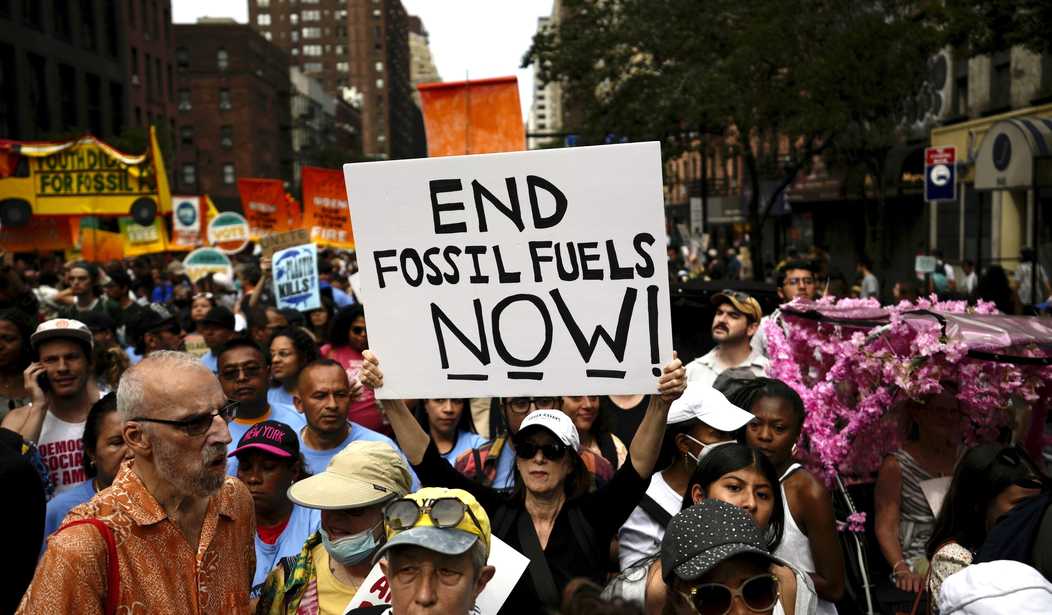

The 31st meeting of the UN Conference of the Parties (COP31), held in Turkey last week, ended in failure on Sunday when conscience-stricken industrialized countries refused to ratify a statement that didn't include a commitment to the eventual elimination of fossil fuels.
Commerce Secretary Howard Lutnick identified the reason why oil-producing countries won the day and convinced a majority of delegates that the "climate consensus" was in ruins.
"For nearly two decades, American federal policy, corporate disclosure, insurance underwriting, endangered-species regulation, infrastructure siting and allegations in a growing body of climate litigation have relied on a set of emissions scenarios that have now been dismissed by the same international scientific committees that released them," Lutnick writes in The Wall Street Journal.
Lutnick points out that the "assumptions about energy use, population growth and technology" that runaway global warming was based on are no longer valid. Rep. Alexandria Ocasio-Cortez's idiotic remark in 2019 that we only have 12 years or "the world is going to end" was based on these assumptions of rapid, uncontrollable warming that would make many parts of the planet uninhabitable.
"The elimination of these scenarios isn’t a small technical adjustment," writes Lutnick. "It is the largest shift in international and U.S. science on climate in over a generation, and it corrects the assumptions on which most of the world was relying for investment decisions and policymaking, which weren’t scientifically defensible."
Hooray for reason!
The fact is, the Intergovernmental Panel on Climate Change (IPCC) has not altered its basic predictions of catastrophe. It just changed the timeline. This will make misusing the IPCC reports far harder.
The delegates went back and forth about reaching a "cover decision," but the divide between oil- and gas-producing states and the moral posturers in the EU and elsewhere was too vast.
"The EU said it rejected the deal because the text 'does not respond to the science' of climate change," reports CNBC. “We will not accept a COP that greenwashes fossil fuels,” the EU said in a statement Sunday.
And the rest of humanity will not give in to a false panic and "phase out" fossil fuels based on faulty projections.
These projections, which formed the foundation of tens of thousands of academic papers and government reports, were sold to the public as “settled science” even though they were based on completely unrealistic assumptions. Emissions scenarios relied on a theory that global coal consumption would expand to roughly eight times its current level by 2100. Real-world data show that coal, as a proportion of global energy, has been declining for nearly 15 years. The models incorrectly assumed that coal liquefaction to manufacture synthetic fuels would replace petroleum, and its consumption would increase exponentially beginning in the early 2000s. That didn’t happen. The flawed assumptions don’t stop there. Scenarios were based on a global population of 12 billion to 13 billion people. No projection comes remotely close to this number. The U.N. predicts the world population will peak at 10.3 billion in the 2080s and decline thereafter, while the Institute for Health Metrics and Evaluation limits the peak to 9.7 billion with a decrease to 8.8 billion by 2100.
Recommended: AI Companies Are Building Models They Barely Understand and Can't Control
One significant result of this reassessment of climate science is that liability claims made by cash-hungry green groups looking for an easy payout after a disastrous weather event are in big trouble.
"When observed events can’t be statistically distinguished from their natural range, the causal chain required for damages—this storm, this loss, this defendant—can’t be established," Lutnick writes. "The Intergovernmental Panel on Climate Change’s Sixth Assessment Report says there is 'low confidence' in any observed trends in almost all types of extreme events and that 'the usefulness or applicability of available extreme event attribution methods for assessing climate-related risks remains subject to debate.'”
The maximalist edifice of climate policy took the direst scenarios as “settled science” and projected catastrophic damages against those scenarios, demanding regulatory and legal responses proportionate to the catastrophe. It was built on false assumptions that the scientific community has formally repudiated.
COP31 broke down because reality intruded on the fever dreams of Europeans who can't break away from the "settled science" that's "settled" no more. It's not going to kill the climate change industrial complex. Trillions of dollars have been invested in carbon schemes, payouts to NGOs, and national policies dealing with other hazards that were once imminent and now are not so much.
But the failure of COP31 was a welcome sign that a more rational, science-based approach to the hysteria over climate change is beginning. That's a very good development that bears watching.