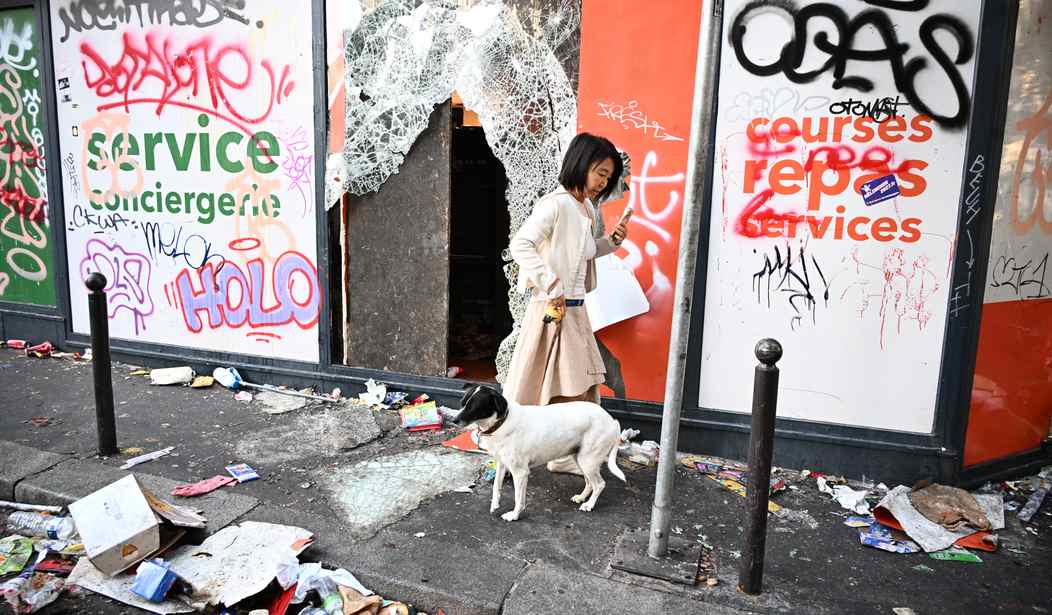

The protests in France continue, and French President Emmanuel Macron is apparently stirring himself into action. His timidity in the face of the rage roiling the streets of Paris and a dozen other cities so far has not impressed anyone, least of all the red-green (radical left and Islamists) alliance that is now orchestrating the riots for maximum media coverage.
Now, Macron has bestirred himself into action, calling for curbs on "illegitimate protests" for the first time and finally blaming the radical left for the violence. With another day of huge, nationwide protests called for on Saturday by the radical left and radical Muslims, some French cities are going into lockdown. Lyon has banned all Saturday protests, and Marseille has, too. They may as well try to stop the Seine River from flowing, because the radicals are already planning to march.
Macron, who tried to soft-pedal the riots in the few public pronouncements he's made previously, finally decided to call a spade a spade and fingered the culprits.
"Last Saturday we had political and seditious acts by ultra-left groups whose aim is to bring down the Republic," he said.
There. He said it. The radical secularists and the fanatical religious nuts are trying to bring down the Fifth Republic. Each previous iteration of the French Republic fell because of instability and paralyzed leadership. Is it happening again?
In the northern city of Orléans, police are bracing for a potential incendiary confrontation as the conservative National Rally, led by presidential frontrunner Marine Le Pen, is holding its annual meeting. The radical left is already organizing to confront them. I don't envy the local police. Violence between the two sides could easily ignite a conflagration that may lead to a nationwide government crackdown.
"The French political class has also descended into a bitter blame game, with the government accusing far-left political groups of stoking the unrest," Reuters reports. Many establishment politicians are still giving Muslims a pass and denying the role of the immigration policies that led to millions of immigrants from majority-Muslim countries like Algeria, Morocco, Tunisia, and Turkey arriving in France since 2010.
Nora Bussigny, a French reporter who spent more than a year undercover with radical Islamists and leftists, lists some of the radical groups most prominent in the protests.
Radical-left groups were involved even at the very beginnings of the high school protest movement in late September. They include the Jeune Garde Antifasciste (Antifascist Young Guard), which was dissolved in 2025 due to its incitement of violent confrontation, but is still operating underground, and Génération Espoir Dignité Résistance—which is facing dissolution by the French government for its ties to the Jeune Garde Antifasciste. Génération Espoir Dignité Résistance was founded by the leaders of the Jeune Garde as well as those of three other activist organizations: the radical-left political collective RED Jeunes, the high school student union Union Syndicale Lycéenne, and Étudiants Musulmans de France (Muslim Students of France). Étudiants Musulmans de France is the youth wing of the Muslim Brotherhood movement in France, as confirmed by a 2025 government report on the extent of the Muslim Brotherhood’s presence in France.
Red or green, it doesn't matter. The commonality of goals, including bringing down the Fifth Republic, has created a situation where the exhausted French establishment, worn down by infighting and grappling for power, seems unable to stem the assault on the republic.
For several years, Étudiants Musulmans de France has been setting up chapters in universities across France. These chapters decided to join the high school movement, with the aim of inserting the fight against “Islamophobia” into the middle of demands about the shortage of teachers and the dilapidated state of schools. They encouraged the protesters to rise up against laïcité, France’s principle of secularism. In their sights are the 2004 law banning religious symbols (including the hijab) in schools, and former prime minister Gabriel Attal’s 2023 ban on the abaya in state schools.
Laïcité has sustained the Republic since the turn of the 20th century. In 1905, the Third Republic passed the Law on the Separation of the Churches and the State, which codified this principle. It has served France well — until now. The core principle — ensuring the state remains neutral on religion and keeping religious institutions out of public governance — has been a continuous thread providing civic stability and binding the French nation together across its various political upheavals.
The radical Muslims and their radical left allies (who have their own reasons to ditch secularism, namely, that it would create the chaos that would supposedly bring them to power) are organized and working toward this goal.
France's future could very well be determined in the next couple of weeks. Will the center hold? Will the political leadership find the courage to face down this threat?
I'm not optimistic.