
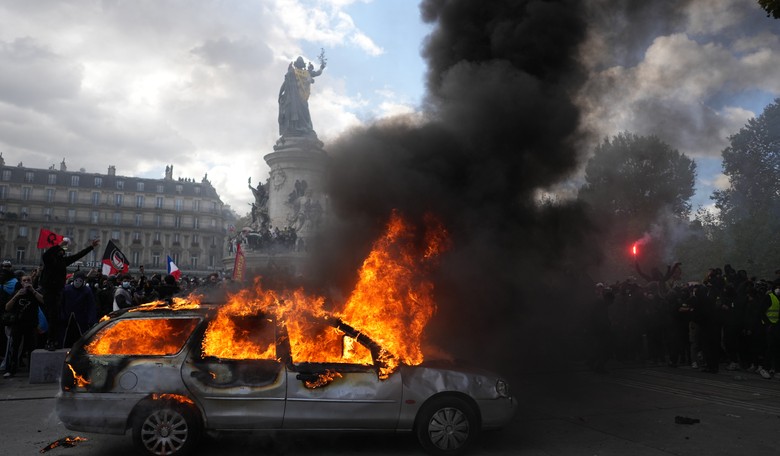
In France, more than half a million people poured into the streets as mobs of radical left rioters, students, labor unions, and antifa thugs rampaged through historic districts, burning government buildings and bringing the country to a "point of no return," according to Prime Minister Sébastien Lecornu.
“Behind all this, there is obviously a political battle to wage,” Mr. Lecornu said.
The ancient city hall in Limoges, a classic example of neo-Renaissance and Louis XIII-style architecture, was burned to the ground overnight, along with other symbols of the national government.
Le beffroi de la mairie de Limoges, en flammes, s'est effondré https://t.co/tu9UBPS7iI
— BFM (@BFMTV) October 17, 2026
Other city halls were attacked "from Lille in northern France to Marseille in the south, where masked infiltrators broke into the local government headquarters and tipped over a bust of Marianne, a symbol of the French Republic," reports the New York Times.
Lecornu is pointing the finger at the radical left, which has been on the front lines of the protests since students began demonstrating in mid-September against unequal funding for poor districts, poor school conditions, teacher shortages, and school days of up to 10 hours in the classroom.
Once the far-left radical party France Unbowed joined the protests, the riots began, and the stated reasons for the unrest changed. Now, the protests ostensibly include opposition to the budget cuts being proposed by Emmanuel Macron's government, as well as the cost of living and other affordability issues.
“It’s also time to choose sides,” Lecornu said. “Either you are in the camp of the Republic, and therefore of law enforcement — and of those who protect people and property and enforce the laws — or you are on the side of the rioters.”
Interior Minister Laurent Nuñez said more than half a million people took part in the protests, including 110,000 in Paris.
The leader of France Unbowed, Jean-Luc Mélenchon, is blaming Macron and his government, saying the violence was "due to incompetence or a worst-case strategy to create a party of order that would make people forget his failure in public finances.”
Mélenchon, like all radical leftists who benefit from violent protests, gave a tepid response to the mayhem, refusing to condemn it outright, stating that “those who share our fight have no place in looting, in pillaging."
“Regardless of the 'responsibilities of those in power',” he said on Saturday night, the left “must refuse to take part in actions without political meaning and contrary to our methods.”
There is deep political meaning in burning government buildings and destroying property. And the "methods" the rioters are using are tried-and-true radical left tactics used for at least the last 150 years all over the world.
“We witnessed scenes of methodical looting that have nothing to do with social demands, nothing to do with the thousands of demonstrators who marched peacefully throughout the afternoon. It’s absolutely tragic," said the deputy mayor of Paris, Lamia El Aaraje.
In some cities, clashes erupted between demonstrators and officers who unleashed tear gas. Masked rioters smashed up banks in Paris, ransacked a department store in Bordeaux and set the city tourism office ablaze in Lyon.
In Marseille, on France’s southern coast, footage showed a group of people breaking into the city hall; they were later dispersed by law enforcement.
Macron denounced “the sowers of chaos, who seek only to destroy our institutions and prevent those who peacefully express their demands from doing so.” Posting on X, he also pledged to prosecute and punish those involved in attacks on businesses and public buildings
Le Pen, signaling that Mélenchon is now her chief rival, wrote on social media that “legitimate social demands have once again been taken hostage by the extreme left.”
Marine Le Pen, head of the conservative National Rally, must be very careful. She's leading in the polls for next year's presidential election, but is dealing with historic and cultural headwinds. So far, her comments on the riots have mostly been supportive of the government while blaming Mélenchon and France Unbowed for the riots.
"Protest organizers had hoped that the demonstrations on Saturday would lead to a convergence between the student demonstrations that have roiled France since September demanding better school conditions, and a broader social movement that addressed a wider array of concerns, including the rising cost of living," reports the Times.
Mujtaba Rahman, managing director for Europe at Eurasia Group, says that "France is suffering from a crisis of liberal democracy, a crisis of fiscal mismanagement, and a crisis of youth disaffection," according to Fortune magazine.
“But the fiscal crisis is the most dangerous, underlying many of the country’s woes and threatening to bring it to ruin,” he wrote in a New York Times op-ed on Thursday. “France, truly, is on the brink.”
I don't think the analyst is overstating the threat to France. It's not just the riots. It's the lackadaisical response to the unrest from the establishment that makes this a potential existential crisis. The French elites don't seem very interested in saving themselves.
That can only lead to tragedy.