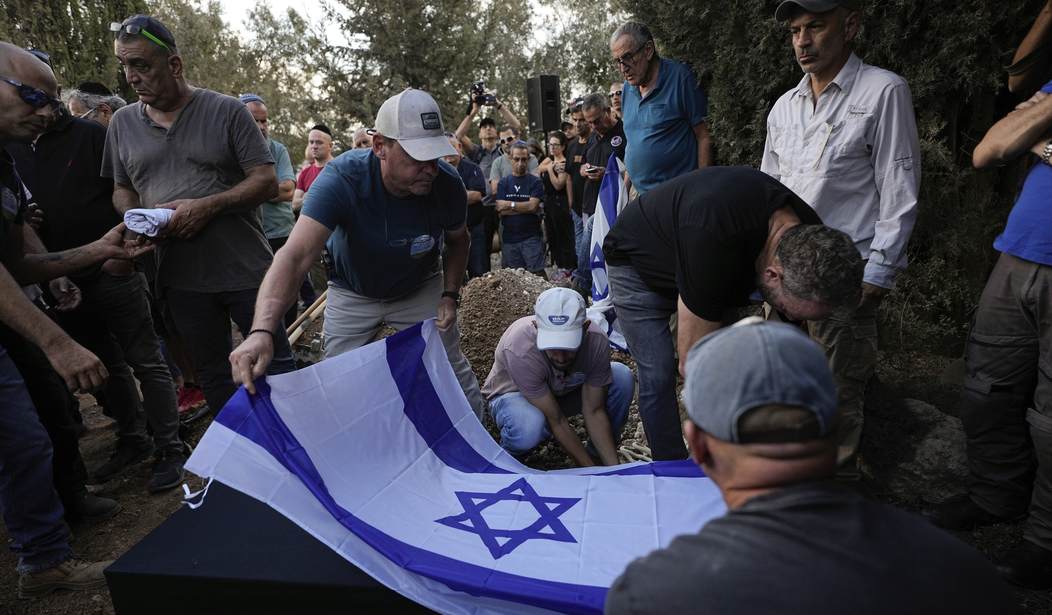

It's impossible to imagine. One moment, a child is living his or her normal life, playing outdoors on their kibbutz, laughing with his or her parents, and perhaps arguing with a sibling. Then, in the blink of an eye, a monster's bullets destroy his or her life, killing his or her parents and sibling, making him or her an orphan.
Perhaps they killed the parents right before his or her eyes. Maybe he or she was forced into hiding after a parent made it the last act of his or her life to shelter him or her.
The trauma, the pain, is too ugly, too severe to bear. Even today, three years removed from the unspeakable tragedy, the children of Oct. 7, 2023 are having great difficulty trying to get beyond the suffering and live something like a "normal" life.
"For the children with one living parent, they are being cared for by a person grappling with their own traumas from the Oct. 7 terror attacks," writes Judah Ari Gross in eJewish Philanthropy (eJP). "Those who lost both have mainly been fostered by aunts and uncles or grandparents, who also have just lost a sibling or child — in some cases, more than one."
Fortunately, there is help available specifically for the orphans of October 7. Shortly after the attack, former air force pilot Modi Kidon co-founded the Israel Children’s Fund (ICF).
“Everything is much slower than you would believe,” Kidon told eJP. “We have to be more patient. Each one of them is a different story.”
ICF, known in Hebrew as Atufim B’Ahava (“Wrapped in love”), supports 573 orphans of October 7 from those still in the womb to age 30. "Roughly two-thirds of them are minors; 15% of them are from hostage families," reports Gross. "Three-quarters lost their father, and 8% lost both parents." In addition to the orphans from Southern Israel near Gaza, 18% are from Bedouin communities.
Like most volunteer efforts, ICF started small. But when Kidon realized others shared the same idea of helping the orphans, he got on the phone and brought several other groups together to unite and pool their resources. The result was ICF.
Its financial support is provided in “three kinds of packages,” Yaacobi Horowitz said. The first is focused on the immediate rehabilitation needs, providing funding for mental health care, resilience and recovery programs — paying for things beyond what is covered by government benefits and the National Insurance Institute.
The second is the “opportunity package,” paying for the formal and informal education programs that a parent would normally pay for: from after-school activities for elementary school children and summer camps to vocational training and scholarships for higher education.
And the third, Yaacobi Horowitz said, is for “lifecycle milestones”: birthday gifts, presents for Rosh Hashanah and Passover; bar and bat mitzvahs, weddings, graduations, first children, help buying a first car.
So far, the ICF has allocated nearly $5 million to the orphans and their caregivers. CEO Miri Yaacobi Horowitz told eJP, “We understood with time that giving money in this kind of situation of loss and trauma has to be combined with professional, tailor-made guidance, and this is how we we started to build our professional team of social workers who are guiding each family, each young adult to make sure that they are exercising their rights, that they get our [regular] grants, and then to feel what is really needed,” she said.
“We need to understand that recovery is not a linear process. They have ups and downs, ups and downs all the time, and it’s really so individual and so long-term, which is something that I’m not sure anyone knew or understood in the beginning,” Miri Yaacobi Horowitz said. “This is complex, personal work that we need to build as we go… We don’t know exactly how the trauma will be exposed, and what will be the needs. And our job is to stay here with them.”
One man who is caring for his nephew after he lost both parents on October 7 says there have been other NGOs looking to exploit the orphans for their own ends.
“We had NGOs come in that were unpleasant, in my view,” the uncle said. “They had a savior complex; it felt like they were in it for themselves, using us and our suffering to feel good about themselves, using our ‘sob story’ to raise money. I’ve had none of that with ICF.”
ICF will continue its work until at least 2053, when all the orphans inside and outside the womb reach the age of 30. We have 10 babies that were born after the attacks. We have a few that were born in May 2024,” CEO Yaacobi Horowitz told eJP.
Coming from a day when these kids experienced unimaginable pain, ICF and the work they do is a testament to the resilience of people and faith.