


More than any other Western European nation, Germany is feeling the effects of a crashing birth rate that's now far below replacement levels.
The 2015 refugee crisis was Chancellor Angela Merkel's response to this demographic death spiral. It seemed such an easy answer to the enormously complex problem of demographics contributing to society's ills.
Millions of Germans disagreed. They didn't oppose migration to fill gaps in the labor force. They opposed migration that threatened the national identity and character of the German nation.
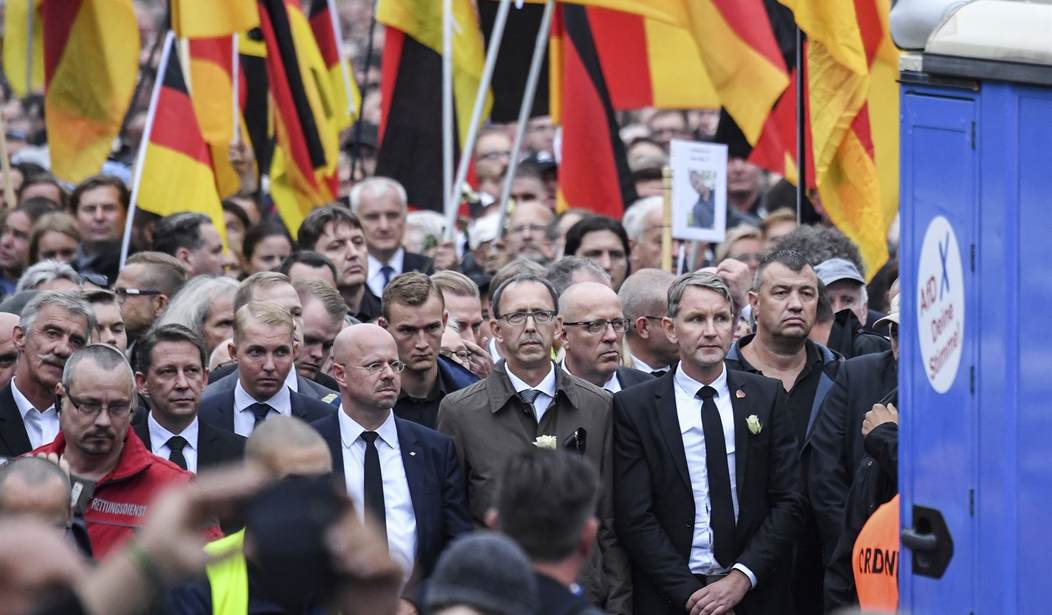
Because of Germany's past, red flags went up all across the establishment, warning about the "Nazification" of opposition to immigration. The new party, Alternative für Deutschland (Alternative for Germany), was immediately branded as the resurrection of National Socialism for its opposition to immigration. There were also some AfD nutcases who actually wanted to resurrect the Nazis, given loving attention by the German media.
Compared to the Christian Democrats (CDU) and the Socialists, the AfD is, in fact, radical, especially on the migration issue. Now, 10 years after a million refugees from nations with no concept of Western freedoms or culture arrived in Germany, the AfD is making huge strides because the evidence for the loss of the German national character is plain to see.
Local elections in Saxony-Anhalt, a key region in the old East Germany, could give AfD a majority in state government. "Polls have the CDU at around 23% at the moment, down from 37% at the last election," writes UnHerd's Katja Hoyer. "By contrast, the Alternative für Deutschland (AfD), whose Saxony-Anhalt branch has been classified by domestic intelligence as “Right-wing extremist”, is currently at 43%. With the election on September 6, the AfD has a chance for a true majority.
The regions of old East Germany are where the demographic death spiral is felt most keenly. After reunification, nearly a quarter of East Germans moved West or abroad. Most of the departed are young, well-educated women.
"That’s left behind a region that is now Germany’s oldest, with its birth rate among the lowest, and with many of its communities watching schools, playgrounds, clubs and traditions slowly disappear," notes Hoyer.
“Germany suffers from massive depopulation,” AfD writes in the first sentence of the first chapter of its 'manifesto'. “What in political debate is referred to as ‘demographic change’ is nothing less than the ageing and extinction of the German people.”
This is going for the jugular in German politics, as it evokes all kinds of Nazi imagery that the major parties make sure the German media takes note of.
The AfD’s language may be stark, but the party is not wrong to suggest that the established parties are deeply uncomfortable with the idea of discussing explicitly pro-natal politics. As with many other topics, debates around demography are fraught with uniquely German anxieties. The country where Nazis once pinned medals on the chests of particularly fertile mothers doesn’t want to be seen to be doing anything like it ever again.
Indeed, there was public outrage when the popular German news anchor Eva Herman started talking about it in 2007. Arguing in books and TV appearances that the German people was on the brink of extinction because feminism was eroding traditional family models and causing low birth rates, she referenced Nazi family policy. Hitler’s Germany, Herman claimed in a press conference, “was a cruel time”, one which ultimately led the country to its downfall. But, Herman added , “then we also abolished what was good, and that was values, children, mothers, families, solidarity”. Facing massive public criticism, and despite trying to back-track, Herman was fired from her job as a newsreader.
No wonder most German politicians tip-toe around the pro-natal issue. Any hint of nationalism, or raising the birthrate as something patriotic, brings swift denunciations.
Nationally, the party polls significantly higher in the former East Germany, regularly exceeding 35% to 40%+ in states like Saxony-Anhalt, Thuringia, and Saxony. Support in the western federal states is lower but notable, generally hovering between 15% and 20%.
Despite strong polling numbers, mainstream parties maintain a political "firewall" (Brandmauer), refusing to form governing coalitions with the AfD at both federal and state levels.